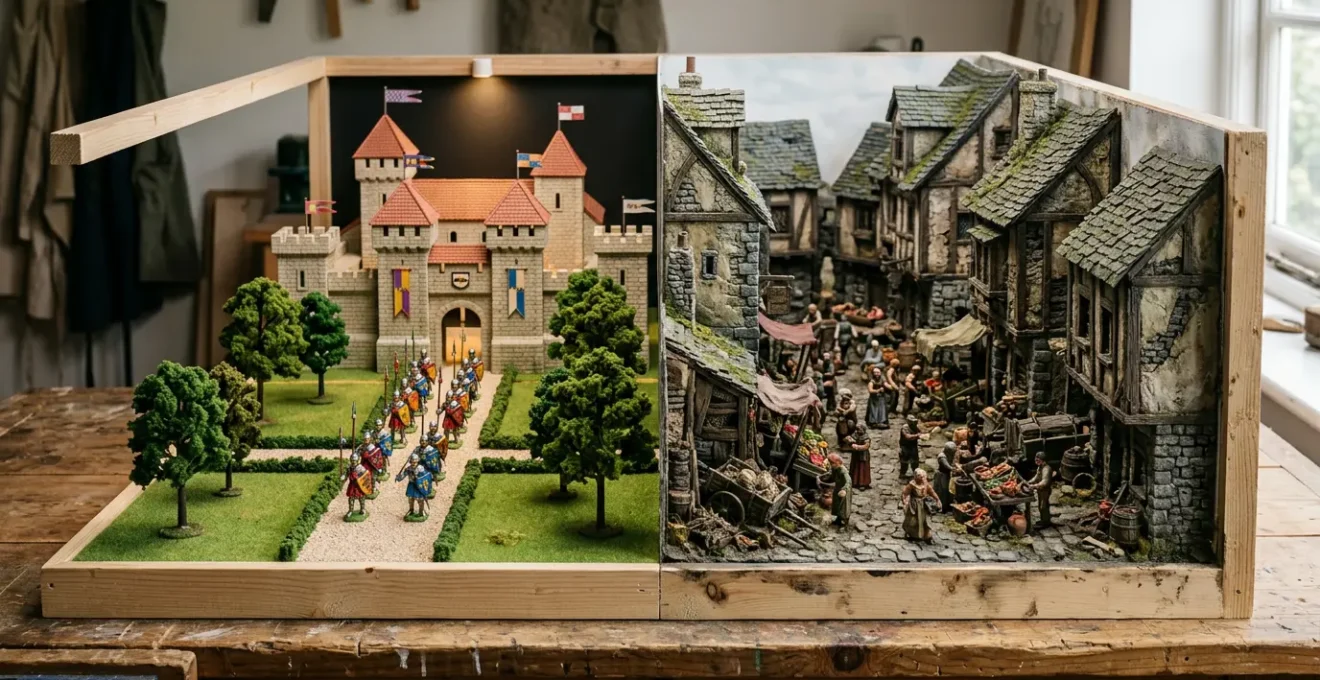
Many writers believe detailed maps, histories, and magic systems create a believable world. In reality, this often builds a lifeless theme park.
- True believability comes from the consequences of your world’s systems, not the systems themselves.
- Subplots and secondary characters must be connected to the main story through thematic resonance, not just convenient plot points.
Recommendation: Stop building assets in isolation. Start designing the feedback loops between your world’s economy, magic, and culture to generate genuine narrative friction.
You’ve done the work. You’ve drawn the maps, chronicled the thousand-year history of the Eldarin Empire, and designed a magic system with seventeen schools of arcane power. Yet, the feedback is always the same: your world feels… thin. Like a meticulously designed but ultimately hollow theme park where characters walk through a beautiful set without truly living in it. The feedback stings because it’s true. Your world has all the elements of a fantasy epic, but it lacks the weight, the messiness, the undeniable pulse of a real society.
The common advice is to simply add more detail: create a language, flesh out the trade routes, write more history. But this is a trap. It treats worldbuilding as an act of accumulation, a checklist to be completed. This approach ignores the single most important element that separates a static backdrop from a dynamic, living world: systemic cohesion. The problem isn’t a lack of detail; it’s a lack of interconnected consequences.
The true key to immersive worldbuilding is not to build more assets, but to build deeper connections between them. It’s to understand that magic warps economies, that faith shapes laws, and that history is not a lore entry but a living wound that informs every character’s prejudice. This guide is a shift in perspective. We will move beyond the checklist and explore how to design the feedback loops and systemic tensions that breathe life into a fictional society, transforming your theme park into a world with structural integrity.
This article explores the core systems that underpin any believable society. The following sections will guide you through the process of connecting these elements to create a world that feels not just imagined, but truly inhabited.
Summary: Beyond the Theme Park: A Guide to Building Living Fictional Societies
- Why Do Readers Reject Your Magic System When the Economy Doesn’t Support It?
- How to Create a Fictional Religion That Feels Authentic Without Copying Real Faiths?
- Map First vs Story First: Which Approach Produces More Coherent Fictional Worlds?
- The 3-Page History Lesson That Makes 40% of Readers Abandon Fantasy Novels
- When to Create a Story Bible: Before Draft One or After the First Novel Sells?
- Why Does Your B-Plot About the Sister Feel Unrelated to the Murder Mystery?
- Abstract Memorial vs Figurative Monument: Which Better Serves Divisive Historical Events?
- Why Do Your Subplots Feel Like Distractions Instead of Enriching the Main Story?
Why Do Readers Reject Your Magic System When the Economy Doesn’t Support It?
Readers don’t reject a magic system because it’s too fantastical; they reject it when it feels like a cheat code that exists outside the world’s fundamental logic. When a character can conjure infinite food in a world where others are starving, or create priceless gems from thin air without causing hyperinflation, the structural integrity of your world collapses. This is the first and most critical test of systemic cohesion: your magic must have an economic footprint. It must cost something, come from somewhere, and its use must have tangible consequences on the social and political landscape.
The most compelling magic systems are those with clear limitations that force characters to be creative. As fantasy author Brandon Sanderson notes, these limits are more interesting than the powers themselves. A great system is deeply tied to the culture and economy. Ask yourself: Is magic a natural resource to be mined? A craft to be learned? A divine gift to be earned? Each answer creates a different economic reality. A resource can be controlled, taxed, and fought over. A craft creates guilds, masters, and apprentices. A divine gift creates a priesthood with immense political power. The magic is not just a tool for the plot; it is the engine of your world’s economy and class structure.
Case Study: Mistborn’s Economic Magic System – Mining and Class Oppression
Brandon Sanderson’s Mistborn trilogy offers a masterclass in consequence-driven worldbuilding. In this world, magic is fueled by consuming and « burning » specific metals. This simple rule has profound economic implications. The noble elite control the mines that produce these metals, effectively monopolizing magical ability and creating a brutal system of class oppression. According to an analysis on the economics in fantasy literature, this makes magic a physical resource that directly creates believable economic and social consequences. The entire rebellion and plot are driven by this single, elegant connection between magic and economy.

This visualization of a resource chain, from raw ore to refined crystal, illustrates the point perfectly. Where does your magic fall on this supply chain? Who are the miners, the refiners, the gatekeepers, and the end-users? Answering these questions transforms your magic system from a collection of « cool powers » into a foundational pillar of a living, breathing, and often deeply unjust society. This is where narrative friction is born.
How to Create a Fictional Religion That Feels Authentic Without Copying Real Faiths?
A common pitfall in worldbuilding is creating religions that are little more than thinly veiled copies of real-world faiths or, worse, a generic pantheon of gods with predictable domains like « war » and « love. » An authentic fictional religion doesn’t feel like a collection of lore; it feels like an operating system for a culture. As author J. W. Barlament states in his guide on the topic, a core principle is that the religion must make sense within the world you’ve created. If the gods are real and interact with the world, that reality should permeate every aspect of the society.
Authenticity arises not from mimicking specific doctrines, but from understanding the function of religion within a society. Religion explains the unexplainable, provides a moral compass, codifies laws, dictates social hierarchies, and gives meaning to suffering. To build an authentic faith, you must move beyond the gods themselves and focus on the systems they inspire. What are the central tenets and creation myths, and how do they explain the world’s unique physical or magical laws? What are the daily practices, the holidays, the taboos? A religion is defined as much by what its followers *do* (orthopraxy) as by what they *believe* (orthodoxy).
Consider the relationship between faith and power. Does the religion sanction the ruling class, or is it a source of rebellion for the oppressed? How does it interact with magic? Is magic seen as a divine gift, a demonic temptation, or a neutral tool? The answers to these questions will generate the core conflicts and ethical dilemmas that drive your story. An authentic religion isn’t just background flavor; it’s a source of immense narrative friction and character motivation.
Your Fictional Religion’s Foundational Audit
- Core Object of Worship: Define precisely who or what is worshipped. Are they tangible gods, abstract principles, ancestral spirits, or historical myths?
- Creation & Tenets: Write the one-paragraph creation myth that explains the world’s most unique feature. List the three fundamental tenets that form the religion’s moral backbone.
- Relationship to Power: Determine if the religion’s power is empirical (gods perform miracles) or mysterious (based on faith alone). How does this affect its relationship with secular and magical power structures?
- Rituals & Practices: Design one major holiday and one daily ritual that directly reflect the faith’s core values and creation myth. What tangible actions do followers take?
- Taboos & Morality: Define the single greatest sin or taboo within the faith. What is the one moral choice that every follower is expected to make, even at great personal cost?
Map First vs Story First: Which Approach Produces More Coherent Fictional Worlds?
The debate between starting with a map or starting with a story is a classic worldbuilding dilemma. The « map first » approach, favored by epic cartographers, risks creating a beautiful but sterile world with no compelling narrative hook. The « story first » approach, beloved by character-driven authors, can lead to an inconsistent world that feels like it’s being made up on the fly to serve the plot’s immediate needs. This debate, however, presents a false dichotomy. It assumes worldbuilding is a linear process, when in fact it is a dynamic, iterative cycle.
The most coherent worlds are not built « map first » or « story first. » They are grown through a process of continuous feedback between the two. The initial spark of a story demands a place to happen; a quick sketch of a map reveals a mountain range that creates a political border and a new source of conflict; that conflict, in turn, reshapes the story. This is not about choosing a starting point, but about fostering a conversation between your narrative and your setting. The goal is to let the needs of the story sculpt the world, and let the facts of the world create obstacles and opportunities for your characters.
This approach moves you from the role of an architect with a fixed blueprint to that of a gardener cultivating an ecosystem. You plant the seeds of a story, see what features the landscape needs to support it, and then discover the unexpected story seeds that the landscape itself contains. This is the essence of consequence-driven worldbuilding, where every choice has a ripple effect that informs every other choice.
Case Study: The Mistborn Development Process – Repurposing for Story
The magic of Allomancy is central to Mistborn’s identity, but it wasn’t created for it. Brandon Sanderson originally developed the system for a different, unwritten novel. As he developed the story of a thieving crew pulling a heist, he realized this pre-existing magic system could be repurposed and refined to perfectly serve the new narrative’s needs. The magic, the society that grew around it, and the characters all evolved in tandem. This demonstrates that worldbuilding elements are not static assets. They are flexible tools that can be iteratively developed alongside narrative demands to create a world that feels alive and deeply integrated, rather than artificially constructed from a pre-set plan.
The 3-Page History Lesson That Makes 40% of Readers Abandon Fantasy Novels
While the « 40% » is a dramatic hook, the underlying truth is painfully real for many authors: the dreaded info-dump. You’ve spent months crafting a rich, detailed history for your world, and you’re proud of it. The temptation to open your novel with a three-page prologue detailing the « War of the Shadow Kings » is immense. It provides context! It sets the stakes! In reality, it grinds the narrative to a halt before it has even begun. Readers pick up a novel for a story, not a textbook. They want to be immersed, not lectured.
This doesn’t mean your world’s history is unimportant. On the contrary, it’s vital. But it should function like the submerged part of an iceberg. Most of it remains unseen, providing mass, stability, and depth, while only the essential, story-relevant elements break the surface of the narrative. Fantasy readers are a dedicated group; a 2018 survey published in SAGE Open found that, among those surveyed, 95.5% of fantasy/science fiction readers report always reading something, averaging five books a month. These are not readers who abandon books lightly, but they are discerning. They will abandon a book that values its own lore more than their engagement.

History in a living society is not a neat timeline of events. It is a messy, contested, and deeply personal force. As this image of layered cultural debris suggests, the past should be felt in the present through weathered ruins, conflicting traditions, old grudges between families, and the very language characters use. Instead of telling the reader about the ancient war, show them a character tracing the eroded carvings on a fallen statue, or another character spitting on the ground at the mention of a rival’s ancestral name. Reveal history through action, dialogue, and conflict, not through exposition.
Every piece of history you reveal must answer a crucial question: why does this matter, to this character, right now? If a historical fact doesn’t directly influence a character’s decision, create a new obstacle, or reframe the stakes of the current scene, it does not belong in the narrative. It belongs in your notes. Let the reader discover the history of your world the same way we discover the history of our own: piece by fragmented piece.
When to Create a Story Bible: Before Draft One or After the First Novel Sells?
The « story bible »—that centralized document containing all the lore, character sheets, and rules of your world—can feel like a professional author’s ultimate tool. This leads to a paralyzing question for many writers: when is the right time to create it? Do you build a comprehensive bible before writing a single word to ensure consistency, or do you wait until you have a finished manuscript, or even a book deal? Approaching this as a matter of timing misses the point. A story bible is not a static prerequisite for writing; it is a dynamic tool for thinking.
Building a massive, encyclopedic bible before you’ve discovered your story through the act of writing is often a form of productive procrastination. It gives the illusion of progress while keeping you from the messy, uncertain work of drafting. The result is often a rigid world that chokes the story. Conversely, waiting too long can lead to a chaotic first draft riddled with contradictions that require herculean effort to fix in revisions. The most effective approach is to treat the story bible as a living document that grows in tandem with your manuscript.
Start with a « seed » bible. Before you write, jot down the core, non-negotiable principles of your world. What is the central concept of your magic? What is the one historical event that defines the present-day conflict? Keep it lean—no more than a few pages. Then, as you write, you will make discoveries. You’ll realize a character needs a secret society to belong to, or that a city needs a specific political structure to create the conflict you need. When these discoveries happen, don’t just add them to the scene; add them to your bible. This turns the bible from a restrictive set of rules into an organic record of your world’s evolution. As Brandon Sanderson advises, it’s better to « expand what you already have before you add something new, » focusing on the depth and interconnection of a few core ideas rather than a thousand shallow ones. This is the essence of building structural integrity.
Why Does Your B-Plot About the Sister Feel Unrelated to the Murder Mystery?
Your protagonist is a hard-bitten detective hunting a killer (Plot A), and in his spare time, he’s helping his estranged sister deal with a gambling debt (Plot B). On the surface, these two stories seem disconnected. The B-plot feels like a distraction, a slice-of-life interlude that pulls focus from the main event. Readers get restless. Why are we spending time on this when there’s a murder to solve? The problem isn’t that you have a B-plot; the problem is that it lacks thematic resonance with the A-plot.
A story’s various plotlines should not just run in parallel; they should be woven together into a single, cohesive tapestry. This connection is rarely mechanical (the sister’s bookie is not the killer). The connection is thematic. A great B-plot explores the same central questions as the A-plot, but from a different angle or on a different scale. It acts as a distorted mirror, a harmonic counterpoint that deepens the audience’s understanding of the story’s core themes.
If your A-plot (the murder mystery) is about the failure of institutions to protect the innocent, then the B-plot about the sister must also be about a failure of protection. Perhaps the protagonist failed to protect his sister from their father’s gambling addiction years ago, and now he’s facing his personal failure on a small scale while simultaneously battling a systemic failure on a large scale. The emotional stakes of the B-plot now directly inform his motivation in the A-plot. He isn’t just solving a case; he’s seeking redemption. This is what creates a rich, satisfying narrative experience.
Thematic Resonance in Multi-Plot Fantasy Structures
In effective storytelling, as explained in an analysis of Brandon Sanderson’s structural laws, different narrative threads are tied together thematically. If your main plot explores a grand struggle for justice against a tyrannical empire, your subplot should not be an unrelated romantic comedy. Instead, it should examine justice on a smaller, more personal scale. Perhaps it involves a character fighting for their rights within a corrupt guild or seeking personal justice for a past wrong. This creates a powerful resonance without being redundant. The B-plot becomes an essential part of the story’s argument, proving that the grand themes are not just abstract concepts but lived realities at every level of society.
Abstract Memorial vs Figurative Monument: Which Better Serves Divisive Historical Events?
In a world fractured by a past civil war, the victorious kingdom decides to erect a monument in the capital. Do they commission a heroic, figurative statue of the triumphant general on horseback? Or do they create an abstract memorial, a space of quiet contemplation with no clear heroes or villains? This choice is not merely aesthetic; it is a profound political act that demonstrates the world’s approach to history, power, and memory. It is a stress test for the systemic cohesion of your society.
A figurative monument—the general on his horse—is an act of narrative consolidation. It presents a single, unambiguous interpretation of history: « We were right, they were wrong, and this is our hero. » This type of monument is designed to enforce a state-sanctioned memory and legitimize the current power structure. In your world, this would likely be favored by an authoritarian regime, a young empire seeking to solidify its identity, or a culture that values martial glory above all else. It is a statement of power, and it will inevitably create narrative friction by angering and alienating those on the losing side, sowing the seeds for future conflict.
An abstract memorial, by contrast, creates a space for multiple, often conflicting, interpretations. Think of the Vietnam Veterans Memorial wall: a simple, stark list of names that makes no claim about the glory or justice of the war. It is a space for personal grief and collective mourning, allowing individuals to project their own experiences and feelings onto it. In your world, such a memorial might be built by a society attempting a difficult reconciliation, a democratic government trying to appease different factions, or a culture that values individual experience over collective myth. It acknowledges the divisiveness of the event without trying to resolve it, leaving the wound open but clean.
The choice between these two forms is a powerful worldbuilding tool. It reveals more about your society’s values, fears, and unresolved tensions than a thousand words of exposition. What does your world choose to remember, and how? The answer defines the present as much as it reflects the past. Does the state try to control memory with heroic statues, or does it allow for the messy reality of individual grief? The monuments your people build are a direct reflection of the society they live in.
Key Takeaways
- Stop building assets; start designing consequences. A believable world is defined by the feedback loops between its core systems.
- True narrative depth comes from thematic resonance. Every subplot and character arc should be a different lens through which to view the story’s central question.
- Treat your world’s history, magic, and culture not as lore to be explained, but as active forces that create pressure, friction, and conflict in the present moment.
Why Do Your Subplots Feel Like Distractions Instead of Enriching the Main Story?
You have reached the final and most crucial stage of systemic design: integrating your plots. If your world is a body, and the core systems are its skeleton and organs, then the plot and subplots are the circulatory system. If they are not connected, the extremities will wither and die. A subplot that feels like a distraction is a sign of poor circulation. It is not receiving thematic lifeblood from the heart of the story, nor is it pumping anything of value back. The solution is not to amputate the subplot, but to graft it onto the main artery.
This requires a shift in thinking from addition to integration. As Brandon Sanderson noted about strengthening his own complex worldbuilding, progress came when he stopped trying to add more « awesome magics » and instead focused on interconnecting and consolidating the themes he already had. This same principle applies directly to plot design. Before you add a new subplot, ask yourself if its narrative or thematic purpose can be served by an existing character or plotline. Could the protagonist’s rival provide the information, instead of a new, one-off informant? Could the thematic point about betrayal be made within the main relationship, instead of a separate B-plot? Consolidation is almost always stronger than proliferation.

Each subplot must have a clear purpose, and that purpose must serve the main narrative. It should exist to challenge a character, to reveal a new aspect of the theme, to complicate the stakes, or to provide a crucial resource at a critical moment. Like the hands in this image weaving disparate threads into a single pattern, your job as the author is to ensure no thread is left dangling. Every color must contribute to the final, unified tapestry.
Your Subplot Integrity Audit: A 5-Step Checklist
- Identify Core Function: State, in a single sentence, the primary purpose this subplot serves for the main character’s arc or the story’s central theme. If you can’t, it may be redundant.
- Trace the Consequences: List three tangible ways the subplot’s events alter the main plot’s resources, information, or stakes. If there are no consequences, it’s just noise.
- Check for Thematic Resonance: Articulate how the subplot’s central conflict is a micro-version of, or a counterpoint to, the story’s main thematic question.
- Map the Intersection Point: Pinpoint the exact scene where the subplot must collide with the main plot to deliver its payload. Is this intersection inevitable, or merely convenient?
- Perform the Consolidation Test: Could this subplot’s function be combined with another character or plotline to increase efficiency and impact? Be honest.
Ultimately, building a living society is an act of weaving, not of listing. It requires you to see the world not as a collection of static assets, but as a dynamic system of interconnected consequences. By applying this systemic thinking to your magic, your history, and your very story structure, you can finally move beyond the theme park and create a world with the weight and complexity of reality itself.