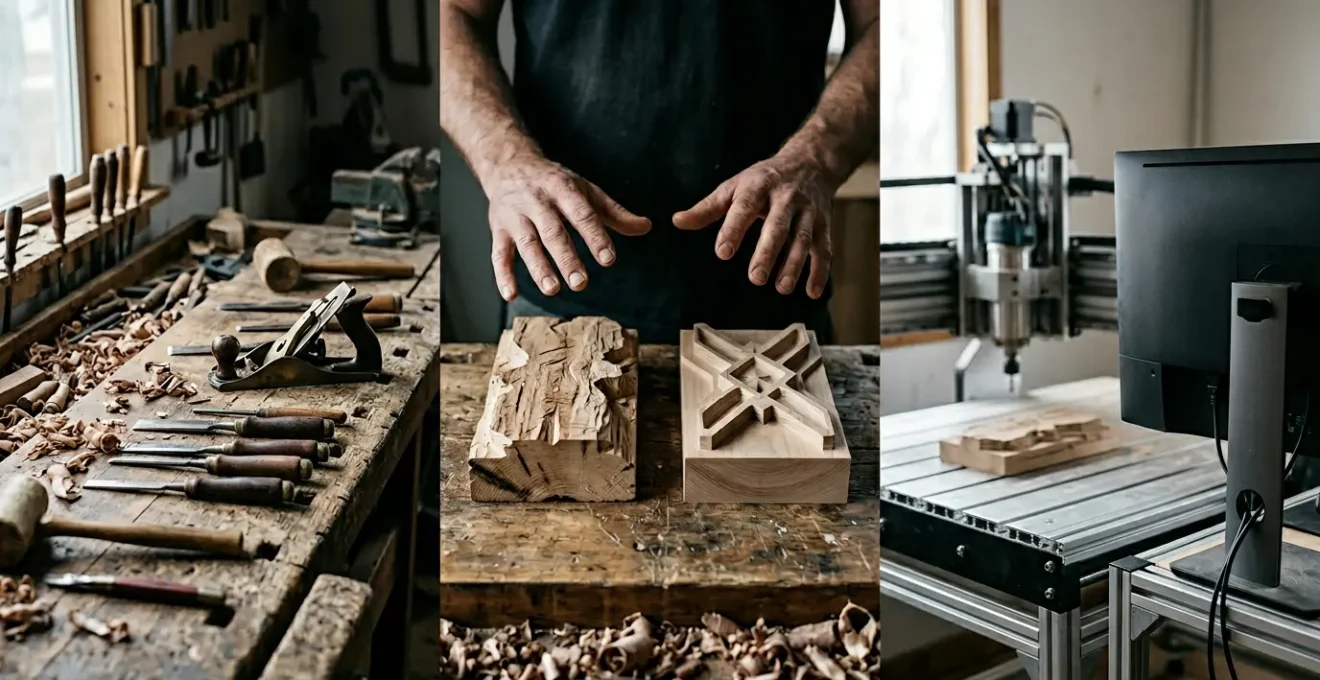
The rise of digital fabrication is not a threat to handcraft; it’s a challenge to how we define and communicate value.
- The core conflict isn’t machine vs. human, but opacity vs. a transparent, documented narrative of authenticity.
- Strategic hybridity—using machines for rough work and hands for the final touch—can enhance, not diminish, a piece’s soul and market price.
Recommendation: Stop selling a « handmade » product and start selling a documented story of provenance. This is the one thing a machine cannot replicate.
The hum of a CNC machine or the whisper-quiet layering of a 3D printer can sound like an encroaching threat to a traditional workshop. For the skilled UK maker, whose hands and eyes have been the ultimate measure of quality for decades, this anxiety is real. You see articles debating the « soul » of an object, or hear calls to simply « adapt or die, » but these discussions often miss the point. They frame it as a battle between old and new, between human and machine, where one must ultimately lose.
This article argues for a different perspective. The perceived threat from digital fabrication isn’t about the tools themselves, but about a fundamental misunderstanding of where true value now lies. The defence of handcraft is no longer about rejecting the machine outright. Instead, it is about mastering a new skill: the art of creating an irrefutable narrative of authenticity. It’s about strategically documenting the human touch in a way that machines cannot, and by doing so, not just preserving your skills but making them more valuable than ever.
We will explore this by first understanding the tangible differences a collector feels, then moving to practical hybrid workflows. We’ll analyse what truly commands a higher price, investigate the crisis of trust in the « handmade » label, and finally, look at the systemic challenges to passing on these irreplaceable skills in Britain today. This is not a eulogy for craft; it’s a strategy for its future.
Summary: Why Digital Fabrication Is a Challenge to Your Craft, Not a Death Sentence
- Why Can Collectors Feel the Difference Between Hand-Carved and CNC-Cut Wood?
- How to Use CNC for Rough Cuts While Preserving Hand-Finished Authenticity?
- Pure Handcraft vs Digital-Assisted Making: Which Commands Higher Prices from UK Collectors?
- The « 100% Handmade » Label That Lost a Maker Their Reputation When Jigs Were Discovered
- When to Teach Traditional Techniques: While Demand Exists or After Revival Interest Grows?
- Why Does Hand-Cut Dovetailing Look Different from CNC-Routed Joints Even to Untrained Eyes?
- Why Did UK Furniture Making Lose 60% of Its Apprenticeships Since the 1990s?
- Why Are Master Bookbinders Retiring Without Apprentices in Britain?
Why Can Collectors Feel the Difference Between Hand-Carved and CNC-Cut Wood?
It’s a common refrain in workshops and galleries: a machine-made piece, no matter how perfect, lacks « soul. » While this sounds like a romantic notion, it’s grounded in tangible, physical reality. The human hand, guided by a trained eye, is not a perfect machine. It introduces minute, almost imperceptible variations—a slight hesitation here, a confident stroke there. This is not a flaw; it is the source of the object’s character. A hand-pushed chisel creates micro-facets on wood that catch the light in a dynamic, living way, a rhythm that a CNC router, with its mathematically perfect and unvarying path, can never replicate.
This is the « authenticity gap » that a discerning collector doesn’t just see, but feels. The CNC-cut surface is uniform and sterile; the hand-carved surface tells a story of pressure, movement, and decision. It carries the signature of the maker in its very texture. This difference is not just about aesthetics; it is about connection. As one expert observed when analysing a machine-made object:
CNC carved bamboo brushpot. No cracks, no discoloration in the material, perfect carving and zero soul.
– Roger Schwendeman, Antique Chinese Furniture – Hand Carving vs CNC Analysis
The following image illustrates this profound textural difference. On one side, the organic, varied landscape of hand-tooling; on the other, the cold, repetitive precision of the machine. The soul is in the supposed imperfection.
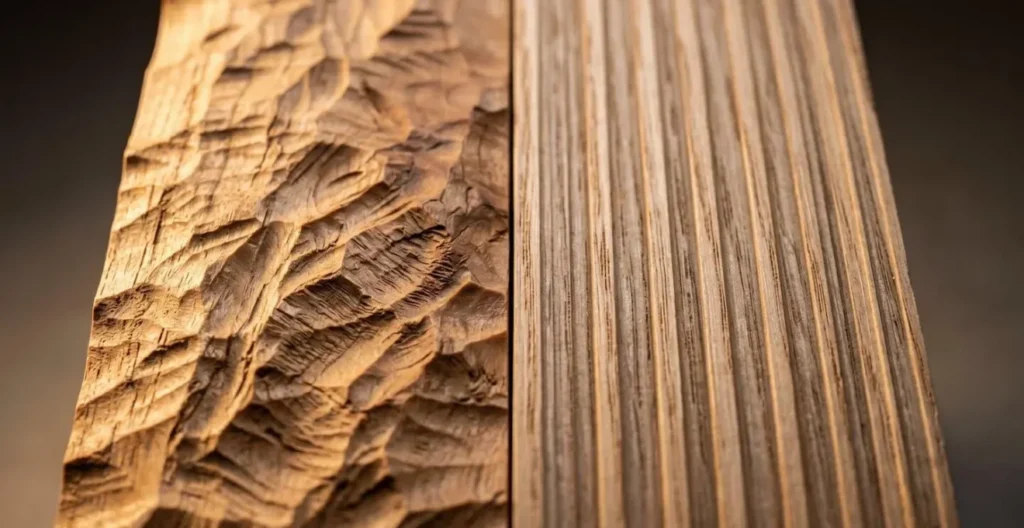
Ultimately, the machine produces a perfect copy, but the craftsperson creates a unique presence. A collector can feel this because the hand-carved object is a direct record of human touch, a quality that is becoming increasingly rare and, therefore, more valuable.
How to Use CNC for Rough Cuts While Preserving Hand-Finished Authenticity?
The fear of digital tools often stems from a false binary: either a piece is 100% handmade or it is a soulless, machine-made product. The future for many successful craftspeople, however, lies in a third way: strategic hybridity. This approach views the CNC machine not as a replacement for skill, but as an incredibly precise and tireless apprentice. Its role is to handle the laborious, repetitive, and dimensionally critical tasks, freeing up the master craftsperson to focus their time and energy on what truly matters: the final, value-adding touch.
The key is to consciously design a workflow where the machine does the « what » (creating the basic form) and the human does the « how » (imbuing it with character and life). By programming a CNC to remove the bulk of waste material—a process known as roughing—you save hours, if not days, of physical labour. Crucially, you program it to leave a small material allowance, a few millimetres of ‘skin’ on every surface. This skin is where the magic, and the value, happens. It is this material that you will then address with your own hand tools—your chisels, planes, and scrapers—transforming the mechanically perfect blank into a true handcrafted masterpiece.
Action Plan: A Hybrid Workflow for Authenticity
- Primary Shaping: Use CNC for creating the primary shape and any accurate, repetitive patterns that require consistent geometry.
- Material Allowance: Program the CNC to leave a 1-2mm material allowance on all final surfaces, creating a ‘blank’ for hand-finishing.
- Hand-Carving Details: After the CNC completes its work, use your hand tools to carve the fine lines, sharp details, and flowing curves that bring the piece to life.
- Process Transparency: Document the process with photos or video, showing clearly where the machine’s work ends and your handiwork begins. This builds trust and value.
- Surface Transformation: Apply hand-scraped or hand-planed final surfaces to fundamentally transform the piece, removing all traces of the CNC’s mechanical signature.
Case Study: Vishwakarma Wood Carvings’ Blended Approach
Vishwakarma Wood Carvings exemplifies this model. They leverage CNC machines to create accurate shapes and patterns for pieces like temple doors and decorative panels efficiently. Once the rough form is complete, skilled artisans take over, hand-carving the fine details, sharp lines, and flowing curves. This method successfully transforms a mechanically perfect CNC product into a handcrafted masterpiece, allowing them to maintain both consistency for their clients and the artistic richness that defines their brand.
This hybrid approach is not a compromise; it is an intelligent allocation of resources. It respects the craftsperson’s time, protects their body from the most gruelling tasks, and focuses their unique skill exactly where it adds the most value.
Pure Handcraft vs Digital-Assisted Making: Which Commands Higher Prices from UK Collectors?
The question of price is often where the anxiety of a traditional maker is most acute. The assumption is that a machine-assisted process must inherently be worth less. However, the market, especially discerning UK collectors, is more nuanced. The commanding price is not dictated simply by the « 100% handmade » label, but by a combination of material quality, longevity, and the power of the object’s story—its documented provenance.
Pure handcraft often has an edge because, by its very nature, it involves more intimate contact with the material. As Moruxo Design notes, this process inherently leads to a more valuable and lasting object. A maker working a piece of timber entirely by hand will discover its unique character, its tensions, and its grain in a way a CNC programmer never can. This deep relationship with the material often translates into a superior final product.
Hand-carved furniture often uses higher-quality wood and goes through more manual inspection at every stage, which increases its lifespan. Additionally, handmade furniture tends to hold its value better over time and is often considered collectible or a family heirloom.
– Moruxo Design, CNC vs Hand-Carved Live Edge Furniture Analysis
However, a digital-assisted piece with a transparent and compelling story can command an equally high, if not higher, price. Imagine two cabinets: one is simply labelled « handmade, » the other comes with documentation showing the CNC roughing process, followed by detailed videos of the artisan hand-cutting the dovetails and planing the surfaces. The second piece, despite being « less pure, » has a powerful narrative of intelligent, modern craftsmanship. Its price is justified not by a vague label, but by a clear demonstration of skill and decision-making.
The demand for authentic, story-rich items is not a small niche; it’s a significant and growing global market. The global handicrafts market was valued at a staggering USD 739.95 billion in 2024. This figure demonstrates a powerful consumer desire to connect with products that have a human story, a trend that UK makers are perfectly positioned to capitalize on by clearly articulating the value of their process, whether it’s pure or hybrid.
The « 100% Handmade » Label That Lost a Maker Their Reputation When Jigs Were Discovered
For the honest craftsperson, one of the greatest frustrations is the debasement of the term « handmade. » This single word, which should be a clear hallmark of quality and skill, has been stretched to the point of meaninglessness. When large-scale operations can legally label items « handmade » because a worker performs the final, simple assembly of mass-produced components, the term loses all power. This ambiguity is the true threat, not the CNC machine in a fellow artisan’s workshop.
As Janie of The Lucky Sixpence points out, the lack of regulation creates a fertile ground for exploitation that undermines genuine artisans.
The term ‘handmade’ can be loosely defined and is not strictly regulated in many regions meaning there is minimal risk of legal repercussions. Many companies who mass make accessories and jewellery exploit this ambiguity, claiming that their items are ‘handmade’ because workers, rather than machines, assemble or finish the products, even if the pieces are produced on mass.
– Janie, The Lucky Sixpence, Beware of Handmade Labels: Artisan vs Factory
When trust in a label is eroded, reputation becomes fragile. A well-known maker who built their brand on the « purity » of their process can face ruin if a customer discovers the use of an undeclared jig, a routing template, or a CNC-cut component. The backlash is not about the use of the tool itself; it’s about the perceived deception. The customer feels they were sold a story that wasn’t true. This is where the narrative of authenticity becomes paramount: it is better to be transparent about a hybrid process than to be caught hiding a « pure » one.
The ‘Made in Italy’ Crisis: When a Label of Prestige Implodes
The global fashion industry witnessed a catastrophic loss of trust with the ‘Made in Italy’ label. This stamp was supposed to guarantee superior craftsmanship and ethical production. However, investigations revealed that major fashion houses, including Prada and Dolce & Gabbana, were having products cut and assembled in low-wage factories in Romania or Asia, with only the final clasps being affixed in Italy. In other cases, production happened within Italy but in sweatshops exploiting immigrant labour. The fallout was immense, leading to the formation of a consortium, Centopercento Italiano, dedicated to restoring trust through a commitment to 100% local production and transparent supply chains. It serves as a powerful lesson: a prestigious label, once broken, is incredibly difficult to mend.
The lesson for the individual UK maker is clear. Do not rely on a debased label like « handmade. » Instead, build your reputation on radical transparency. Show your process, explain your choices, and let the integrity of your work and your story be your brand. That is a fortress no imitator can breach.
When to Teach Traditional Techniques: While Demand Exists or After Revival Interest Grows?
The conversation about digital tools inevitably leads to a deeper, more existential question: how do we ensure hand skills survive at all? There is a dangerous temptation to wait—to postpone the difficult work of teaching until a « revival » creates clear market demand for a particular craft. This is a fatal miscalculation. Skills are not like seeds that can lie dormant for a generation and then be revived. They are living things, passed from one pair of hands to another. If the chain is broken, the skill dies.
The time to teach is always now, especially when faced with systemic decline. The UK’s craft and manufacturing sectors have seen a troubling erosion of their training infrastructure. As an analysis by Winchester Furniture grimly notes, apprenticeship numbers in craft have fallen sharply over the past two decades. Waiting for demand to grow in this environment is like waiting for rain in a desert you are actively helping to create. The demand must be cultivated, and that begins with ensuring there are skilled practitioners to meet and inspire it.
Passing on traditional techniques is not just about preserving the past; it is an investment in the future value of craft. Every apprentice trained is another voice advocating for quality, another maker creating objects with authentic narratives, and another teacher for the generation to come. To neglect this is to voluntarily cede the entire field to mass production and soulless automation.
A country that cannot train its craftspeople cannot preserve its culture. The decline in apprenticeships is not inevitable. It is a challenge, and challenges can be met.
– Winchester Furniture, The Decline of Apprenticeships: Why Britain’s Craft Future Depends on What We Do Next
The responsibility falls on the current generation of master craftspeople not just to make, but to teach. This may require new models—weekend workshops, mentorship programs, online tutorials—but the imperative is clear. To wait for a revival is to guarantee you will not be there to see it.
Why Does Hand-Cut Dovetailing Look Different from CNC-Routed Joints Even to Untrained Eyes?
Even someone with no woodworking experience can often sense that a hand-cut dovetail joint looks « right » in a way a CNC-made one doesn’t. This intuition is based on subtle geometric cues that the human brain is surprisingly adept at noticing. The difference lies in the fundamental nature of the cutting tools used.
A hand-cut dovetail is created with saws and chisels—tools that create perfectly straight lines and sharp, acute internal corners. The joint is a celebration of crisp, precise angles. A CNC machine, however, cuts with a spinning cylindrical router bit. By its very nature, a round tool cannot cut a sharp internal corner. It will always leave a small, rounded fillet, often called a « dog-bone » fillet in machining. This small, rounded corner is a physical impossibility for a traditional chisel, and the eye, however untrained, registers this geometric anomaly as something not quite right. It breaks the visual language of traditional joinery.
Furthermore, there is the question of scale and rhythm. A craftsperson can use a fine saw and a narrow chisel to create incredibly slender, elegant pins between the tails of the joint. This is a classic hallmark of high-end, bespoke cabinetry. A CNC machine is limited by the diameter of its smallest practical cutting bit. As a Vectric community expert, Bill, explains, this is often the most obvious giveaway.
The biggest difference in hand cutting vs. CNC cutting is the aesthetics of the design. With hand cutting you can make small pins, much smaller than with CNC because the cutter size limits you. This is how you can usually tell if a dovetail was machine cut or hand cut.
– Bill, Vectric Community Expert, How to Cut Dovetails on Your CNC – Vectric Forum
Finally, a hand-cut joint possesses a subtle, human asymmetry. Each pin might be minutely different from its neighbour, creating a visual rhythm. The CNC joint, by contrast, is a display of cold, mathematical perfection. Every pin is an identical clone of the last. While technically perfect, this can appear lifeless and mechanical in a material as organic as wood. It is the perfect imperfection of the human hand that ultimately looks and feels more sophisticated.
Why Did UK Furniture Making Lose 60% of Its Apprenticeships Since the 1990s?
The figure of a 60% decline is a stark emblem of a crisis that has been brewing for decades in UK furniture making and other heritage crafts. While a single cause is difficult to pinpoint, the decline is not a mystery; it is the result of a confluence of economic pressures, shifting educational priorities, and complex government policies that have created a deeply challenging environment for small workshops to take on and train new talent.
At the heart of the issue is a simple but brutal economic calculation. The national minimum apprentice wage, while low, is still a significant cost for a small business, especially when paired with the time investment required from a master craftsperson to train a novice. As noted by VHR Technical Recruitment, the wage disparity makes it a hard sell for young people, too. The minimum apprentice wage was £5.28 per hour in 2023, compared to over £10 for an adult worker. Faced with the prospect of university debt and high living costs, many potential artisans are pushed towards careers with higher initial earning potential.
This trend is visible across the board. While the specific « 60% » figure refers to a longer-term trend, more recent data confirms the continued pressure. For instance, a 2023 report from the UK Government’s Department for Education revealed a significant drop in overall apprenticeship starts from 393,400 in 2016/17 to 349,200 in 2021/22. While not specific to craft, this shows the broader systemic headwinds.
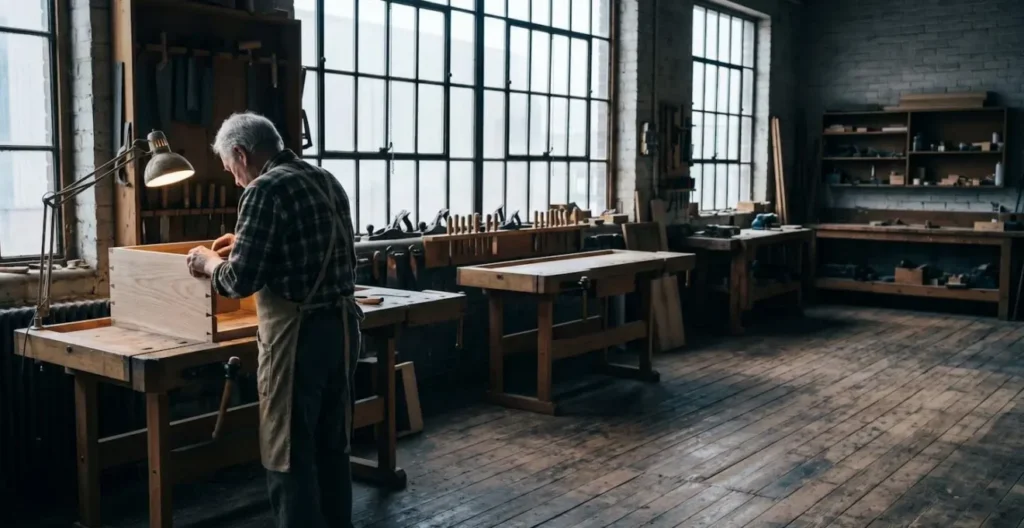
The decline is not due to a lack of interest from young people or a lack of willingness from masters to teach. It is a systemic failure. The image of an empty workbench next to a solitary, aging master is not just a poignant symbol; it is the daily reality in workshops across Britain. It represents a slow-motion hollowing-out of the very skills that define the nation’s cultural heritage.
Key Takeaways
- Authenticity is not a label; it’s a transparently documented story that machines cannot replicate.
- Strategic hybridity—using CNC for roughing and hand tools for finishing—is a powerful model for modern craftsmanship.
- The real threat to craft is not technology, but the systemic ‘viability gap’ that makes passing on skills economically untenable.
Why Are Master Bookbinders Retiring Without Apprentices in Britain?
The plight of the master bookbinder, retiring alone from a workshop filled with a lifetime of tools and knowledge, is a potent microcosm of the entire UK craft crisis. It is here, in highly specialized, low-volume fields, that the systemic failures are most acute. The core issue is what can be termed the « viability gap »: the economic model for traditional, multi-year apprenticeships is fundamentally broken in the 21st-century British economy.
The analysis is stark. A master craftsperson must invest years of their time—time they could be using for income-generating work—to train an apprentice. The materials are expensive, and mistakes are part of learning. Simultaneously, the apprentice is asked to survive on a minimal wage for years in a country with high living costs, all while a university path seems to promise a faster route to financial security. For a craft with a niche market like bespoke bookbinding, the numbers simply do not add up for either party. It’s not a lack of passion; it’s a failure of economics.
This is compounded by government schemes that, while well-intentioned, often fail to address the specific needs of small, specialized craft businesses. The Apprenticeship Levy, for example, has been criticized for being too complex and inflexible for micro-enterprises. Astonishingly, FE Week reported that treasury figures show the government raised £3.6 billion via the levy but spent only £2.5 billion, with hundreds of millions going unspent that could have been used to support these vital skills.
The viability gap: It’s not just a lack of interest, but a broken economic model. The high cost of training in time and materials and low starting wages for a craft with a niche market make a multi-year apprenticeship untenable for a young person with student debt and high living costs.
– Analysis based on UK craft sector research, Winchester Furniture – Craft Apprenticeship Crisis
Closing this viability gap is the great challenge. It will require new models: cooperative training schemes, better-targeted government support, and, most importantly, a market that understands and is willing to pay for the true cost of creating and sustaining human skill. This brings us full circle. By creating powerful narratives of authenticity, we not only sell a product but also build the perceived value that can, in time, make the craft economically viable enough to be taught again.
The answer to the threat of digital fabrication is not to smash the machines, but to elevate what makes us human. It is to take control of your story, to be transparent in your process, and to charge a price that reflects not just your time, but the irreplaceable value of your accumulated skill. Begin today to document your work, explain your choices, and build the narrative that will be your greatest asset.