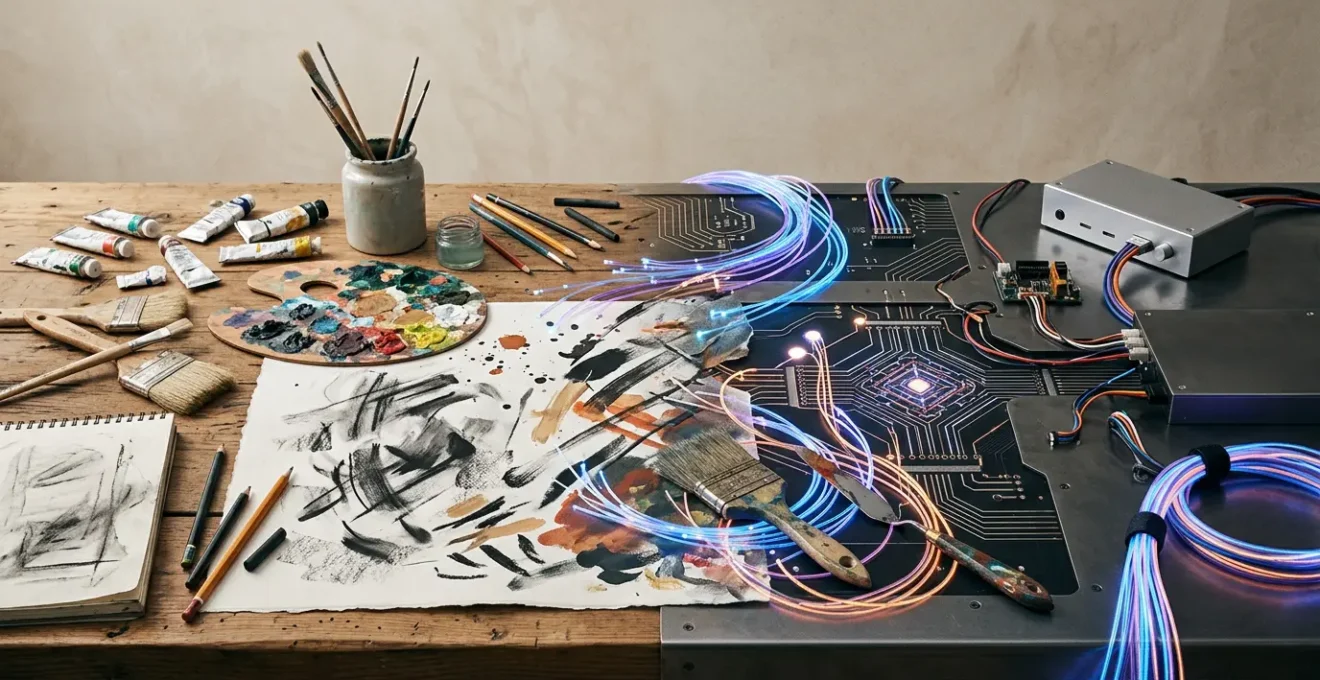
The debate over AI in art isn’t about technology; it’s a crisis of authorship.
- Fearing AI stems from the belief that artistic value lies in manual skill and originality of form, which generative models seem to automate.
- Embracing AI involves shifting the definition of creativity from the act of making to the act of conceptualising, selecting, and contextualising.
Recommendation: Stop asking if AI will replace you. Instead, ask how it can be forced to collaborate on your conceptual terms, pushing your practice beyond the predictable.
The sudden ubiquity of generative AI has sent a tremor through the creative world. For many artists, the screen flashes with a familiar anxiety: is this new technology a partner, a shortcut, or an existential threat? The conversation is often polarised, pitting technophobic artists who see AI as a soul-crushing plagiarist against enthusiastic evangelists who declare it the next great medium. This binary view, however, misses the point entirely. The fear isn’t just about job replacement or copyright; it’s a profound unease about the very definition of creativity and the value of human authorship in an age of seemingly infinite, automated image production.
Common advice often falls into predictable camps. Some urge artists to simply « learn to prompt better, » reducing artistic practice to a form of sophisticated search-engine query. Others focus almost exclusively on the legal morass, viewing the technology only through the lens of infringement. But what if the most potent response isn’t technical or legal, but philosophical? What if the key to navigating this new terrain lies not in mastering the tool, but in fundamentally reframing our relationship with it? The most resilient and innovative artists are not those who are simply « using » AI, but those who are challenging its purpose, subverting its outputs, and reasserting their role as the primary source of conceptual intent.
This article moves beyond the fear-versus-hype dichotomy. We will deconstruct the misleading language that surrounds AI, re-evaluate creativity through the lens of established art world criteria, and explore historical parallels that prove art has survived similar « deskilling » moments before. By shifting the focus from generation to curation and from prompt to concept, we can chart a path for artists to transform AI from a perceived threat into a powerful, if unpredictable, conceptual collaborator.
To navigate this complex landscape, this guide is structured to move from deconstructing common myths to building a practical and philosophical framework. We will explore the core functions of the technology, assess its output, and provide strategies for integrating it meaningfully into your practice.
Summary: A Guide to AI as a Conceptual Partner for Artists
- Why Does Saying « AI Creates » Misrepresent What the Technology Actually Does?
- How to Assess Whether AI Output Constitutes Genuine Creative Contribution?
- Stable Diffusion vs Midjourney vs DALL-E 3:Why Are West End Producers Now Hiring Robotics Engineers Alongside Choreographers?
- The Photography Killed Painting Panic: What AI Doomsayers Get Wrong?
- When to Double Down on Human Skills vs Learn AI Integration?
- Artist-Directed Prompting vs Emergent Curation: Which Produces More Interesting Results?
- How to See the Conceptual Link Between Readymades and Generative Code Art?
- Why Does Your AI Artwork Stop at the Prompt Instead of Pushing the Technology?
Why Does Saying « AI Creates » Misrepresent What the Technology Actually Does?
The first and most critical step in forming an informed position on AI is to dismantle the anthropomorphic language we use to describe it. When we say an AI « creates, » « imagines, » or « thinks, » we are projecting human qualities onto a statistical process. An AI model is not a nascent consciousness; it is a vastly complex pattern-matching engine. It has been trained on billions of data points—images, texts, sounds—and it learns the mathematical relationships between them. When you provide a prompt, it doesn’t « understand » your request. Instead, it generates a statistically probable output that correlates with the patterns associated with the words in your prompt. It is a process of sophisticated synthesis and interpolation, not creation in the human sense.
This distinction is not merely semantic; it has profound legal and philosophical implications. The UK Government has been grappling with this, clarifying the existing legal framework around authorship. As a government report on the matter states:
Authorial copyright applies to original literary, artistic, musical, and dramatic works. It protects an author’s creativity, as expressed in their work.
– UK Government, Report on Copyright and Artificial Intelligence, March 2026
The key here is « author’s creativity. » An AI model, lacking intention, consciousness, and independent creative spark, cannot be an author. The authorship resides with the human who directs the process. The complexity arises because these models are frequently trained on billions of copyright works from various global jurisdictions, making the output a derivative mosaic. Fearing that the AI is « creating » gives the machine too much credit. The real power, and therefore the artistic responsibility, remains with the artist who sets the conceptual parameters, curates the output, and imbues the final work with meaning.
By reframing the technology as a powerful synthesiser rather than a rival creator, you shift your own role from a passive user to an active director of a complex process.
How to Assess Whether AI Output Constitutes Genuine Creative Contribution?
If an AI doesn’t « create, » how do we evaluate the artistic merit of work that heavily incorporates it? The art world has long-standing frameworks for this that have nothing to do with technical skill alone. The question isn’t « Is AI art real art? » but rather, « Does this specific work offer a genuine creative contribution? » The answer lies in the same criteria used to judge any piece of contemporary art: conceptual novelty, critical engagement, and the artist’s intentionality.
Consider the judging criteria for the UK’s most prestigious contemporary art award, the Turner Prize. The prize has a history of rewarding artists who push the boundaries of what art can be, often prioritising the strength of the idea over the craftsmanship of the object. The £25,000 awarded to the winner is based on recent developments in British art, emphasising innovation and conceptual rigour. An AI-generated image that is merely a technically perfect but conceptually empty pastiche of a known style would likely fail this test. However, an artist using AI to explore themes of digital identity, algorithmic bias, or the nature of authorship itself is making a significant creative contribution.
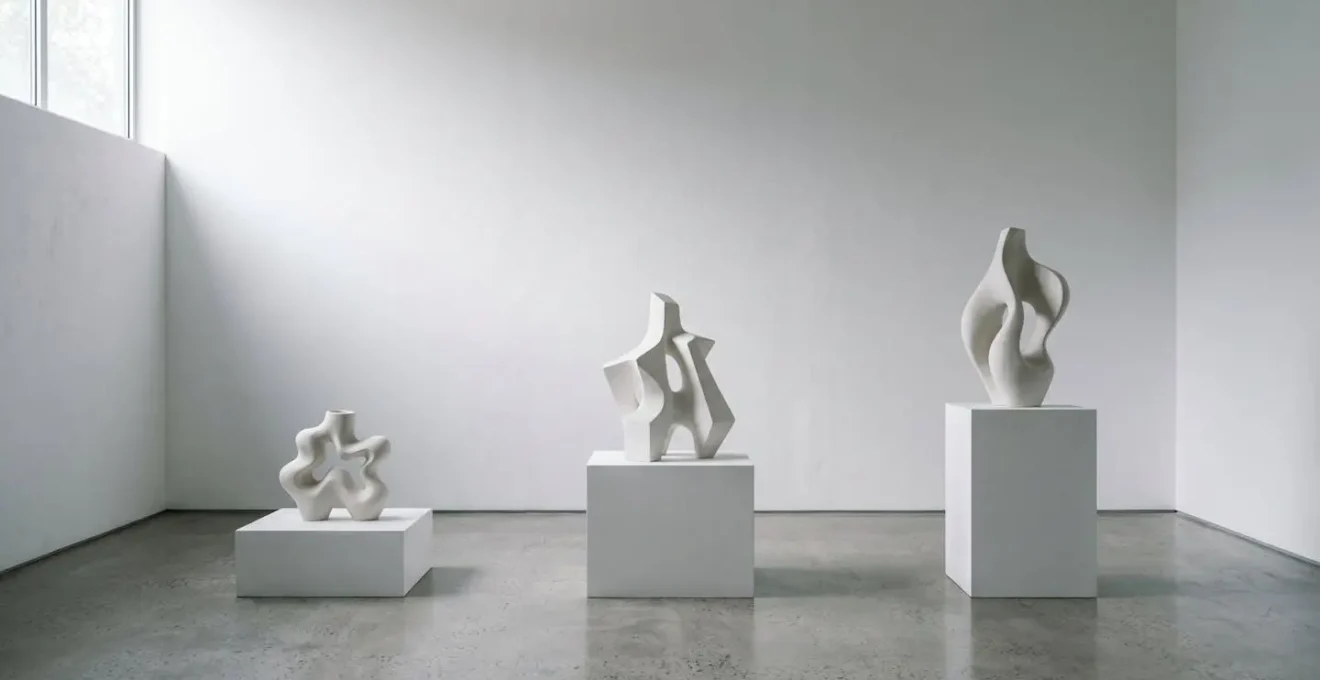
As this visualisation suggests, evaluating art is about weighing multiple factors. The genuine contribution of an AI-assisted work is not located in the raw output of the machine. It is found in the artist’s conceptual framework: Why was this prompt chosen? How were the countless outputs curated and edited? What new meaning is created by placing this specific image in a specific context? Is the artist using the technology to ask a compelling question or reveal an unseen truth? The creativity is in the entire process, not just the final pixel arrangement. The AI provides the raw material; the artist provides the soul.
Ultimately, a work’s value is determined by the quality of the artist’s thinking, and AI has not, and cannot, automate that.
Stable Diffusion vs Midjourney vs DALL-E 3:Why Are West End Producers Now Hiring Robotics Engineers Alongside Choreographers?
The title of this section is a deliberate provocation. Debates that fixate on which AI model is « best » — Stable Diffusion for its open-source flexibility, Midjourney for its aesthetic polish, or DALL-E 3 for its prompt adherence — miss the bigger picture. This is like painters in the 19th century arguing over the best brand of pre-mixed tube paint. While tools matter, the truly transformative question is not *which* tool to use, but *how* technology is fundamentally reshaping entire creative fields. The more interesting conversation is happening where disciplines collide.
Look no further than London’s West End. In an industry that saw 17.1 million attendees in 2023 and represents a cornerstone of the UK’s cultural economy, innovation is not a gimmick; it’s a strategic necessity. Producers are beginning to understand that technology like robotics and AI isn’t just for creating marketing posters. It can be woven into the very fabric of live performance, creating experiences that were previously impossible. Hiring a robotics engineer alongside a choreographer is no longer a futuristic fantasy; it’s a recognition that the future of storytelling involves a synthesis of human movement and machine precision.
Case Study: The AI-Generated Theatre Production ‘Gap’
This paradigm shift was showcased at the Camden Fringe, which hosted the world’s first AI-generated theatre production, ‘Gap’. The play didn’t just use AI to write the script; it actively integrated technology into the performance itself. By incorporating audience participation through smartphones and WhatsApp, the production blurred the lines between spectator and participant, turning technology from a distraction into an essential element of the theatrical experience. This moves far beyond simple content generation and into the realm of systemic, interactive art.
This is the level at which artists should be thinking about AI. The most groundbreaking work will not come from generating a prettier picture, but from integrating the *logic* of AI into a practice. It might mean a sculptor using generative algorithms to create 3D models for forms that defy human intuition, or a performance artist collaborating with a robot to explore themes of labour and automation. The specific tool is secondary to the conceptual integration.
The real opportunity lies not in replacing human skills, but in augmenting them with entirely new capabilities drawn from other disciplines.
The Photography Killed Painting Panic: What AI Doomsayers Get Wrong?
The current panic surrounding AI echoes historical anxieties with an almost uncanny resemblance. When photography emerged in the 19th century, the French painter Paul Delaroche famously declared, « From today, painting is dead. » The fear was that a machine capable of perfectly replicating reality would render the painter’s skill obsolete. Of course, painting did not die. Instead, liberated from the burden of purely realistic representation, it exploded into a hundred new directions: Impressionism, Cubism, Surrealism, and Abstraction. Photography didn’t kill painting; it freed it.
The same pattern can be seen in more recent art history. When the Young British Artists (YBAs) emerged in the 1990s, they were met with outrage for their use of readymades and conceptual installations that seemed to require little to no traditional « skill. » As Tate Britain notes, this controversy was a key part of their impact.
Tracey Emin’s My Bed attracted huge media attention and even after two decades, it still remains one of the most notorious works in the history of the Turner Prize.
– Tate Britain, Five common questions about the Turner Prize
What doomsayers got wrong about photography, and what they get wrong about conceptual art like Emin’s, is the assumption that art’s value is primarily located in the technical labour of its creation. Art’s value is in its ability to transmit an idea or an emotion. The medium is a vehicle for that transmission. AI, like photography, is a « deskilling » technology in one sense: it automates the process of rendering. But this is not a threat; it is a liberation. It frees the artist to focus even more intensely on the things that truly matter: the concept, the context, the critique, and the curation.
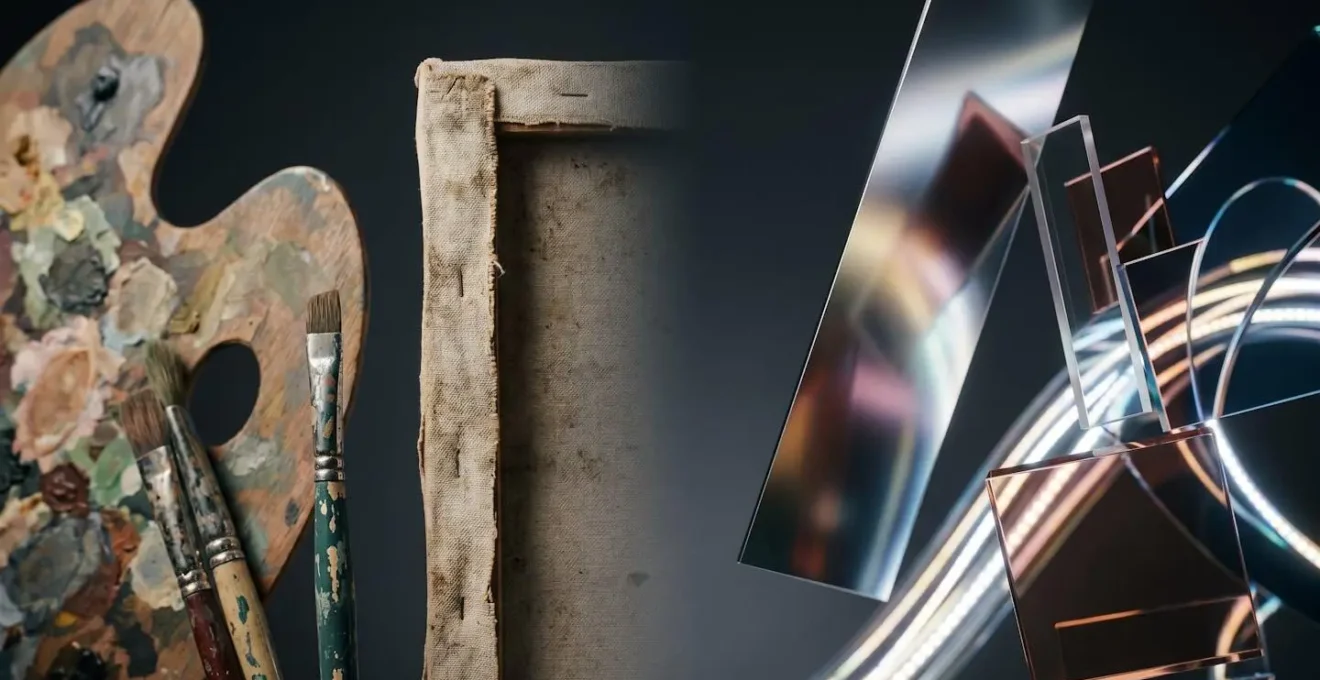
AI doomsayers are making the same mistake as Delaroche. They see a machine that can « paint » and declare the artist obsolete. They fail to see that the artist’s job was never just to paint, but to *see*, to *think*, and to *feel* in a way that resonates with others. AI automates rendering, not meaning. This forces a crucial question upon every artist: if the « how » is partially automated, what is your « why »?
This historical perspective provides a powerful antidote to the current panic, reframing this moment as an opportunity for reinvention.
When to Double Down on Human Skills vs Learn AI Integration?
For an artist navigating this new landscape, the central strategic question is one of resource allocation: where should I invest my time and energy? The answer is not a simple binary of « learn AI » or « ignore AI. » It is a nuanced balancing act that depends on your individual practice. The key is to identify which parts of your work are uniquely human and which parts can be augmented or challenged by technology. The rapid adoption of these tools in arts education, as seen at the prestigious Royal College of Art, shows this is no longer a niche concern.
A recent report from the RCA highlights a six-fold increase in AI-related projects at their end-of-year show, signalling a profound shift in the next generation of creative practice. This isn’t happening in a vacuum; the college is actively building frameworks to support it.
Case Study: The Royal College of Art’s Strategic AI Integration
The RCA’s approach is a model for the field. They established the Laboratory for Artificial Intelligence in Design (AiDLab) and have been integrating AI themes across the curriculum for years. Courses like ‘Designing Services & Products with Artificial Intelligence’ and major student projects focusing on ‘Being Digital’ and ‘Justice Equality and Misinformation’ show a commitment to treating AI not just as an image-maker, but as a complex cultural and social force that artists must critically engage with.
So, when should you double down on your existing skills? When those skills involve embodied knowledge (the unique touch of a sculptor’s hand), critical judgment (the ability to discern subtle meaning), social and emotional intelligence (connecting with an audience or subject), and conceptual synthesis (forging unexpected connections between disparate ideas). These are the domains where humans still hold a profound advantage.
When should you learn AI integration? When you want to accelerate ideation, explore formal possibilities beyond your own imagination, automate repetitive tasks, or when your work is conceptually about technology itself. Learning AI is not about replacing your core skills, but about building a bridge between them and a new set of capabilities.
Action Plan: Auditing Your Artistic Practice for the AI Era
- Map Your Process: List every step of your creative workflow, from initial concept to final presentation. Be granular.
- Identify Human-Centric Skills: For each step, identify where your unique judgment, embodied skill, or conceptual insight is absolutely essential. This is your « human core. »
- Pinpoint Augmentation Points: Identify repetitive or formally restrictive tasks (e.g., creating texture variations, brainstorming colour palettes, initial sketching) where AI could act as an assistant or a source of novelty.
- Assess Conceptual Alignment: Does your work’s subject matter (e.g., identity, memory, landscape) have a potential intersection with themes of data, algorithms, or digital representation? This could be a rich area for AI integration.
- Define a Pilot Project: Instead of trying to overhaul your entire practice, define one small, low-stakes project where you can experiment with integrating an AI tool at a specific augmentation point you identified.
The goal is to become an artist who uses AI, not an « AI artist. » The distinction is crucial.
Artist-Directed Prompting vs Emergent Curation: Which Produces More Interesting Results?
As artists begin to engage with AI, they typically adopt one of two primary modes of working. The most common is Artist-Directed Prompting. In this mode, the artist has a specific vision in their mind and attempts to translate it into the perfect text prompt to get the AI to generate it. This approach treats the AI like a highly skilled but very literal intern. The goal is to reduce the gap between the artist’s intention and the machine’s output. While this can be effective for commercial illustration or design, it often limits the potential for genuine surprise.
A more sophisticated and conceptually interesting approach is Emergent Curation. Here, the artist’s role shifts from a director to a curator, or even an ecologist. Instead of aiming for one perfect image, the artist creates a system or a loose set of parameters and allows the AI to generate a vast number of outputs. The primary creative act then becomes the process of sifting through this raw, chaotic material to discover unexpected gems, identify emergent themes, and assemble a cohesive body of work. The art is found in the selection.
Case Study: Mario Klingemann’s Generative Curation
Pioneer AI artist Mario Klingemann is a master of this approach. He doesn’t just write prompts; he builds his own generative systems. These systems produce thousands of haunting, distorted portraits, most of which are nonsensical. Klingemann’s artistry lies in his curatorial eye, his ability to dive into this sea of algorithmic noise and pull out the images that possess a strange beauty or emotional resonance. He creates the process, then curates the results.
This method embraces the AI’s nature as a « stochastic collaborator » — an unpredictable partner. It leverages the very thing that makes AI non-human: its capacity to produce outputs rooted in a statistical « perspective » that can be radically different from our own. As curator and AI expert Luba Elliott notes, this is where the real excitement lies.
Outputs from machine creativity are ‘rooted in a machine perspective that can be vastly different from the human one.’ The exciting aspect of art made with AI is that it pushes beyond the boundaries of human imagination.
– Luba Elliott, Nesta’s 10 Predictions for 2018
This approach moves beyond mere execution and into the realm of discovery, where the artist’s judgment and sensibility are paramount.
How to See the Conceptual Link Between Readymades and Generative Code Art?
To truly grasp the shift towards « Emergent Curation, » it is incredibly useful to look back over a century to Marcel Duchamp and the invention of the « readymade. » When Duchamp selected a common urinal, signed it « R. Mutt, » and submitted it to an art exhibition in 1917, he detonated the art world’s definitions of creativity. He demonstrated that a work of art could be created not through manual skill or fabrication, but through the intellectual act of selection and re-contextualisation. The artistry wasn’t in making the urinal; it was in choosing it and declaring it to be art, thereby forcing the viewer to see a familiar object in a new light.
This is precisely the conceptual territory of the AI artist working with emergent curation. The thousands of images generated by an AI model are, in a sense, a vast warehouse of digital « readymades. » The artist’s role is to walk through this warehouse and, with a discerning eye, select the one object (or series of objects) that, when pulled out and presented in a specific context, transcends its mundane origin and becomes charged with artistic meaning. The creative act is the choice.
This conceptual link is not just an academic exercise; it has real-world implications for how we understand authorship in the digital age. Interestingly, UK law has a unique, if debated, position on this. Unlike many other countries, the UK has historically offered some form of protection for works created without a human author. As legal experts at Pinsent Masons explain, the UK is one of only a handful of countries that grants copyright protection to creative works solely generated by a computer, protecting them for 50 years. While this is under review, it shows a pre-existing legal acknowledgement of non-human generation that complicates, and enriches, the current debate.
The readymade teaches us that authorship can be an act of the mind, not the hand. The AI artist, like Duchamp, becomes a « chooser » whose taste, intellect, and conceptual framework are the true medium.
This re-frames the practice from one of passive prompting to one of active and authoritative artistic choice.
Key Takeaways
- AI is a statistical synthesiser, not a creator; artistic authorship remains with the human who provides intent and context.
- The value of AI-assisted art lies in its conceptual novelty and critical engagement, not its technical perfection, aligning with established contemporary art criteria.
- True innovation comes from integrating AI conceptually into a practice, not from mastering a single generative tool. The focus should be on process, not just output.
Why Does Your AI Artwork Stop at the Prompt Instead of Pushing the Technology?
For many who experiment with AI, the process ends with the prompt. The generated image is seen as the final product. This is the artistic equivalent of a photographer taking a single snapshot and calling it a day, without considering composition, editing, printing, or presentation. To create truly compelling work with AI, you must see the initial output not as the destination, but as the raw material for a much deeper artistic process. It is the first step, not the last. The most meaningful work emerges from a « post-prompt practice. »
This involves asking critical questions: What happens if I layer multiple outputs? What if I take this digital image and physically alter it through printmaking or collage? What if I feed the AI’s output back into the model to create iterative, generational decay? What if the AI is used not to create an image, but to analyse a personal archive and reveal hidden patterns? This is where the artist’s unique vision reasserts itself with undeniable force.
Case Study: Gregor Petrikovič’s ‘Sincerely, Victor Pike’
A brilliant example of this post-prompt practice is the film ‘Sincerely, Victor Pike’ by RCA graduate Gregor Petrikovič, which won the prestigious Colección SOLO AI Award in 2024. The work was not born from a simple text prompt. It was built upon hundreds of hours of recorded conversations, originally collected to manage the artist’s chronic memory loss. Petrikovič used AI tools not to generate a fiction from scratch, but to transform this deeply personal, human archive into a powerful and coherent artistic statement. The AI was a collaborator in making sense of a life, a far more profound task than just making a picture.
This approach transforms the artist from a consumer of technology into a critical interrogator of it. It is an act of reclaiming agency. As RCA MDes student and researcher Ramla Anshur powerfully argues, the future is not something that just happens to us; it is something we must actively shape.
By collective organising, we can begin to imagine and craft the futures we desire: ones that value human creativity, that embody our cultural and ancestral knowledge, that exist within planetary boundaries rather than exploit.
– Ramla Anshur, RCA MDes Design Futures student
Your task as an artist is not to be afraid of AI or to embrace it uncritically, but to bend it to your will, to force it into a conversation on your terms, and to use it to create work that only you could make.