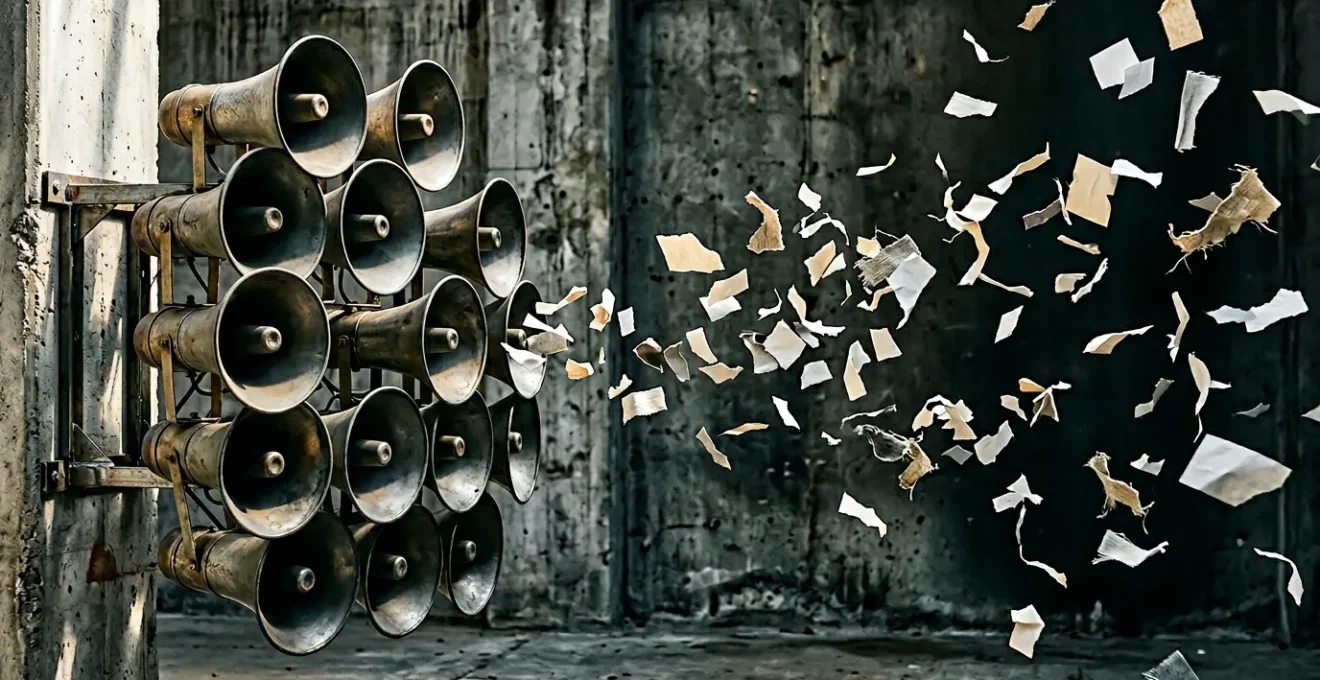
The most effective political art doesn’t provide answers; it engineers questions that force a resistant audience to participate in creating the meaning.
- Instead of delivering a clear message, successful works create « strategic voids » that disarm ideological opponents by inviting their interpretation.
- Physical street actions are most powerful when used as a stage to generate shareable digital content, multiplying their reach far beyond passersby.
Recommendation: Shift your practice from creating monologues to designing dialogical platforms. Audit your work to see where you can remove certainty to invite curiosity.
You pour months of work, passion, and righteous anger into a piece. You install it, share it, and wait for the impact. The response is predictable: praise from those who already agree with you, and either silence or vitriol from those you most want to reach. It feels like shouting into an echo chamber. The common advice—to be bolder, to make your message clearer, to be more authentic—often just makes the shouting louder, further entrenching the opposition and solidifying your status as a « preacher to the choir. » Your work becomes a symbol for your own side, not a catalyst for change on the other.
The hard truth is that in a hyper-polarised society, clarity can be a weakness. A direct message gives a resistant viewer a solid, easily identifiable target to reject. They can dismiss it as propaganda, critique its aesthetics, or attack the artist, all without ever having to engage with the uncomfortable idea at its core. But what if the problem isn’t the message, but the very act of ‘messaging’ itself? What if real change comes not from delivering a perfect, unassailable statement, but from engineering an unresolved, inescapable question?
This is the fundamental shift: from artist-as-orator to artist-as-architect of dialogue. It involves creating what can be called strategic voids—intentional gaps in the narrative or aesthetic that a viewer is compelled to fill with their own biases, memories, and politics. When they complete the work themselves, the meaning becomes co-created. It is no longer an external argument to be fought, but an internal question to be wrestled with. This guide moves beyond the platitudes to analyse the mechanics of this approach, using concrete examples from the UK to build a practical framework for art that doesn’t just state a position, but actively works to change minds.
To understand how to build art that persuades rather than polarises, we will deconstruct its core components. This article examines the psychological triggers that cause resistance, the power of asking questions, the strategic choice of venue, the role of controversy, the timing of your intervention, and the critical importance of authentic community engagement.
Summary: Why Your Political Art Fails to Persuade
- Why Does Your Anti-Racist Artwork Make Some White Viewers More Resistant?
- How to Make Political Art That Asks Questions Instead of Shouting Answers?
- White Cube Exhibition vs Guerrilla Street Action: Which Changes More Minds?
- The Controversy That Gave a Marginal Political Artist National Platform
- When to Launch a Refugee Crisis Artwork: During Media Peak or When Attention Fades?
- Why Did That Sculpture Meant to Celebrate Diversity Anger the Community It Depicted?
- Why Does Your Working-Class Character Sound Like Your Middle-Class Protagonist?
- Why Does Public Art Generate Controversy When It Tries to Unite Communities?
Why Does Your Anti-Racist Artwork Make Some White Viewers More Resistant?
Directly confronting a white audience with a message about their privilege or complicity in systemic racism often triggers a defensive psychological response known as ‘reactance’. When people feel their freedom of thought or identity is being attacked, they don’t just disagree; they often adopt an even stronger opposing view. An artwork that shouts « You are part of the problem » allows for an easy retort: « No, I’m not, » shutting down all engagement. The work confirms their priors about « preachy artists » and reinforces their resistance.
A more effective strategy bypasses this confrontational dynamic. Consider the aftermath of the toppling of Edward Colston’s statue in Bristol. The act itself was a direct, confrontational statement that divided the city. However, the subsequent curatorial decision by Bristol’s museums was a masterclass in creating a strategic void. Instead of restoring the statue or hiding it away, they displayed it horizontally, still covered in graffiti, and surrounded it with a timeline of placards from the protest. This transformed a declarative statement (« Colston was bad ») into a series of questions: What does this object mean now? Is it a historical artifact or a piece of contemporary protest art? Who gets to decide?
Case Study: The Curated Question of the Colston Statue
The 2020 toppling of Edward Colston’s statue succeeded by transforming an abstract historical debate into an intensely present and local conversation. Museum curators displayed the statue horizontally with graffiti preserved, and presented interactive timelines inviting visitors to add their own perspectives. This approach of confronting shared history through participatory methods proved far more effective at fostering dialogue than any top-down messaging about privilege could have. In fact, a Museums Journal poll revealed that while the initial act was divisive, the museum’s approach was widely supported, with over 80% of respondents preferring the new, questioning display.
This approach didn’t tell white viewers what to think; it created a space where they were invited to reflect on a shared, complicated history. By turning a monologue into a dialogue, it disarmed resistance and fostered genuine introspection, a goal the original, intact statue failed to achieve for centuries. The lesson is clear: your work’s power might lie not in the statement it makes, but in the quality of the question it forces.
How to Make Political Art That Asks Questions Instead of Shouting Answers?
The shift from declarative statements to interrogative frameworks requires a fundamental change in artistic process. It means abandoning the goal of creating a self-contained, perfect message and instead designing an incomplete system—a platform for dialogue. The artwork becomes a catalyst, not a conclusion. This involves intentionally engineering ambiguity and creating entry points for multiple, even contradictory, interpretations. Your role is not to provide the answer, but to frame a question so compellingly that the audience cannot help but try to answer it for themselves.
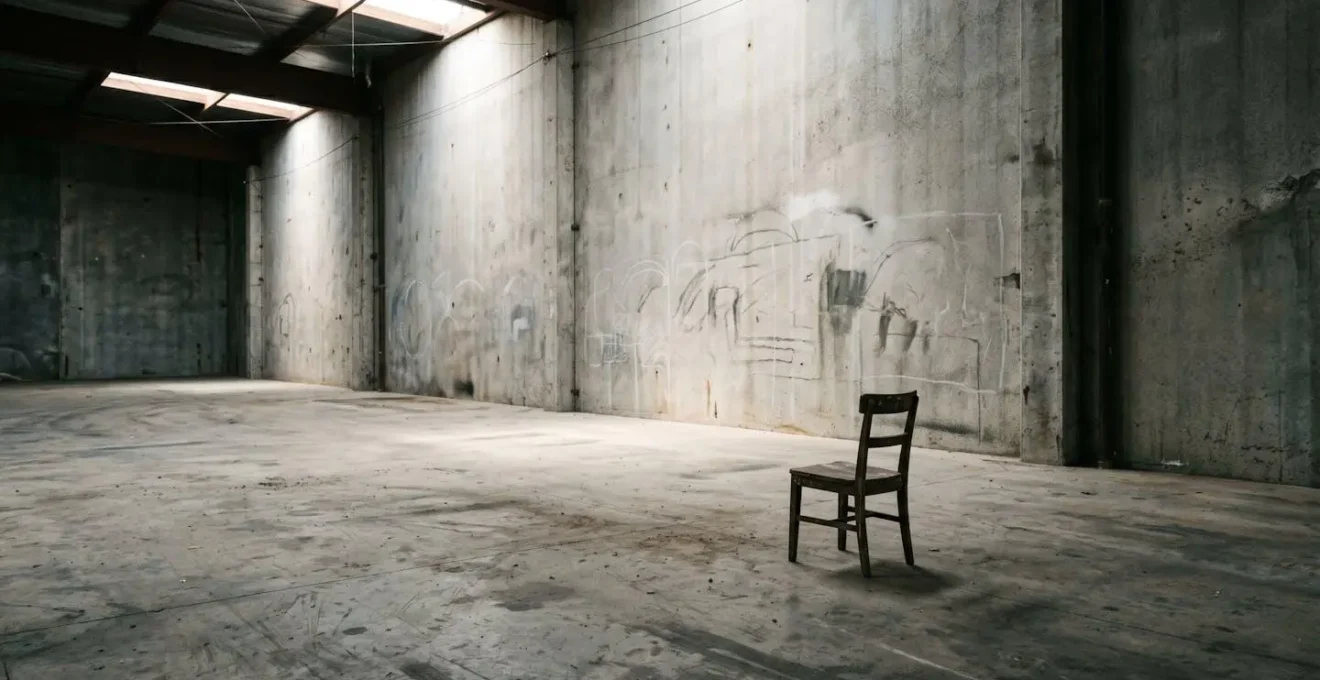
This is the concept of the dialogical artwork. It functions as a space for conversation rather than a vessel for a monologue. To achieve this, the artist must embrace vulnerability, relinquishing total control over the work’s meaning. The visual metaphor below captures this idea: the focus isn’t on a finished piece, but on the potential held within an empty, expectant space. It is an invitation.
Jeremy Deller’s 2001 masterpiece, The Battle of Orgreave, is a canonical example of this practice. Instead of making a documentary or a didactic painting about the 1984 Miners’ Strike, Deller orchestrated a large-scale re-enactment with nearly 1,000 participants, including many of the original miners and police officers. The work didn’t offer a single interpretation of the historic, violent clash. Instead, by re-staging the event, it created a living, breathing question about memory, trauma, and the rewriting of history. As one analysis notes, it was designed to be interpreted through conversation, not just observation.
The Battle of Orgreave is best understood as a dialogical artwork, containing multiple strands created through conversations between the artist, veterans of the Miners’ Strike, re-enactment specialists, the audiences of the work.
– Academic analysis of Jeremy Deller’s practice, Interpreting Jeremy Deller’s The Battle of Orgreave
The work’s power came from its refusal to provide a simple hero/villain narrative, forcing viewers and participants from all political stripes to project their own experiences and ideologies onto the event, thereby co-creating its meaning.
Your Action Plan: Auditing Your Work for Dialogical Potential
- Identify the ‘Answer’: What is the single, declarative statement your artwork is currently making? Be brutally honest. (e.g., ‘Brexit was a mistake’).
- Engineer the ‘Void’: What key piece of information or visual element can you remove or obscure to turn that statement into a question? (e.g., Show the promise, but not the outcome).
- Map the Entry Points: List three different ways a sympathiser, an opponent, and a neutral viewer could interpret or complete the work with the ‘void’ in place.
- Test for Personal Resonance: Does the work require the viewer to access their own memories, fears, or hopes to make sense of it? Pinpoint where this happens.
- Activate the Context: Is the artwork’s context (a gallery, a street, a social media feed) an active part of the question, or just a neutral background? How can you change the context to amplify the ambiguity?
White Cube Exhibition vs Guerrilla Street Action: Which Changes More Minds?
The debate between the controlled environment of the gallery and the chaotic immediacy of the street presents a false dichotomy. For the contemporary political artist, the most effective strategy is a hybrid one that treats the physical world as a content-generation engine for the digital one. A guerrilla street action that is seen by a few hundred people is a failure if it ends there. A street action that is photographed, shared, and goes viral to millions online is a resounding success. The street is not the audience; it is the stage for creating media.
The anti-Brexit campaign group Led By Donkeys perfected this model. Their core tactic was simple: pasting giant billboards of politicians’ past hypocritical tweets and statements in public spaces. The physical billboards were potent, but their real power was as shareable media assets. Each installation was professionally photographed and immediately pushed onto social media, where the outrage and validation cycles propelled them to a massive audience. The campaign’s success was not measured in foot traffic, but in digital reach. They understood that a compelling image of a protest in the physical world is infinitely more scalable than the protest itself.
Case Study: The Led By Donkeys Hybrid Campaign
Led By Donkeys demonstrated the power of the hybrid model by turning street billboards into a viral content machine. Their campaign, which highlighted politicians’ contradictory statements, raised nearly £500,000 from over 16,000 supporters and built a social media following of 340,000. Individual photos of their billboards garnered millions of online views—an audience exponentially larger than the physical passersby. The strategy was so effective that Crowdfunder UK reported their work reached over a billion people in global editorial reach, proving that the true value of street action often lies in creating powerful, shareable media moments.
This approach flips the traditional logic. The goal is not just to interrupt the public’s daily commute but to interrupt their social media scroll. The « white cube » then becomes the digital platform—Twitter, Instagram, TikTok—where the work is exhibited to a global audience. The validation for this strategy even came from the establishment, with the head of a major outdoor advertising company acknowledging their genius in starting a conversation.
They have really captured the way out of home can deliver a very strong, public message and start a conversation. Whether one supports the campaign or not, they’ve done a fantastic job.
– William Eccleshare, Worldwide Chief Executive of Clear Channel, Led By Donkeys: We are creating political street theatre
The Controversy That Gave a Marginal Political Artist National Platform
Controversy is often seen as a risk to be managed, but for political art, it can be the primary medium. A deliberately provocative act can hijack the media cycle, forcing a national conversation on an issue that was previously ignored. The key is to design the work so that the ensuing controversy, media coverage, and legal battles become integral parts of the artwork itself. The work is not just the initial object or action, but the entire public and institutional reaction that follows. This is the strategy of using media-as-material.
The toppling of the Edward Colston statue is again the key text. The act itself was carried out by a small group, but it generated a global news event. The subsequent arrest and trial of the « Colston Four » extended the life of the artwork for over a year and a half. The courtroom became a new stage. The legal arguments, the media commentary, and the public debate were all incorporated into the expanded « piece. » The government’s condemnation of the act as « utterly disgraceful » only added to the drama and raised the stakes.
The ultimate vindication of this strategy was the jury’s verdict. When all four protesters were found not guilty in January 2022, it was a stunning climax. This legal outcome, a direct result of the initial artistic/activist act, retrospectively reframed the entire event. It wasn’t just vandalism; a jury of peers had legitimized it as a valid form of political expression in a specific context. The controversy didn’t just give the issue a platform; it led to a tangible, history-making result. The acquittal of the four people charged with criminal damage demonstrated that the calculated risk of a controversial act can pay off by forcing the system to publicly wrestle with its own values.
For an artist, this means planning for the second, third, and fourth waves of reaction. The goal isn’t just to create a controversial image, but to spark a process. You must be prepared to engage with, document, and frame the backlash as a continuation of the work itself, transforming detractors into unwitting collaborators in your piece.
When to Launch a Refugee Crisis Artwork: During Media Peak or When Attention Fades?
The temptation is to launch an artwork about a crisis at the peak of its media coverage, riding the wave of public attention. This « rapid response » approach can be effective for fundraising or immediate awareness, but it often results in work that is superficial and quickly forgotten, lost in the noise of the 24-hour news cycle. An artist’s voice simply becomes one more shout in a cacophony. The work risks being judged on its timeliness rather than its depth, and its message is flattened by the simplistic narratives that dominate breaking news.
A more powerful, counter-intuitive strategy is to launch the work *after* the media attention has moved on. This « echo » strategy creates its own strategic void—a temporal one. It asks the uncomfortable question: « Remember this? Why have we stopped talking about it? » Launching in the quiet aftermath allows for a more complex, nuanced, and contemplative engagement. The audience is no longer in a state of reactive shock but is more capable of deeper reflection. The artwork can serve as a potent reminder of collective amnesia, a call to long-term accountability rather than short-term alarm.
This approach allows the work to function on a more profound level. As researchers on art and anti-racism point out, the real work is in constructing « multilayered understandings » that reveal the lived experiences of systemic issues. These are insights that cannot be conveyed in a breaking news headline but can be cultivated in the quiet space an artwork creates when the world has gone silent.
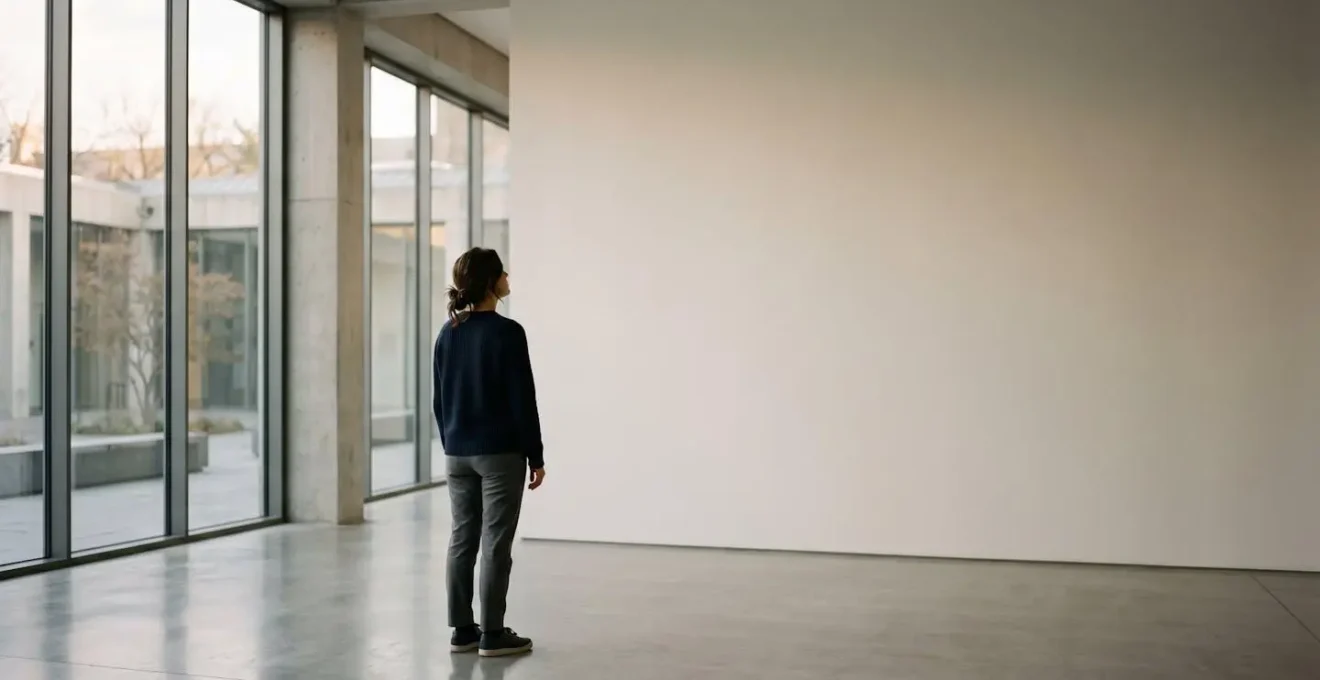
The artwork becomes a site of memory and sustained focus in a culture of perpetual distraction. It doesn’t just react to the news; it questions the very nature of the news cycle itself. It stands as a quiet but firm refusal to forget. The contemplative atmosphere suggested by the image above—a solitary figure in a quiet space—is the goal: to create a moment of focused reflection long after the cameras have left.
Why Did That Sculpture Meant to Celebrate Diversity Anger the Community It Depicted?
Public art intended to « celebrate » or « represent » a community often fails spectacularly when it is created without the deep, authentic involvement of that community. The anger stems from a sense of misrepresentation and appropriation. When an artist, particularly one from outside the community, creates a top-down vision of what that community’s identity or struggle looks like, it is often perceived as an act of silencing. The artist’s interpretation, cast in bronze or stone, replaces the community’s own multifaceted, living voice with a static, external one. The work ceases to be a celebration and becomes a monument to the artist’s good intentions, not the community’s reality.
The solution is to shift from a model of representation to one of collaboration and co-creation. The artist’s role changes from being a visionary author to a skilled facilitator. Success is not a beautiful object, but a meaningful process. Again, the curatorial handling of the Colston statue provides the blueprint. After the toppling, the Bristol museum didn’t just decide what to do next; they launched a massive public consultation survey. Crucially, as the results showed, nearly 14,000 people responded, and 4 out of 5 from Bristol supported a museum display that contextualised its history. This was not a small focus group; it was a genuine attempt to build a city-wide consensus.
The museum listened. The decision to keep the graffiti was a direct response to the public mood, a validation of the protest as a legitimate part of the statue’s story. The Bristol History Commission’s statement on this choice is telling:
The graffiti is not a temporary blemish on a piece of celebratory art, it is an intrinsic part of the statue’s history and relevance.
– Bristol History Commission curatorial decision, Colston’s Toppling Five Years On
This act of listening and incorporating the community’s « mark » (the graffiti) transformed the object. It was no longer just Colston’s statue; it became a statue about Bristol’s complex relationship with Colston. The anger directed at the original statue was transmuted into broad support for the new display because the community saw its own voice reflected in the final outcome. They became co-authors of the new meaning.
Why Does Your Working-Class Character Sound Like Your Middle-Class Protagonist?
This is a common pitfall and a clear symptom of representation without research. An artist, often from a middle-class background, attempts to depict a working-class experience and ends up creating a caricature based on media stereotypes or assumptions. The character’s dialogue, motivations, and worldview feel inauthentic because they are an external projection, not an internal reality. The artist’s own voice, biases, and linguistic patterns bleed through, creating a dissonance that is immediately obvious to anyone with lived experience of that background. It is an act of well-intentioned ventriloquism that ultimately fails.
The antidote is a process of ethnographic immersion and genuine collaboration. It requires humility and a willingness to listen more than you speak. It means spending significant time within the community you wish to represent, not as an observer with a notebook, but as a participant. The goal is to absorb the nuances of language, the unspoken social codes, and the lived economic realities that shape a person’s voice and perspective. This is not about finding « authentic » dialogue to copy, but about understanding the world from which that dialogue emerges.
Case Study: Jeremy Deller’s Ethnographic Approach
Jeremy Deller’s two-year research process for The Battle of Orgreave is a prime example of getting this right. To represent the 1984 Miners’ Strike, he didn’t rely on history books alone. He immersed himself in the former mining communities, building relationships and listening to stories. The resulting re-enactment involved nearly 1,000 participants, including 200 former miners and policemen who had been part of the original conflict. By giving them a platform to re-enact their own history, Deller ensured their voices were not just heard, but were the very fabric of the artwork. His work is consistently noted for this collaborative methodology, which prioritizes the authentic voice of participants over a singular artistic vision.
This deep collaboration is the only way to achieve an authenticity of voice. It moves beyond creating a character that ‘sounds’ working-class to creating a character that ‘thinks’ from a place of working-class experience. The difference is subtle but profound. It is the difference between a costume and a skin. If your characters from different social strata all sound suspiciously like you, it is a sign that you have skipped this crucial, time-consuming, and deeply respectful work of listening.
Key takeaways
- Effective political art shifts from monologue to dialogue by creating unresolved questions that invite audience participation.
- The physical location of an artwork is often best used as a stage for creating shareable digital content that reaches a far wider and more diverse audience.
- Authentic representation requires deep, collaborative, and often long-term engagement with communities, replacing top-down assumptions with co-created meaning.
Why Does Public Art Generate Controversy When It Tries to Unite Communities?
Public art commissioned with the noble goal of « uniting the community » frequently becomes a flashpoint for controversy for a simple reason: it often operates on the flawed assumption that a single aesthetic or historical language can be universally understood and embraced. An artist might create a work using a modernist, abstract language meant to symbolise unity and progress. However, a segment of the community may see that same abstraction as elitist, alienating, and a dismissal of their own cultural heritage or figurative traditions. The « uniting » gesture is heard as an act of erasure.
Controversy erupts when these different « languages »—of aesthetics, history, class, and identity—clash. As Dr. Kelli Morgan, a leading voice on decolonising museums, has highlighted, the dominant narrative in our public art and institutions has been overwhelmingly singular. A work attempting to be universal can be perceived as perpetuating this exclusive tradition.
For over two centuries the traditional art-historical narrative in the US has remained predominantly Eurocentric and male in nearly every major museum.
– Dr. Kelli Morgan, To Bear Witness: Real Talk about White Supremacy in Art Museums Today
This institutional bias informs the public’s reception of new art. The controversy, therefore, is not a failure of the art’s intention, but a raw manifestation of pre-existing social fractures. The artwork doesn’t create the division; it simply makes it visible. The clashing materials in the image below serve as a metaphor for these incompatible languages meeting at a sharp, unresolved boundary.

The effective political artist does not try to impose a single, « unifying » language. Instead, they acknowledge the existence of these multiple, conflicting languages. Their work becomes a platform where these tensions are made explicit—a space for the « controversy » to happen in a structured, visible way. The goal shifts from achieving a harmonious, unified response to facilitating a difficult but necessary conversation. The artist’s role is not to be a peacemaker, but a lucid and honest translator of the conflicts that are already there.
The ultimate goal, then, is not to stop preaching to the converted, but to transform the sermon into a Socratic dialogue. It requires relinquishing control, embracing ambiguity, and having the courage to create work that doesn’t just offer your truth, but has the structural integrity to withstand—and even welcome—the truths of others. To begin this shift in your own work, apply this critical framework and start designing questions, not just answers.