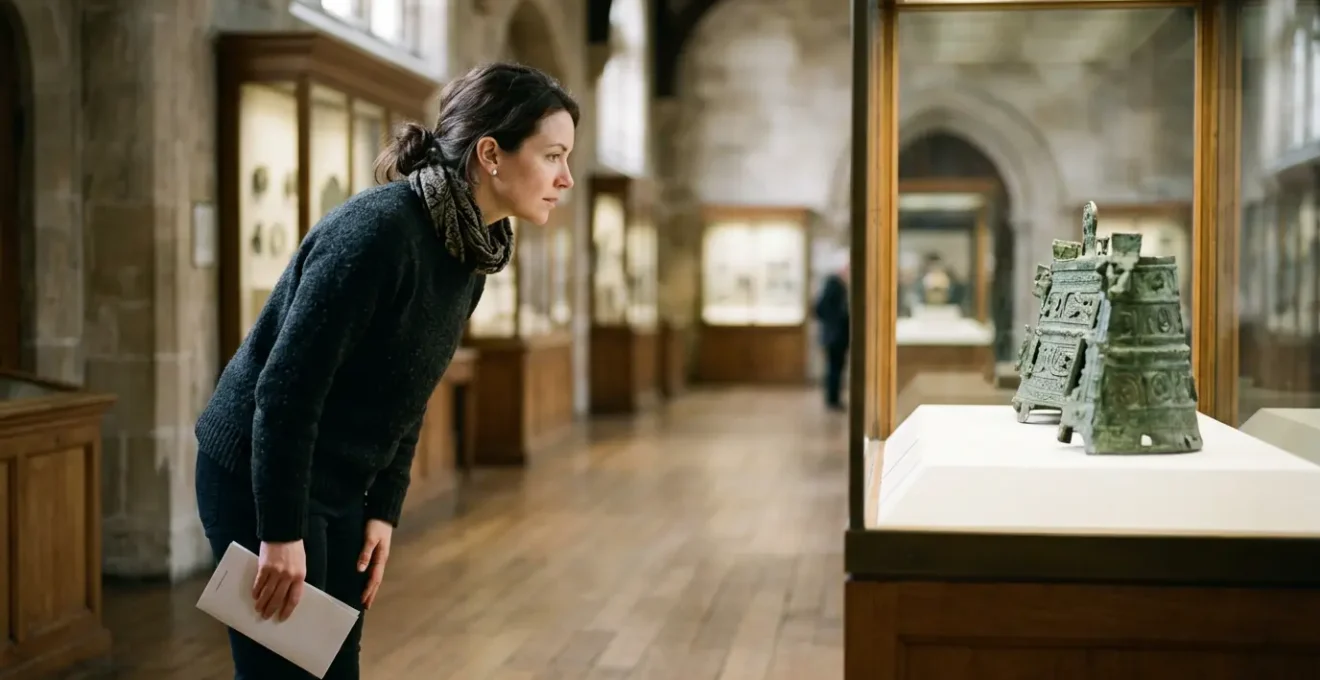
Visitor disengagement isn’t caused by complex objects, but by interpretation that provides answers before visitors have a chance to ask questions.
- Traditional 150-word labels are frequently ignored because they overload cognition instead of sparking curiosity.
- True connection is forged through sensory, emotional, and provocative encounters, not passive information consumption.
Recommendation: Shift your focus from what to tell visitors to how to make them care enough to look closer.
As a museum professional, you have likely felt the quiet disappointment of watching a visitor glance at a priceless artefact for three seconds before moving on. You see it every day: a gallery filled with historical treasures, yet the audience seems to float through, disconnected, their attention captured more by their phones than by the history in front of them. The collections are preserved, the lighting is perfect, the labels are painstakingly researched, but the connection—the spark of understanding and wonder—is absent. Visitors are leaving without grasping the significance of what they’ve just seen, turning a potential moment of revelation into a forgettable stop on their itinerary.
The conventional response is to simplify. We are told to shorten labels, use more accessible language, or add a QR code. While well-intentioned, these solutions often miss the fundamental issue. The problem isn’t necessarily that the information is too complex; it’s that it’s delivered without first establishing relevance or provoking curiosity. We are giving them the answers to questions they haven’t even thought to ask. This approach treats the visitor as a passive vessel for information, rather than an active participant in the process of meaning-making.
But what if the key to engagement isn’t about dumbing down content, but about designing more intelligent encounters? This guide proposes a shift in perspective. Instead of focusing solely on the delivery of information, we will explore how to strategically design visitor experiences that provoke questions, foster personal connections, and empower visitors to discover meaning for themselves. It’s about moving from being an expert who dictates knowledge to an interpreter who facilitates discovery.
This article will deconstruct the common pitfalls of museum interpretation and offer visitor-focused strategies to transform your displays. By examining everything from label writing to virtual gallery design, we will build a new framework for creating exhibitions that resonate deeply and leave a lasting impact.
Summary: Re-Engaging the Museum Visitor
- Why Does Nobody Read Those 150-Word Labels You Spent Weeks Perfecting?
- How to Make Visitors Care About a 500-Year-Old Pot Without Manipulation?
- Augmented Reality vs Unmediated Object: Which Creates Deeper Heritage Understanding?
- The Display Lighting That Protects Objects but Makes Them Impossible to See
- When to Retire Popular Displays: After Light Damage Thresholds or When Attendance Drops?
- Why Did UK Furniture Making Lose 60% of Its Apprenticeships Since the 1990s?
- How to Create a Virtual Gallery Where Average Visit Time Exceeds 5 Minutes?
- Why Does Your Virtual Gallery Feel Lonely Instead of Immersive?
Why Does Nobody Read Those 150-Word Labels You Spent Weeks Perfecting?
The 150-word label is the cornerstone of traditional museum interpretation, yet it is a tool that is fundamentally failing. The core issue is one of cognitive load and misplaced intent. We write these labels from a position of expertise, aiming to distill complex histories into a digestible paragraph. However, for a visitor who has no pre-existing context or emotional investment in the object, this block of text represents an unsolicited cognitive burden. They are asked to process dates, names, and materials before they’ve even decided if they care about the object itself.
This isn’t just anecdotal; research consistently shows a disconnect. In fact, eye-tracking research reveals that almost half of visitors do not engage with labels at all. They might glance, but they don’t truly read or absorb the information. Why? Because the label preemptively answers the « what » and « how » without first inspiring the « why. » It treats curiosity as a given, when in reality, it must be earned. As writer and researcher Seema R. notes, « Museum labels are often written for highly informed museum-goers, » effectively alienating the majority of the audience who lack that specialist background.
The solution is not necessarily to write shorter labels, but to write smarter ones. An effective label should function as a « curiosity trigger » rather than an information summary. It could start with a provocative question, a surprising fact, or an observation that encourages the visitor to look closer at the object. The goal is to initiate a dialogue, not deliver a monologue. The primary function of the initial text should be to make the visitor invest their attention in the object. Only once that investment is made will they be receptive to the deeper information you have to share.
How to Make Visitors Care About a 500-Year-Old Pot Without Manipulation?
Making a visitor care about a seemingly mundane object like a 500-year-old pot is the central challenge of interpretation. The instinct is to « sell » its importance through facts: its rarity, its age, its famous owner. But this is an intellectual appeal that often fails to create an emotional connection. The key is to move beyond conveying information and start facilitating an experience. This involves designing an encounter that allows for personal meaning-making, where the visitor’s own perceptions and emotions are the primary entry point.
This approach prioritises sensory and emotional engagement over intellectual instruction. Instead of telling them the pot is important, create the conditions for them to feel its significance. This can be achieved through a variety of techniques that encourage closer, more personal examination. Consider using carefully directed lighting to highlight a specific texture, a fingerprint left by the maker, or a crack from a lifetime of use. Ask open-ended, speculative questions: « What might this pot have held? » or « Whose hands might have touched this surface? » These prompts invite the visitor to use their imagination, transforming them from a passive observer into an active investigator.
This concept of active engagement is beautifully articulated by the interpretation team at one of the world’s leading cultural institutions. As the British Museum’s team explains, the goal is to shift the dynamic entirely:
It is not about providing information that visitors passively absorb, but more about encouraging visitors to actively engage, to look closer at objects and to reveal something relevant that they might otherwise have missed.
– British Museum Interpretation Team, A question of interpretation
This subtle shift turns a static object into a catalyst for thought and feeling. The visitor’s connection isn’t based on the facts you’ve given them, but on the personal discoveries they’ve made for themselves. The pot is no longer just a 500-year-old artefact; it’s a tangible link to a human past they have actively imagined and connected with.

The power of this connection lies in its authenticity. It is not manipulative because it doesn’t tell the visitor what to feel. Instead, it creates an environment of focused contemplation, trusting that the object, when properly presented, has the inherent power to evoke a response. It’s about creating space for wonder, rather than filling it with words.
Augmented Reality vs Unmediated Object: Which Creates Deeper Heritage Understanding?
The debate between technology and tradition in the gallery space is often framed as a zero-sum game. Purists argue that digital layers like Augmented Reality (AR) distract from the « aura » of the authentic object, while technologists champion AR as the solution to static, unengaging displays. The truth, as always, is more nuanced. The effectiveness of AR doesn’t depend on the technology itself, but on its application. It fails when it becomes a gimmick; it succeeds when it serves as an interpretive bridge to deeper understanding.
AR should not be used to simply overlay text or play a video that could exist elsewhere. Its unique power lies in making the invisible visible. It can reveal the original colours of a faded textile, reconstruct a broken pot, or place an object back into its original architectural context. Used this way, AR doesn’t replace the unmediated encounter with the object; it enhances it by answering the questions that the object itself provokes. A visitor might wonder, « What did this Roman statue look like when it was painted? » AR can provide a stunning, evidence-based answer directly on the object, creating a « wow » moment that deepens, rather than distracts from, their appreciation.
When implemented with clear interpretive goals, the results can be transformative for visitor engagement, turning fleeting glances into sustained examination.
Case Study: The Art Gallery of Ontario’s AR Experience
The Art Gallery of Ontario’s AR installation provided a powerful demonstration of this principle. Before its implementation, the average visitor spent a mere 2.31 seconds in front of each artwork. After introducing an AR app that revealed hidden layers and stories within the paintings, the gallery saw a dramatic shift. A subsequent study of the AR installation showed that 84% of visitors to the exhibition reported feeling engaged with the art, and a remarkable 39% looked at the images again after using the app. The technology served as a catalyst, encouraging visitors to look closer and spend more time with the physical object.
The choice is not between AR and the object, but between passive and active interpretation. A poorly designed AR experience can be just as alienating as a dense label. However, a well-designed AR feature that respects the object and the visitor’s intelligence can become one of the most powerful tools in our interpretive arsenal, fostering a level of understanding that neither the object nor the tech could achieve alone.
The Display Lighting That Protects Objects but Makes Them Impossible to See
Display lighting is the silent narrator of every exhibition, yet it is often governed by a single, overriding concern: conservation. The professional standard is to limit light exposure, especially for sensitive materials like textiles and watercolours, to a strict 50 lux. This is done for the crucial purpose of preventing irreversible fading and degradation. The unintended consequence, however, is that many galleries are plunged into a protective gloom where visitors must squint to discern any detail, undermining the very purpose of the display.
This creates a fundamental conflict between preservation and presentation. As interpretation specialists, our role is to mediate this conflict. We must respect the conservator’s mandate while advocating for the visitor’s experience. Simply accepting low light levels as an unavoidable necessity is a failure of interpretation. It communicates to the visitor that the object’s long-term future is more important than their present-moment connection with it. While true from a preservation standpoint, it creates a frustrating and alienating experience.

The solution lies in strategic and dynamic lighting design, not uniform dimness. Instead of bathing an entire gallery in low light, we can use precisely focused spotlights to « paint » with light, illuminating key details of an object while leaving less sensitive areas in lower light. Occupancy-activated lighting is another powerful tool; an object can rest in near-darkness at 10 lux until a visitor approaches, at which point the light gradually increases to a more viewable 50 or even 100 lux for a limited time. This method both minimises the cumulative light exposure over time and creates a magical, theatrical moment of revelation for the visitor.
This approach transforms lighting from a passive, protective measure into an active interpretive tool. It guides the visitor’s eye, reveals texture and form, and creates atmosphere. By balancing the needs of the object with the needs of the audience, we can create displays that are both sustainable and spectacular, proving that good conservation and good interpretation are not mutually exclusive goals.
When to Retire Popular Displays: After Light Damage Thresholds or When Attendance Drops?
The decision to retire or refresh a display is one of the most complex a museum faces. Traditionally, this decision is driven by two primary metrics: physical condition and visitor numbers. An object is rotated out when its cumulative light exposure limit is reached, or a gallery is overhauled when attendance figures begin to decline. While these are important considerations, they overlook a more critical, albeit harder to measure, factor: interpretive relevance.
A display’s message can become outdated or irrelevant long before the objects are damaged or the crowds disappear. Societal values change, new research emerges, and what was once a compelling narrative can become a tired cliché or, worse, a problematic representation. A popular display, sustained by its « greatest hits » status, might actually be preventing the museum from telling new, more relevant stories that would connect with a contemporary audience on a deeper level. Relying solely on attendance figures as a measure of success can be misleading, as evaluation data from the British Museum shows that average dwell time for ticketed special exhibitions often far exceeds that of free permanent galleries, suggesting that novelty and curated narratives are powerful drivers of engagement.
The concept of « relevance expiry » should become a key part of our curatorial and interpretive planning. As Museums Galleries Scotland wisely states in its guidance on interpretation:
A display’s relevance can expire long before physical damage occurs or attendance drops.
– Museums Galleries Scotland, Introduction to Interpretation
This requires a proactive approach to evaluation. We must regularly ask difficult questions: Does this display still align with our museum’s mission? Does it speak to the concerns and perspectives of our current community? Are there untold stories within our collection that this display is preventing us from sharing? This shifts the focus from a reactive cycle of repair and replacement to a proactive strategy of curatorial dynamism. It means being willing to retire a popular but intellectually stagnant display to make way for something more challenging, more timely, and ultimately, more meaningful.
Why Did UK Furniture Making Lose 60% of Its Apprenticeships Since the 1990s?
On the surface, the sharp decline in craft apprenticeships in the UK seems unrelated to museum interpretation. Yet, this trend serves as a powerful and troubling metaphor for what is happening inside our galleries. The crisis in craft training is not just about a loss of jobs; it’s about the erosion of « material literacy« —the intuitive understanding of how things are made, what they are made of, and the human skill embedded within them. When a society loses its makers, it also loses its ability to fully appreciate what is made.
The statistics paint a stark picture of a wider trend. Across all sectors, 337,140 people started an apprenticeship in 2023, marking a continued decline. Within specific craft sectors like furniture making, the drop has been even more precipitous over decades. As one industry observer notes, « Across the UK, apprenticeship numbers in craft and manufacturing have fallen sharply over the past two decades. Fewer young people are entering skilled trades, and many long‑established workshops now operate without a single trainee. »
This has a direct impact on the museum visitor. A person who has never seen wood being carved, a pot being thrown, or a thread being woven will struggle to comprehend the level of skill and artistry in a historical artefact. They see a finished product, but they cannot « read » the story of its creation. They lack the conceptual tools to appreciate the maker’s choices, the resistance of the material, and the time invested. The object becomes an abstraction, its « made-ness » invisible.
Our role as interpreters, therefore, becomes a form of apprenticeship. If visitors are no longer learning material literacy in the wider world, we must teach it to them in the gallery. We must design experiences that reveal the process of making. This could involve displaying tools alongside finished objects, using macro photography to show tool marks, or incorporating videos of craftspeople at work. We need to actively « apprentice » our visitors in the art of looking, teaching them to see not just an object, but the human ingenuity, skill, and labour it represents. By doing so, we don’t just explain the object; we restore its value and build a profound respect for the lost art of its creation.
How to Create a Virtual Gallery Where Average Visit Time Exceeds 5 Minutes?
Creating a virtual gallery that holds a visitor’s attention for more than a few minutes is a monumental challenge. Web analytics benchmarks indicate that the average time spent on a webpage hovers around 54 seconds. To achieve a visit time of five minutes or more requires a fundamental rethinking of what a virtual exhibition should be. It cannot simply be a digital replica of a physical space—a collection of JPEGs on a webpage. To succeed, it must be an experience designed for the medium, leveraging interactivity and narrative in ways a physical gallery cannot.
The key is to shift from a model of « browsing » to one of « questing. » Instead of presenting a static grid of artworks, design a journey with a clear narrative arc. This could be a guided path that unlocks content as the user progresses, a mystery they have to solve by finding clues in different artworks, or a challenge to curate their own collection based on a specific theme. These gamified elements provide structure and motivation, encouraging sustained engagement by giving the visitor a clear goal and a sense of accomplishment.
Furthermore, the virtual space allows for layers of interaction impossible in a real-world gallery. Allow users to « turn over » a painting to see notes on the back, use a virtual magnifying glass to explore impossibly small details, or overlay a conservation X-ray to reveal the artist’s original sketches. Each interaction should be a rewarding moment of discovery, encouraging the visitor to spend more time with each object. The goal is to make every click a meaningful action, not just navigation.
Action Plan: Designing for a 5-Minute Virtual Visit
- Define the Narrative Path: Don’t just display objects. Structure the experience around a clear story, question, or theme that guides the user from a defined start to a satisfying conclusion.
- Inventory Interactive Elements: What unique digital interactions can you offer? Think beyond zoom/pan. Consider X-ray overlays, 3D object rotation, audio from the artist, or comparative sliders.
- Integrate « Quest » Mechanics: Introduce a simple goal. This could be « Find the three objects related to… » or « Curate your own exhibition and share it. » This transforms passive viewing into active participation.
- Prioritize Emotional Pacing: Vary the experience. Follow an intense, detailed object examination with a moment of visual calm or a thought-provoking quote. Avoid a monotonous layout.
- Implement « Breadcrumb » Trails: Provide a clear map or progress bar. Users are more likely to stay if they know where they are in the journey and what’s coming next, giving them a sense of control and purpose.
By designing for interaction, narrative, and purpose, we can transform the virtual gallery from a lonely, static catalogue into a dynamic and immersive world. This is how we earn the visitor’s most precious commodity: their time and focused attention.
Key Takeaways
- Visitor understanding is not a given; it must be cultivated by sparking curiosity before providing information.
- Moving beyond text-based labels to sensory and emotional encounters creates more durable and personal connections with objects.
- The success of a display should be measured by its current interpretive relevance, not just its historical popularity or physical condition.
Why Does Your Virtual Gallery Feel Lonely Instead of Immersive?
You have built a technically flawless virtual gallery. The 3D models are high-resolution, the navigation is smooth, and the content is rich. Yet, the experience feels hollow, sterile, and ultimately, lonely. This is a common failure in digital museum experiences. We focus so much on the technical replication of a physical space that we forget what makes a real gallery visit compelling: the shared human context. In a physical museum, you are aware of other people—their hushed conversations, their shared gasps of wonder, their simple presence—which creates a communal atmosphere.
The digital realm, by its nature, is isolating. To overcome this, we must intentionally design for connection and « social presence. » The virtual gallery cannot just be a solitary journey; it must feel like a shared space. This doesn’t necessarily mean creating a complex multiplayer metaverse. Simpler interventions can be highly effective. Incorporate curated visitor comments next to artworks, allowing a new visitor to see what a previous one thought or felt. Implement a feature where users can « leave a light » on their favourite pieces, creating a heat map of collective appreciation that grows over time.
As researchers Rodriguez-Boerwinkle and Silvia point out, this is a critical frontier for museum engagement: « Virtual art galleries represent a rapidly growing and potentially unique context for art engagement, but little is known about the psychological nature of these experiences. » That psychological nature is deeply social. We understand and validate our own experiences by seeing them reflected in others. A virtual gallery that feels lonely fails because it denies the visitor this fundamental human need for shared experience. It provides access to the art but strips away the communal context that gives it life.
Ultimately, the goal is to create an asynchronous community around the collection. By integrating elements that show the traces of past visitors and allow for interaction between present visitors (like live-guided virtual tours or scheduled online discussions), we can transform a lonely digital file repository into a vibrant, populated, and truly immersive cultural destination. The technology is merely the venue; the human connection is the main event.
To move forward, the task for every museum professional is to critically re-evaluate every point of visitor contact, from the text on a label to the click-path in a virtual tour, and ask not « What information can I provide? » but « What question can I provoke? »