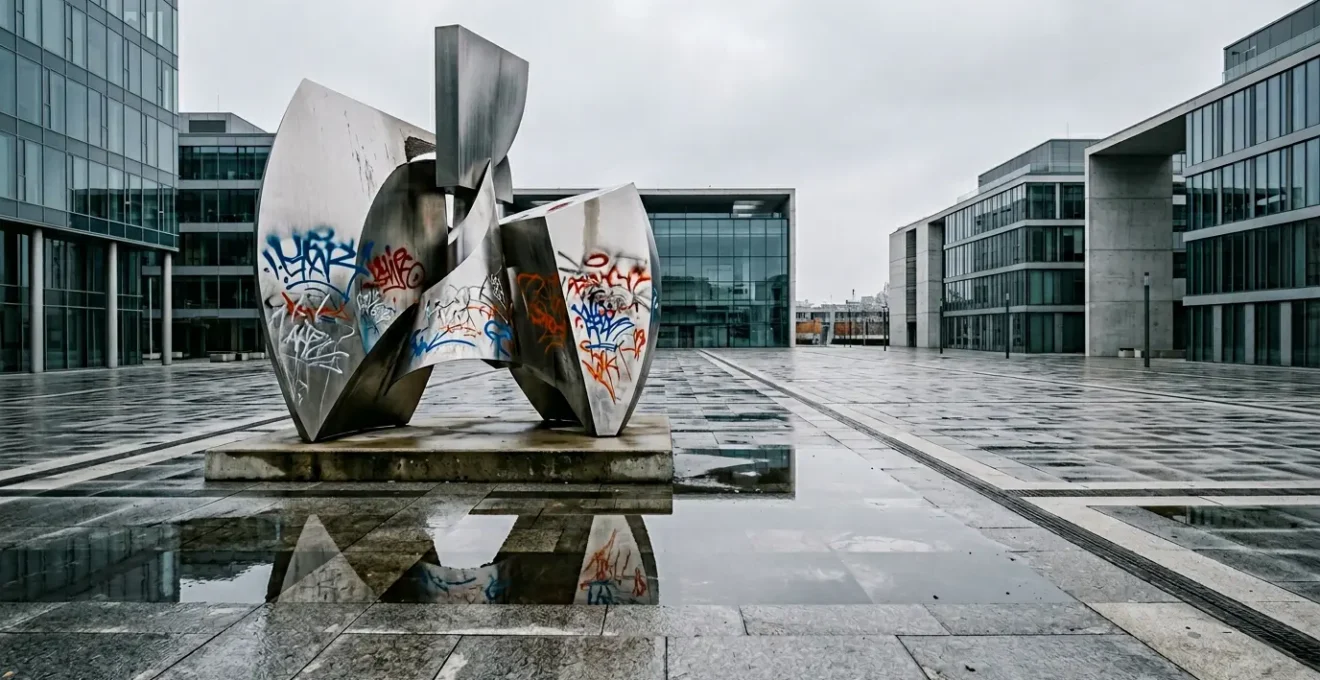
Vandalism of public art is not random destruction; it is the final, brutal verdict on a commissioning process that has failed to create community ownership.
- The core risk is not the quality of the art, but the gulf between an imposed object and an integrated community asset.
- Lasting success is achieved not through tougher materials alone, but through processes that build « community guardianship » from day one.
Recommendation: Shift from a ‘deliver and defend’ mindset to a ‘co-create and co-protect’ strategy by embedding community participation throughout the entire project lifecycle.
As a commissioner, there is no worse feeling than the phone call. The one that reports the brand-new, £500,000 sculpture, the culmination of years of planning and fundraising, has been tagged, scratched, or worse, structurally damaged just weeks after its grand unveiling. The immediate reaction is to blame faceless vandals and to call for more robust materials or increased surveillance. We discuss anti-graffiti coatings and tamper-proof fixings. These are necessary conversations, but they address the symptom, not the disease.
The hard truth is that the vulnerability of public art is rarely a simple matter of material science or security patrols. It’s a failure of integration. When a community feels a piece of art has been imposed upon its space, without its voice or consent, that art is perceived not as a gift, but as an invasion. Vandalism, in this context, becomes the most visceral form of critical feedback—a protest against a process that excluded the very people who live with its outcome every single day.
But what if the true solution wasn’t about building fortresses around our art, but about making the community its most fervent guardians? This isn’t about diluting artistic vision in endless committee meetings. It’s about a strategic shift in the commissioning process itself: from delivering a finished product to facilitating a shared journey. It’s about understanding that the process *is* the product.
This article will deconstruct why some artworks become beloved local landmarks while others become expensive liabilities. We will explore the practical strategies and commissioning models that move beyond risk mitigation and actively build the community investment that is, ultimately, the only truly vandal-proof measure.
This guide delves into the critical factors that determine the long-term success and survival of art in public spaces. By examining specific case studies and strategic choices, we will build a framework for commissioning art that not only survives but thrives by becoming a genuine part of the community fabric.
Summary: Why Do £500,000 Public Sculptures Get Vandalised Within Months of Unveiling?
- Why Does a Locally Designed Mural Survive Decades While Imported Sculptures Get Tagged Immediately?
- How to Specify Materials That Survive UK Weather and Determined Vandals?
- 10-Year Commission vs 6-Month Activation: Which Creates More Lasting Community Impact?
- The 18-Month Planning Objection That Bankrupted a Public Art Project
- When to Involve Local Schools in Unveiling: Before Installation or As Surprise Reveal?
- The Exposed Cable Mistake That Cost an Artist £8,000 in Repairs After One Week
- The Safety Blind Spot That Caused 3 West End Near-Misses Last Season
- Why Do Interactive Artworks Generate 5x More Social Media Shares Than Static Pieces?
Why Does a Locally Designed Mural Survive Decades While Imported Sculptures Get Tagged Immediately?
The core difference between an artwork that is cherished and one that is defaced is a sense of ownership. A mural designed and painted with the help of local residents is not just a piece of art; it’s a collective memory, a shared achievement. It belongs to them. An « imported » sculpture, no matter how artistically significant, can feel like an alien object dropped into a community’s space without context or consent. This lack of connection creates a vacuum where resentment can grow, and the art becomes a target.
This isn’t just anecdotal. Meaningful community engagement is a powerful deterrent to antisocial behaviour. When residents are involved in the creation of public art, they become its natural custodians. As the San Jose Public Art Program notes in its review of successful projects, this involvement is not a ‘nice-to-have’ but a critical factor for longevity. As they state, « Community engagement is a key component to a successful public art project. Their engagement in development of a public artwork can equate to the long-term success of the project. » This engagement transforms passive bystanders into active stakeholders.

The evidence shows this has a tangible impact beyond the artwork itself. Far from being just about aesthetics, research demonstrates that neighbourhoods with new, community-engaged public art often report a significant decrease in vandalism and other petty crimes. The art becomes a symbol of civic pride and a catalyst for positive change. The process of creation builds social capital, strengthens neighbourhood ties, and establishes a powerful form of community guardianship that no security camera can replicate.
How to Specify Materials That Survive UK Weather and Determined Vandals?
While community integration is the best long-term defence, we cannot be naive. Art in the public realm exists in a hostile environment, subject to everything from the relentless UK rain to the determined efforts of a vandal with a spray can. Specifying for resilience is a non-negotiable part of a commissioner’s duty of care. This goes beyond simply choosing « strong » materials; it requires a forensic approach to every component and a realistic plan for maintenance.
The goal is twofold: make the artwork difficult to damage and easy to clean. This means thinking about surfaces, fixings, and response times. An anti-graffiti coating is useless if it’s applied to a material that can be easily scratched or broken. Similarly, robust construction is undermined if a tag remains visible for weeks, acting as an open invitation for more. The key is to deny the vandal the satisfaction of a lasting mark. A case in point comes from conservation specialists working on London’s historic monuments who found that swift tag-removal programs quickly discourage repeat offenders. When the « fame » of their tag is gone in hours, the purpose of the act is nullified.
Therefore, a robust specification must be a holistic system, not just a list of materials. It should dictate not only the physical components but also the operational response to an incident. A well-drafted specification is the commissioner’s primary tool for ensuring quality, managing risk, and protecting the public’s investment from both the elements and human nature.
Your Vandal-Resistant Specification Framework:
- Specify high-quality materials: aluminum, polycarbonate, high-pressure laminate (HPL), and stainless steel for durability against impact and scratching.
- Include anti-graffiti coatings that create smooth, non-porous surfaces allowing paint and markers to be wiped away with standard cleaning products.
- Implement tamper-resistant fixings using pin hex, sentinel or clutch-head designs that require specialized tools to remove.
- Incorporate IP68-rated waterproof enclosures for any electronic components to withstand UK weather conditions.
- Establish a 24-hour graffiti removal Service Level Agreement (SLA) to deny vandals the satisfaction of visibility.
10-Year Commission vs 6-Month Activation: Which Creates More Lasting Community Impact?
The traditional model of public art commissioning often favours the « monument »: a permanent, high-cost installation intended to last for decades. While this approach can create iconic landmarks, it also carries significant risk. A permanent commission that fails to connect with the community is a very public and very expensive failure, a constant source of local friction. There is, however, an alternative and increasingly vital approach: the temporary activation.
A six-month temporary installation offers a lower-risk, higher-engagement way to test ideas, themes, and locations. It acts as a live prototype, allowing commissioners and artists to gauge public reaction and build relationships before committing to a permanent legacy. This model shifts the focus from a single, high-stakes delivery to an ongoing conversation. It allows for more experimentation and, crucially, builds trust by showing the community their feedback has real-world consequences. If an activation is beloved, it builds a powerful case for a permanent version. If it’s met with indifference or hostility, it can be removed with minimal cost and valuable lessons learned.
This isn’t about avoiding ambition; it’s about being smarter with resources and de-risking the creative process. The true cost of a permanent work isn’t just the initial budget; it’s the lifecycle accountability, including decades of maintenance, insurance, and eventual decommissioning, which can often double the upfront cost. As an analysis of public participation in art highlights, temporary projects foster a different kind of relationship.
| Criteria | 10-Year Permanent Commission | 6-Month Temporary Activation |
|---|---|---|
| Community Engagement | Limited to planning phase and unveiling | Ongoing participation throughout creation and installation |
| Lifecycle Cost | Initial budget + 20-year maintenance + insurance + eventual decommissioning (often doubles initial cost) | Predictable end-of-life cost (removal and site restoration) |
| Community Ownership | Often perceived as imposed by external authority | Builds trust and sense of co-creation |
| Risk of Vandalism | Higher due to lack of community investment | Lower when community members are active participants |
| Adaptability | Fixed design, difficult to modify based on community feedback | Allows testing of themes before permanent commitment |
The 18-Month Planning Objection That Bankrupted a Public Art Project
The most significant threat to a public art project may not be a vandal with a spray can, but a resident with a well-founded planning objection. The cautionary tale of projects derailed by community opposition is a familiar one in our field. An 18-month delay caused by a planning challenge can escalate costs, exhaust funding, and ultimately bankrupt an entire initiative before a single spade breaks ground. This is a classic feedback loop failure, where the formal planning process becomes the first, and most expensive, time a community’s voice is truly heard.
These objections rarely arise from a simple dislike of art. They are often rooted in legitimate concerns about location, scale, public access, or a perceived lack of consultation. When the community feels the project is happening *to* them, not *with* them, they will use the tools at their disposal to stop it. This turns a creative endeavour into an adversarial legal battle, draining resources that should be spent on the art itself. The financial implications are stark.
The cost of conflict is always higher than the cost of collaboration. When a project is mired in objections, legal fees mount, and the eventual repair bill for any subsequent vandalism feels like pouring salt in the wound. Indeed, data from London councils reveals that authorities spent between £20-30 million removing graffiti over just five years. This is money that could have been invested in more inclusive commissioning processes. Proactive, genuine, and early-stage engagement isn’t just good public relations; it’s the most effective form of financial risk management a commissioner can deploy.
When to Involve Local Schools in Unveiling: Before Installation or As Surprise Reveal?
The question isn’t whether to involve local youth, but how and when to do it for maximum impact. A surprise reveal, while potentially exciting, positions children as passive spectators. Involving them long before the installation, however, transforms them into active participants and, ultimately, the artwork’s most passionate protectors. The process of creation instills a profound sense of ownership that a simple unveiling ceremony can never hope to match.
Case Study: Philadelphia’s Mural Arts Program Youth Development Model
Philadelphia’s Mural Arts Program, established in 1984, provides a masterclass in this approach. It is not merely about painting walls; it’s a youth development program. By engaging young people in workshops months before a mural is painted, the program transforms them from passive observers into what they call ‘Junior Guardians’. These young people learn skills, contribute to the design, and develop a deep connection to the artwork. As a result, they actively protect and advocate for the murals in their neighbourhoods, dramatically reducing instances of vandalism.
This sense of personal investment is a powerful force. When an artwork is damaged that you helped create, it’s not an attack on public property; it’s a personal affront. A San Jose Public Art Program Collection Manager shared a powerful story that illustrates this perfectly, after a community mosaic was vandalised:
Community members came to me and expressed how upset they were about the damage. They told me about their experience working with the artist and how they contributed pieces of porcelain and tile from their own homes for the mosaic. This type of dedication depicts the role that public art can play in the development of civic pride and care for one’s environment.
– San Jose Public Art Program Collection Manager, Five Lessons Learned for a Successful Public Art Project
The lesson is clear. To cultivate community guardianship, we must involve them from the beginning. The unveiling should not be the introduction; it should be the celebration of a shared journey.
The Exposed Cable Mistake That Cost an Artist £8,000 in Repairs After One Week
Even with full community support, an artwork can fail due to technical oversight. The public realm is an unforgiving environment, and the story of the interactive sculpture with exposed cabling that was destroyed within a week is a painful but necessary lesson. The £8,000 repair bill was not the result of malicious, determined vandalism, but of casual, opportunistic misuse. A loose cable is an invitation to be pulled. A fragile component is a challenge to be tested. When specifying technical or interactive artworks, we must design for reality, not for a respectful gallery audience.
This means adopting a « hostile environment » mindset during the design and fabrication phase. Every component, from the smallest screw to the main power feed, must be considered a potential point of failure. The artist’s vision for how the public *should* interact with the piece is irrelevant if the design doesn’t account for how they *might* interact with it. This involves specifying military-grade components, conducting destructive testing on prototypes, and, crucially, defining liability clearly in contracts between the artist, fabricator, and commissioner.
The financial consequences of technical failure are immediate and severe, not just in repair costs but also in reputational damage. An artwork that is constantly « out of order » quickly becomes a public joke and a symbol of a poorly managed project. A robust technical specification is not an optional extra; it is the fundamental insurance policy for any piece that incorporates light, sound, or interactive elements.
Hostile Environment Specification Checklist for Interactive Art:
- Specify IP68-rated waterproof enclosures for all electronic components as baseline requirement, not optional upgrade.
- Require armoured conduit for all cabling, even if components are concealed within the sculpture structure.
- Implement tamper-proof fasteners using specialized security screws that cannot be removed with conventional screwdrivers.
- Conduct destructive testing on prototype vulnerable components before final fabrication – physically attempt to pull, kick, and break connections.
- Define liability clearly in contracts between artist and fabricator for integration of technical systems and their resilience.
The Safety Blind Spot That Caused 3 West End Near-Misses Last Season
Standard safety checks and risk assessments are an integral part of any public project. However, they often focus on the *intended* use of a space or object. The critical blind spot for public art commissioners is failing to conduct an ‘unintended use’ risk assessment. We must ask not just « Is it safe? » but « How could this be misused to make it unsafe? » This requires a shift in thinking, from the perspective of a responsible user to that of a thrill-seeker, a drunk, or a curious child.
As one Public Monument Conservation Specialist bluntly puts it, this is the key to preventing foreseeable accidents:
Standard safety checks look for intended use risks. The blind spot is ‘unintended use’. A risk assessment must ask: ‘How could a child, a drunk person, or a thrill-seeker misuse this sculpture?’
– Public Monument Conservation Specialist, Repairing Public Monuments and Sculpture
This perspective is crucial. A sculpture with a tempting foothold might become a climbing frame. A slender, elegant element might be used as a lever. The famous Shaftesbury Memorial in London, popularly known as Eros, provides a recurring case study. Every year, it is scaled by climbers, often resulting in damage to the delicate bowstring. Each repair is a costly reminder of the need to anticipate and design against such foreseeable misuse. The three near-misses in the West End last season were not unforeseeable accidents; they were failures of imagination in the planning stage.
An ‘unintended use’ assessment isn’t about stifling creativity. It’s about ensuring the longevity and safety of the artwork and the public. By identifying and designing out potential hazards—weak points, climbing holds, sharp edges—we protect not only the public but also the artwork itself from the damage that inevitably results from such misuse. This proactive approach is a hallmark of a professional and responsible commissioner.
Key takeaways
- Vandalism is a form of feedback on a failed community integration process, not a random act.
- Proactive community engagement and co-creation are more effective deterrents than reactive security measures.
- Specifying for a ‘hostile environment’ and conducting ‘unintended use’ risk assessments are essential for technical and physical longevity.
Why Do Interactive Artworks Generate 5x More Social Media Shares Than Static Pieces?
In the digital age, the success of public art can also be measured by its « shareability. » While this may seem like a superficial metric, it’s a powerful indicator of genuine public engagement. A static sculpture may be admired, but an interactive piece that responds to presence, touch, or sound invites participation. It creates a personal experience, a story. And people don’t share art; they share their stories.
This is the fundamental difference. As an Experience Design Specialist explains, « Interactive art makes the viewer the protagonist of the story. A share is not just ‘look at this art’, it’s ‘look at what I did’. Static art makes the viewer a passive observer; interactive art makes them a co-creator. » This shift from passive observation to active co-creation is what fuels the exponential growth in social media shares. The artwork becomes a stage, and every visitor has the chance to be the star.
Case Study: Urban Grove’s Social Media Impact
The ‘Urban Grove’ installation in Boston’s Seaport District is a prime example. Its reflective canopies and colour-changing lights create a dynamic environment that encourages visitors to linger, play, and capture the moment. According to an analysis of its impact, its inherent three-act structure (approach, interaction, result) makes it incredibly shareable. It has become a destination, drawing people to the area and deepening their connection to the space, all documented through thousands of unique images shared online.

For commissioners, this represents a powerful opportunity. An artwork that generates this level of organic promotion becomes a significant asset to the area, driving footfall and creating a positive online identity. It demonstrates a return on investment that goes far beyond the physical object, contributing to the economic and social vitality of the place. By commissioning art that invites interaction, we are not just installing a sculpture; we are creating a platform for a million shared moments.
By shifting our focus from imposition to integration, from materials to relationships, we can commission public art that is not only respected but actively protected by the community it serves. The ultimate goal is to create works that are so deeply woven into the fabric of a place that the idea of vandalising them would be unthinkable to the local population. That is the true measure of a successful commission.