
Collector’s remorse is rarely a failure of personal taste; it’s a predictable outcome of misunderstanding the opaque financial systems that govern the contemporary art world.
- Market hype is a poor indicator of long-term value, with many trending artists seeing their secondary markets collapse entirely.
- The perceived value of an artwork is heavily manipulated by whether it’s sold through a gallery, which nurtures an artist’s career, or an auction, which prioritizes transaction volume.
Recommendation: Your best defence is to become critically discerning. Learn to decode the market’s structural pitfalls before you acquire your next piece, prioritising artists with proven gallery support over speculative auction darlings.
There is a pervasive and costly myth in the art world: that the key to collecting is simply to « buy what you love. » It is a romantic notion, but one that wilfully ignores the brutal market mechanics that lead a staggering number of enthusiasts to regret their acquisitions. You may have experienced it yourself: the thrill of acquiring a piece by a celebrated emerging artist, only to find its value, and the conversation around it, evaporate within a few short years. This feeling is not an indictment of your eye, but a symptom of a market rife with asymmetric information, where the interests of galleries, auction houses, and speculative investors often conflict with those of the long-term collector.
The common advice—to « do your research » or « visit art fairs »—is hopelessly generic. It fails to address the fundamental structural pitfalls of the contemporary art ecosystem. What does research mean when an artist’s primary gallery price is deliberately inflated? How do you assess value when a work’s auction performance can be manipulated? The real challenge is not developing your taste, but understanding the often-contradictory economic engines that determine an artwork’s trajectory from an artist’s studio to its place on your wall, and, crucially, its potential viability on the secondary market.
This article will not tell you what to love. As your advisor, my role is to protect you. I will dismantle the systems that cause buyer’s remorse by exposing the hidden incentives at play. We will move beyond platitudes and dissect the difficult questions: why hot artists crash, how to distinguish gallery value from auction hype, and when to trust—or dismiss—the documentation that accompanies a work. The goal is to equip you with a framework for critical discernment, enabling you to build a collection that is not only personally meaningful but also intelligently assembled.
To navigate this complex landscape, this guide breaks down the critical pressure points where collectors most often make regrettable decisions. The following sections provide a clear-eyed analysis of the market’s inner workings.
Summary: Why Collectors Regret Contemporary Art Purchases
- Why Does That Artist Everyone Collected Last Year Now Have No Secondary Market?
- How to Define What You Actually Want to Live With Before Entering a Gallery?
- Gallery Purchase vs Auction Bid: Which Offers Better Value for Emerging Artists?
- The Certificate of Authenticity That Turned Out to Mean Nothing Legally
- When to Focus Your Collection: Early Commitment or Breadth Before Depth?
- Why Did a JPEG Outsell a Francis Bacon Sketch at Phillips Last Autumn?
- Why Does Selling £200,000 of Art Still Leave Your Gallery Unprofitable?
- Why Do Auction Houses Now Value Post-Internet Art Higher Than Late Modernist Paintings?
Why Does That Artist Everyone Collected Last Year Now Have No Secondary Market?
The most common path to collector’s remorse begins with the speculative frenzy around an « it » artist. You see their work everywhere—at fairs, on social media, in glossy magazines. Prices climb rapidly. Then, just as quickly, the silence becomes deafening. The artist’s name vanishes from auction catalogues, and their gallery quietly removes them from the roster. This is not an accident; it is a feature of the ultra-contemporary market, which is fuelled by speculation rather than stable, long-term demand. The market for artists with less than a decade of career history is notoriously volatile.
This phenomenon is driven by what is known as price discovery. In the primary market, a gallery sets an artist’s prices. In the secondary market (auctions), the market itself decides the price. When speculators, often called « flippers, » acquire hot works and immediately consign them to auction, they force a public valuation. If the work fails to sell or sells for less than its primary price, the artist’s market is « burned. » Confidence evaporates, and collectors holding their work are left with pieces that are virtually unsellable. According to Bank of America’s Spring 2025 Art Market Update, the recent cooling of the market has been severe, with a 71% decline in emerging artist auction sales to just $101 million, a clear sign that the speculative bubble has burst.
A stark example is the market trajectory of artist Josh Smith. In 2018, his paintings were eagerly acquired from top galleries for around $50,000. By 2024, those same works struggled to find buyers at auction with estimates as low as $20,000. Works that once traded for over $150,000 on the secondary market hammered for a mere fraction of that, illustrating a dramatic and punishing price collapse. This is the direct result of rapid, unsustainable market inflation meeting the unforgiving reality of auction-based price discovery. The lesson is clear: primary market hype is not a reliable indicator of secondary market viability.
How to Define What You Actually Want to Live With Before Entering a Gallery?
Before you are influenced by a gallery director’s compelling narrative or the red dots of a sold-out show, the most crucial act of self-protection is to define your own collecting vision. Entering the art market without a clear sense of your own aesthetic and intellectual criteria is like navigating a storm without a compass. The goal is not to predict trends but to build a collection so personally resonant that market fluctuations become a secondary concern. This process of self-discovery requires a deliberate, almost meditative, engagement with art, far from the transactional pressures of a commercial space.
The first step is to immerse yourself in art without the intent to buy. Visit museums, non-profit spaces, and university exhibitions. The more you see, the more your eye will become attuned to subtleties of form, material, and concept. Ask yourself critical questions: What themes consistently capture my attention? Am I drawn to figuration or abstraction? Do I prefer work that is political, poetic, or purely formal? This foundational knowledge builds your « visual library » and empowers you to make confident choices that align with a genuine, personal vision rather than fleeting market fads. It is about shifting from a reactive mindset (« What’s popular? ») to a proactive one (« What speaks to me? »).
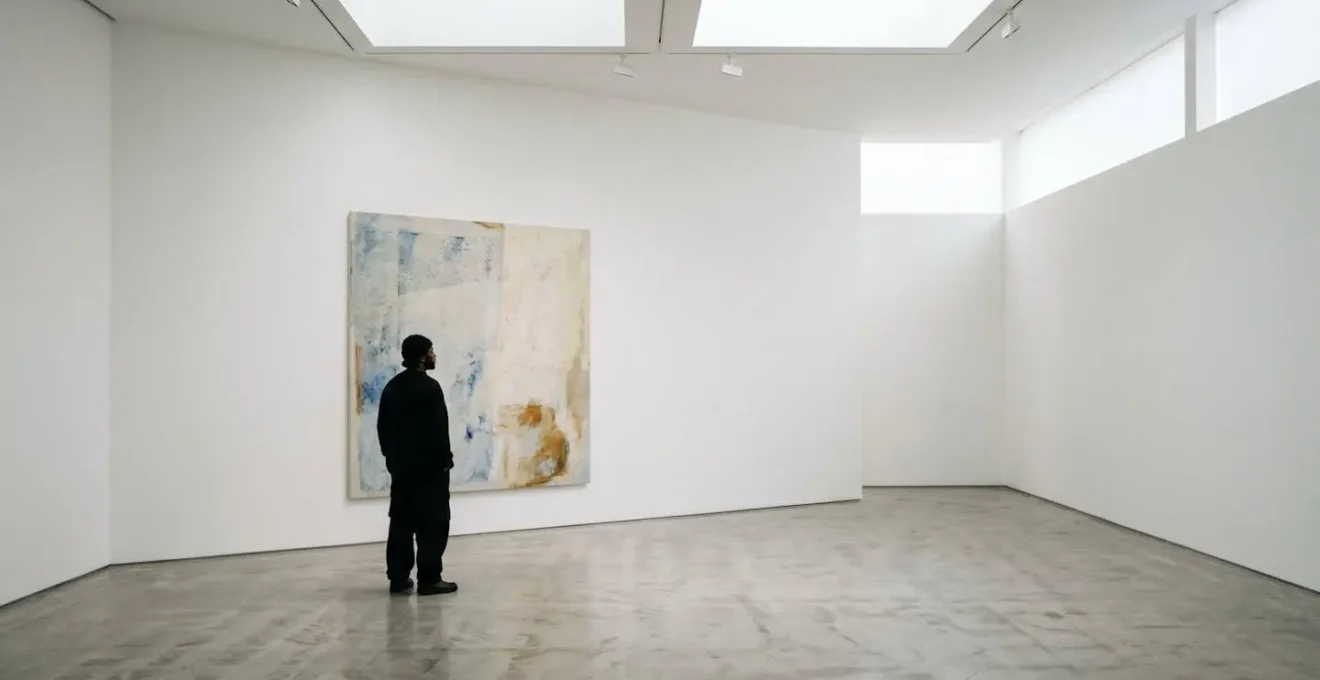
This quiet contemplation, as depicted in the serene gallery space, is the true starting point. It is in these moments, away from the sales pitch, that you can distinguish between a piece you admire and a piece you must live with. A work of art should be a long-term conversation partner. When you find a piece that continues to challenge and engage you long after the initial encounter, you are moving from mere acquisition to true collecting. This deep, personal connection is the ultimate hedge against buyer’s remorse.
Your Pre-Acquisition Audit: A 5-Step Plan
- Visual Immersion: Before considering a purchase, visit at least five different art venues (museums, galleries, non-profits) to inventory the styles, mediums, and themes that consistently resonate with you.
- Motive Interrogation: Write down your primary motivation for acquiring a new piece. Is it to fill a space, join a conversation, support an artist, or for investment potential? Be brutally honest.
- Resonance Test: For any work you are considering, step away for at least one week. If the work does not linger in your mind or you cannot articulate precisely what draws you to it, dismiss it.
- Contextual Research: Investigate the artist’s career beyond the current show. Have they been supported by the same gallery for years? Are they included in museum collections? This indicates institutional support beyond commercial hype.
- Collection Cohesion: Evaluate how the potential new work would interact with your existing collection. Does it create a compelling dialogue, or does it feel like an outlier? Ensure it contributes to a coherent whole.
Gallery Purchase vs Auction Bid: Which Offers Better Value for Emerging Artists?
For an emerging artist, the channel through which you acquire their work is not merely a transactional choice; it is a strategic decision that profoundly impacts the artist’s career and your investment’s stability. The « value » of a piece is not just its price tag. It encompasses the artist’s long-term market health, your relationship with their creative ecosystem, and the hidden costs that differentiate a gallery purchase from an auction win. A common mistake is assuming an auction offers a « deal, » when it often introduces significant risk and higher final costs.
Buying from an artist’s primary gallery is an investment in their ecosystem. The gallery has a vested interest in protecting the artist’s market, carefully placing works with committed collectors and avoiding the kind of speculative flipping that leads to auction burnout. This relationship provides invaluable benefits: early access to new works, invitations to studio visits, and a deeper connection to the artist’s practice. In contrast, an auction is a one-time, anonymous transaction. Winning a bid might feel like a victory, but it severs you from the supportive network that nurtures an artist’s career. Furthermore, if a work fails to sell at auction (a « buy-in »), it creates a public record of failure that can permanently damage the artist’s market. Indeed, research published by the Association for Cultural Economics International shows that works which are bought-in at auction exhibit 14.4% lower total returns over the following seven years compared to those that sell successfully.
The financial argument for auctions is also weaker than it appears. While the hammer price may be lower than a gallery’s list price, the final cost is inflated by the buyer’s premium (often 25% or more), taxes, and potential Artist’s Resale Right (ARR) fees. As the following comparison demonstrates, a work won at auction can easily end up being more expensive than one purchased directly from a gallery, without any of the long-term strategic benefits.
| Purchase Channel | Initial Cost (£15,000 work) | Hidden Costs | Long-term Value | Relationship Benefits |
|---|---|---|---|---|
| Gallery Purchase | £15,000 (potential 5-10% discount) | None | Gallery protects artist market, prevents auction burn-out | Access to future works, studio visits, artist ecosystem entry |
| Auction Purchase | £12,000 hammer + £3,000 buyer’s premium (25%) + VAT + potential ARR | Final cost ~£16,000-£17,000 | Risk of ‘burning’ artist if work fails to sell; bought-in works show 14.4% lower returns over 7 years | None – one-time transaction with no future gallery access |
The Certificate of Authenticity That Turned Out to Mean Nothing Legally
One of the most misunderstood documents in the art world is the Certificate of Authenticity (COA). Many collectors, particularly those new to the market, place immense faith in this piece of paper, viewing it as a quasi-legal guarantee of a work’s legitimacy and value. This is a dangerous misconception. In the traditional art market, a COA is often little more than a sales receipt with a fancy signature. Its legal standing is tenuous at best and, unless issued directly by the artist’s official estate or a recognised catalogue raisonné committee, it can be functionally meaningless.
The problem is a lack of standardisation. A COA can be issued by the artist, the gallery, a publisher, or a self-proclaimed « expert. » Without a clear, unbroken chain of ownership (provenance), the certificate itself proves very little. Forgeries of both artworks and their accompanying certificates are common. A discerning collector must learn to treat a COA with scepticism, understanding that it is only one component of due diligence. The real cornerstones of authenticity are irrefutable provenance, inclusion in the artist’s official catalogue raisonné, and, when necessary, forensic and material analysis. The paper is a clue, not the conclusion.

Interestingly, the rise of digital art and NFTs has thrown this issue into sharp relief by offering a different model of verification. While the NFT market has its own significant problems with fraud and volatility, its underlying technology provides a potential solution to the ambiguity of the traditional COA. As the advisory firm Picture Perfect Portfolios notes in its analysis of the new collectible landscape:
The blockchain immutably records each transaction from the moment of minting. Checking an NFT’s contract address, transaction history, and the wallet that minted it can confirm authenticity. Yet the token itself is easily traceable, so verifying the official origin is simpler if the artist publicly identifies their official minting address.
– Picture Perfect Portfolios, NFT vs. Traditional Artwork analysis
This technological approach highlights the core weakness of the paper-based system: its reliance on trust in intermediaries rather than on a verifiable, transparent ledger. For physical works, the lesson is to value strong provenance over a simple certificate.
When to Focus Your Collection: Early Commitment or Breadth Before Depth?
A fundamental strategic question every collector faces is how to structure their acquisitions. Should one go deep, committing early to a few select artists and growing with them? Or should one go broad, acquiring single works from a wider range of artists to build a diverse survey of a particular movement or period? There is no single correct answer, but the choice has significant implications for both the intellectual coherence and financial health of your collection, especially in a market that is increasingly risk-averse.
The « breadth before depth » approach is often appealing to new collectors. It allows for exploration and reduces the risk of betting heavily on an artist whose market may falter. Acquiring representative pieces from various artists can create a fascinating dialogue within a collection, capturing the zeitgeist of a specific moment. However, this strategy can also lead to a disjointed assembly of « one-hit wonders » that lacks a core identity. While a recent Art Basel/UBS survey found that 52% of recent art spending goes to emerging artists, this high-level figure masks a flight to perceived quality within that category.
The alternative, « depth over breadth, » involves a more significant commitment. It means identifying an artist you believe in and acquiring their work across different periods, mediums, and series. This approach allows you to build a truly comprehensive, museum-quality holding of that artist’s practice. When successful, it can be exceptionally rewarding, both intellectually and financially. You become a true patron and an expert on that artist. The risk, of course, is that you have placed a significant bet on a single career. In today’s cautious climate, many seasoned collectors are hedging this risk by focusing on artists who have already demonstrated some secondary market resilience. As one market analysis succinctly puts it:
Collectors making safer bets. We expect buyers to continue finding comfort in artists with an established secondary market.
– Bank of America Art Market Update, Art Market Update Spring 2025: Trends to Watch and Analysis
Ultimately, the wisest strategy may be a hybrid approach: start with breadth to educate your eye and identify your passions, then pivot to depth by committing to the one or two artists who truly resonate with your long-term vision.
Why Did a JPEG Outsell a Francis Bacon Sketch at Phillips Last Autumn?
The moment a digital file—a JPEG—sold at auction for more than a work by a 20th-century master like Francis Bacon was a watershed. For many, it signalled an irrational, nonsensical market. For a new generation of crypto-native collectors, it was a logical validation of a new value system. Understanding this event is crucial to grasping the cultural and economic shifts that can suddenly re-order the art market, creating new categories of « masterpieces » while leaving others behind.
The phenomenon was driven by the rise of Non-Fungible Tokens (NFTs), which used blockchain technology to create verifiable scarcity for digital assets. The most famous example was the sale of Beeple’s digital collage ‘Everyday: The First 5000 Days’ at Christie’s in March 2021 for a staggering $69 million. This sale was not about aesthetics in the traditional sense. It was about several converging factors: a huge influx of new wealth from the cryptocurrency boom, a desire for assets native to the digital world, and a value system based on on-chain provenance and cultural relevance within the crypto community, rather than traditional art historical significance.
However, what goes up in a speculative bubble must come down. The excitement of 2021 was followed by a dramatic crash. The Art Basel and UBS Art Market Report 2024 documented a precipitous fall in the NFT market, which collapsed from a peak of $2.9 billion in 2021 to $1.2 billion in 2023. This market correction demonstrates a classic cycle of hype, speculation, and disillusionment. The fact that a JPEG could outsell a Bacon sketch was a temporary anomaly driven by a massive transfer of wealth into a new, unregulated asset class. It did not signify the end of traditional art’s value, but rather the birth of a volatile, parallel market whose rules were still being written. For collectors, it serves as a powerful lesson in distinguishing between durable cultural value and fleeting speculative mania.
Why Does Selling £200,000 of Art Still Leave Your Gallery Unprofitable?
Understanding a gallery’s business model is not an academic exercise; it is a vital piece of intelligence for any serious collector. When you know the immense financial pressures a gallery faces, you can better interpret their sales tactics, understand their pricing strategies, and appreciate the true value of their support for an artist. The perception is often of a high-margin luxury business, but the reality for most galleries, even those with prime locations and impressive sales figures, is a precarious existence.
The core of the issue lies in the split between revenue and operating costs. A gallery’s primary income is its commission on sales, which is typically a 40-50% split with the artist. This means that from £200,000 in gross sales, the gallery’s net revenue is only £100,000. From this amount, it must cover an astonishing array of fixed costs: exorbitant rent in a desirable arts district, staff salaries, insurance, shipping, marketing, and the crippling expense of participating in international art fairs, which can cost tens of thousands of pounds for a single booth.
When these costs are tallied, the profit margin shrinks dramatically or disappears entirely. Many galleries operate at a loss for years, subsidized by a wealthy owner or relying on the occasional blockbuster sale of a blue-chip secondary market work to stay afloat. This economic reality explains why galleries are so protective of their artists and why they prioritize placing work with collectors they believe will be long-term custodians, not short-term speculators. They simply cannot afford to have an artist’s market destabilised. For the collector, this knowledge is power. It transforms the gallery-collector relationship from a simple buyer-seller dynamic into a strategic alliance built on a shared interest in sustaining the artist’s career.
| Revenue/Expense Category | Amount (£) | Percentage | Notes |
|---|---|---|---|
| Gross Sales | £200,000 | 100% | Total artwork sold |
| Artist Split (50%) | -£100,000 | -50% | Standard artist commission |
| Gallery Net Revenue | £100,000 | 50% | Before operating expenses |
| Rent (annual) | -£60,000 | 30% | Prime location gallery space |
| Staff Salaries | -£30,000 | 15% | Gallery assistants, curator |
| Advertising & Marketing | -£19,400 | 9.7% | Essential for visibility |
| Insurance & Utilities | -£8,000 | 4% | Protection and operations |
| Operating Loss | -£17,400 | -8.7% | Before art fair costs |
Key Takeaways
- Collector’s remorse is often caused by structural market issues, not poor personal taste. Understanding these systems is your best defence.
- Distinguish between primary market hype (gallery-driven) and secondary market viability (auction-proven). They are not the same.
- Buying from an artist’s primary gallery is a strategic investment in their career ecosystem, offering benefits far beyond the single transaction.
Why Do Auction Houses Now Value Post-Internet Art Higher Than Late Modernist Paintings?
The art market is not a static monolith; it is a dynamic ecosystem where tastes, values, and power structures are in constant flux. A significant recent shift has been the re-evaluation of artistic periods, with auction houses sometimes placing higher estimates on works by « Post-Internet » artists (those whose practice is shaped by the digital age) than on classic paintings by late Modernist masters. This is not necessarily an objective judgment of artistic merit, but rather a reflection of powerful demographic and cultural shifts among the collector base.
The primary driver is a generational transfer of wealth and taste. Younger high-net-worth collectors, who grew up online, have a different cultural frame of reference. They are often more intellectually and aesthetically engaged by art that grapples with digital identity, network culture, and new media than by the formal concerns of mid-20th-century painting. Auction houses, ever responsive to where the money is, adjust their valuations and marketing to cater to this new clientele. They create new collecting categories and build narratives around them to stimulate demand, effectively shaping what is considered « important » for the next generation.
This has created a bifurcated market. While the established, older collector base continues to provide a stable foundation for Modern and Post-War art, the « hot » growth area has shifted to the ultra-contemporary. This has led to a more cautious and discerning market, where the appetite for unproven talent has diminished. As one art dealer noted in a recent market report:
Existing young collectors are no longer buying paintings. With the bursting of the contemporary art bubble, there is a high reliance on older collectors who prefer Modern and Post-War art… Now everyone wants to buy someone they’ve already heard of. The appetite for the unknown isn’t there anymore.
– Anonymous art dealer, Art Basel & UBS Global Art Market Report 2025
For a collector, this means being aware of which market you are participating in. Are you investing in the established history of Modernism, or are you engaging with the more volatile but culturally immediate world of Post-Internet art? Understanding this shift is key to aligning your collection with a coherent vision and avoiding being caught on the wrong side of a major market re-evaluation.
Navigating the contemporary art market requires more than a good eye; it demands a critical understanding of the systems that dictate value. By moving beyond the myth of « buy what you love » and equipping yourself with a discerning, analytical framework, you transform from a passive buyer into a strategic collector, building a collection that is both a source of enduring personal joy and a testament to intelligent acquisition.