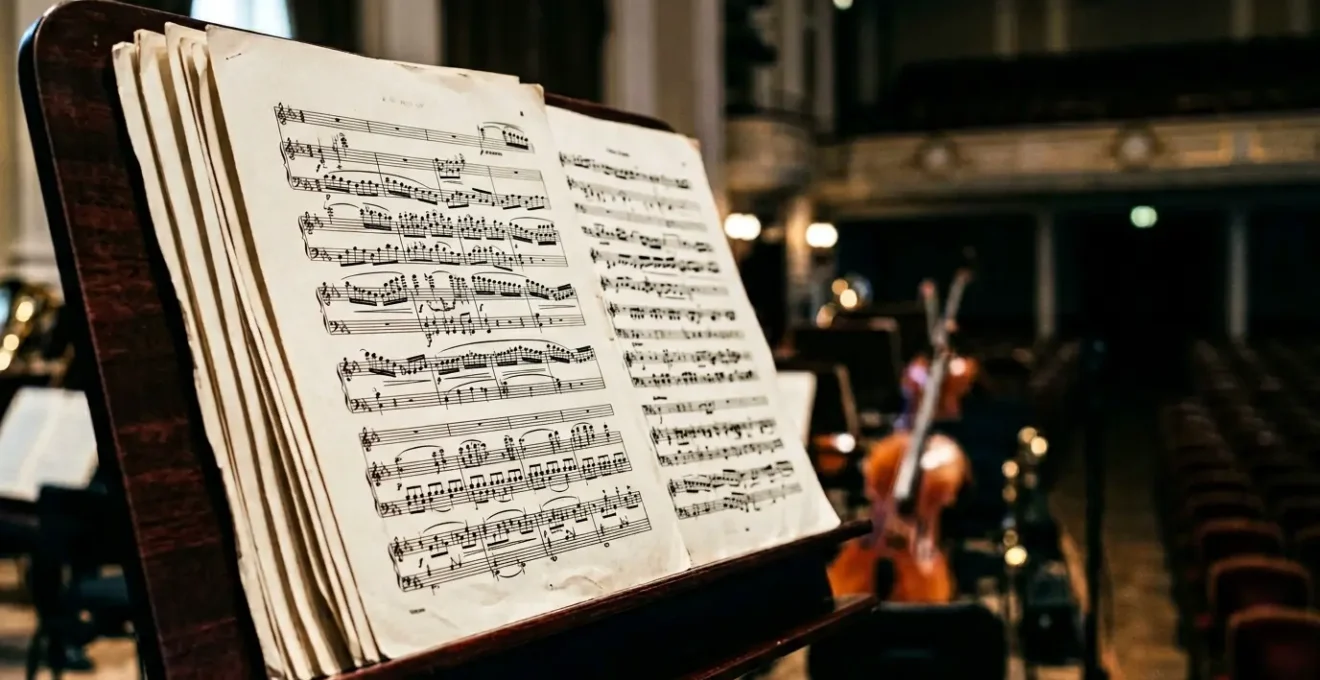
Orchestral fullness is not achieved by adding more instruments; it is achieved by using fewer, more intelligently.
- Poor interval choices and register placement cancel out timbres, creating a homogenous, « grey » sound rather than a rich one.
- Professional texture relies on separating musical roles (melody, harmony, rhythm) and using advanced techniques like dovetailing, not constant « tutti » scoring.
Recommendation: Shift your focus from how many instruments are playing to what each instrument is uniquely contributing to the overall sonic architecture.
You’ve spent weeks hunched over your DAW or manuscript paper, meticulously crafting a 60-instrument orchestral piece. You hit play, expecting a wall of sound that rivals a professional film score, but instead, you’re met with a sound that is congested, undefined, and paradoxically thin. Despite the large forces at your disposal, the result lacks the power, clarity, and richness you hear in the works of masters. This is a deeply frustrating and common experience for emerging composers. The instinct is often to add more layers, to double more parts, convinced that quantity will eventually produce the desired quality.
The standard advice you’ve likely encountered— »study Ravel, » « write idiomatically, » « balance your sections »—is not wrong, but it’s incomplete. It tells you *what* to do, but not *why* it works or, more importantly, why your current attempts are failing. These generic maxims overlook the fundamental principles of psychoacoustics and textural construction that separate student-level work from professional orchestration. The problem isn’t a lack of notes or instruments; it’s a lack of textural intelligence.
But what if the solution was not additive, but subtractive? What if the key to a full, rich sound lies in a more disciplined, almost minimalist approach to allocating your orchestral resources? This article will deconstruct the common traps that lead to thin-sounding scores and reveal the underlying principles that govern professional orchestral texture. We will move beyond superficial rules to explore the mechanics of timbral blending, register, voicing, and role allocation. By understanding these concepts, you can transform your orchestrations from a crowded tutti into a vibrant and powerful sonic tapestry.
This guide breaks down the core issues faced by developing orchestrators, providing practical analysis and solutions for each. The following sections will equip you with the score-analytical mindset needed to build truly powerful textures.
Summary: Deconstructing the Thin Orchestral Score
- Why Does Doubling the Melody in Thirds Not Double Its Impact?
- How to Compose Idiomatic String Parts If You Have Never Held a Violin?
- Listening First vs Score-Reading First: Which Approach Improves Orchestration Faster?
- The Everyone-Plays-Everything Trap That Makes Student Orchestras Sound Like Brass Bands
- When to Accept an Orchestra Commission: After 10 Chamber Works or When the Offer Arrives?
- The Hidden Fifth Motion That Flags Your Arrangements as Student-Level to Professionals
- Why Does Thick Paint Absorbs Light Instead of Reflecting It in Amateur Work?
- Why Does Your Chord Progression Sound Like Every Pop Song Despite Using Complex Voicings?
Why Does Doubling the Melody in Thirds Not Double Its Impact?
A common student instinct to « thicken » a melodic line is to double it in parallel thirds or sixths. On paper, it seems logical: two notes instead of one should equal more impact. In reality, this often creates a sound that is weaker and more dated, robbing the melody of its clarity. The reason lies in a psychoacoustic principle called tonal fusion. Our brains do not perceive all intervals equally; some are processed as a single, blended entity, while others are heard as two distinct pitches. Perfect fifths and octaves have the highest degree of tonal fusion, which is why they create powerful, solid-sounding doublings.
Thirds and sixths occupy a peculiar middle ground. They don’t fuse into a single percept, nor do they create the clear dissonance of a second or seventh. As one orchestration community has noted, this can be their strength in certain harmonic contexts. As a discussion on the VI-Control forum points out:
They’re far enough away from the fundamental to avoid tonal fusion (unlike 5ths and their inversion), but still close enough to avoid dissonance (unlike 7ths and their inversion).
– VI-Control orchestration community discussion, Parallel Harmony thread on VI-Control
However, when used to double an entire melodic line, this « in-between » quality works against you. Instead of a stronger melody, you get a « smudged » harmony that lacks the focused power of an octave doubling or the clean texture of a melody over a separate harmonic accompaniment. This effect is not just subjective; a 2024 study involving 235,440 human judgments on tonal fusion confirms that the brain processes these intervals in a fundamentally different way than unisons or octaves. The professional approach is not to « thicken » the melody with harmony, but to support it with a distinct textural layer, giving each element its own space and role.
How to Compose Idiomatic String Parts If You Have Never Held a Violin?
Nothing marks a score as « student-level » faster than unidiomatic writing—passages that are awkward, unrewarding, or physically impossible to play. This is a major source of « thin » sound, as players struggle against the instrument instead of making it resonate freely. While playing every orchestral instrument is impractical, you can develop a deep understanding of their mechanics through targeted study. For the string section, the foundation of the orchestra, this is non-negotiable. You must learn their language.
The key is to move from a pianist’s abstract view of pitch to a string player’s physical reality of fingerings, bowings, and open strings. The same note, a G4, sounds vastly different on a violin’s open G-string versus the D-string or A-string. Each has a unique register timbre and resonance. A professional orchestrator leverages these colours for expressive effect. You can learn to identify them not by playing, but by listening with intent and studying the work of masters who understood the instruments intimately.
Case Study: Bach’s Solo Violin Sonatas as an Idiomatic Model
J.S. Bach’s Sonatas and Partitas for solo violin are the gold standard for idiomatic writing. Works like the Chaconne from Partita No. 2 demonstrate a profound understanding of the violin’s capabilities, using intricate fingerwork, double stops, and arpeggiated chords that exploit the instrument’s full range and resonant properties. By studying how Bach navigates these challenges, a composer learns what is not just possible but also musically satisfying for a professional player, providing a blueprint for effective string section writing.
To bridge the gap between theory and practice, you need a systematic approach to internalising the « feel » of the instrument.
Your Action Plan for Idiomatic String Writing
- Points of Contact: Find a string player at your institution or a local music school. Ask them to play a single note on each of its available strings and listen intently to the change in timbre. Then, have them play a two-octave scale to hear how the instrument’s character shifts across registers.
- Collecte (Inventory): Systematically study the solo repertoire (Bach, Paganini, Ysaÿe) and string-centric orchestral scores (Ravel’s String Quartet, Strauss’s Metamorphosen). Create a « phrasebook » of common, effective gestures: arpeggiations, string crossings, and types of bowing.
- Coherence Check: Compare the professional gestures you’ve collected to your own writing. Are your slurs too long for a single bow? Do your leaps involve awkward string crossings? Confronting these discrepancies is crucial.
- Emotional Resonance: Identify the « signature » sounds of an instrument—the resonant open G on a violin, the cello’s powerful A-string. Audit your work to see if you are using these most resonant and characterful notes for moments of emotional impact.
- Integration Plan: Actively replace generic or « pianistic » passages in your existing scores with the idiomatic figures from your phrasebook. Make this a conscious step in your compositional process.
Listening First vs Score-Reading First: Which Approach Improves Orchestration Faster?
To learn orchestration is to study the work of others, but the method of study is a point of debate. Should you listen to a piece first to get an overall impression, or dive directly into the score to analyse the mechanics? For the emerging composer, the answer is not one or the other, but a strategic, layered combination of both. Each approach develops a different but equally crucial skill. Listening without the score trains your ear to identify textures, balances, and timbral combinations. Reading without listening develops your « inner ear » and your ability to decipher the composer’s intent directly from the page.
A purely analytical, score-first approach can lead to technically correct but musically sterile orchestrations. Conversely, a purely aural approach can lead to a good general « feel » but an inability to replicate specific effects. The most effective method is a cycle of listening, analysing, and internalising, which builds the critical skill of connecting sound to symbol.

The image above captures the essence of this dual process: the tactile connection to the score and the aural tool waiting to provide context. The goal is to eventually not need the headphones—to be able to « hear » the score with your eyes. Professional orchestrators like Thomas Goss advocate for a structured methodology to achieve this.
Case Study: Thomas Goss’s Score-Reading Methodology
Professional orchestrator Thomas Goss recommends a multi-layered approach for students. First, listen and read simultaneously to grasp the overall structure and emotional arc. Then, put the recording aside and analyse specific elements on the page: trace a single instrumental line through the piece, identify all doublings of a specific melody, or analyse the harmonic voicing of a single chord across sections. Finally, the crucial step is to read the score without any audio, letting the notes on the page guide what you hear mentally. This final stage is what develops a true internal orchestral imagination—the ability to predict the sonic outcome of your own writing.
The Everyone-Plays-Everything Trap That Makes Student Orchestras Sound Like Brass Bands
A major cause of thin, or rather, « congested » textures is the « tutti trap »—the tendency for the student composer to have most of the orchestra playing most of the time. The intention is to create a powerful, full sound, but the result is a homogenous, undifferentiated mass. It’s the sonic equivalent of mixing all your paint colours together and getting a muddy grey. It sounds loud, but it lacks power because there is no contrast, no space, and no clarity of function. A professional score achieves power not through constant loudness, but through textural separation and contrast.
Instead of having everyone play the same rhythm, a mature orchestrator assigns clear roles: one family of instruments might handle the melody, another the harmonic support, and a third a rhythmic counterpoint. Furthermore, a continuous musical line is often not given to a single instrument but is passed seamlessly between different instruments or sections. This technique, known as dovetailing, creates a sense of an unbroken line while allowing players to breathe and remain in their most comfortable, resonant registers. It’s a hallmark of sophisticated orchestration that creates a texture feeling far richer and more complex than a simple tutti.
Case Study: Ravel’s Dovetailing Technique
Maurice Ravel, a master of orchestral texture, provides a perfect example of professional dovetailing. In his works, sustained notes or melodic phrases are seamlessly handed off from one instrumental choir to another, often in their optimal overlapping registers. For instance, as detailed in an analysis on Orchestration Online about woodwind dovetailing, a line might pass from a flute to a piccolo in the C6-G6 range. This creates the illusion of a single, superhuman instrument with an endless breath and a continuously shifting timbre. This is textural intelligence in action: distributing the workload to achieve a result that is greater than the sum of its parts and sounds far more expansive than a constant, blocky tutti.
The key takeaway is to think of the orchestra not as a single entity, but as a collection of specialist choirs. Giving each choir a clear, and often separate, function will paradoxically create a fuller and more powerful whole.
When to Accept an Orchestra Commission: After 10 Chamber Works or When the Offer Arrives?
For an emerging composer, the prospect of a first orchestral commission is both thrilling and terrifying. A common question arises: am I ready? Is there a set amount of experience, such as a portfolio of ten chamber works, that one must acquire first? The reality of the profession is often a paradox, as articulated by composer and educator Matthew Nicholl:
You can’t get an orchestral work performed unless you’ve already had an orchestral work performed.
– Matthew Nicholl, The Art and Craft of Writing Music
This « Catch-22 » suggests that you must seize the opportunity when it comes. However, being offered a commission and being ready to deliver a successful piece are two different things. While there is no magic number of prior works, extensive experience with chamber music is arguably the single most important prerequisite. A chamber ensemble is a microcosm of the orchestra. It is the laboratory where you make your mistakes, learn about balance, and master idiomatic writing on a manageable scale.
The experience of writing for smaller groups directly informs your ability to handle larger forces. It’s where you learn firsthand what works under the fingers and in the breath of a real musician. As one composition student astutely described their learning journey:
A composition student at UCLA described their learning path: After studying orchestration with hands-on experience, they emphasized that chamber music serves as a direct testing ground – ‘Your string quartet is a rehearsal for your string section; your wind quintet is a study for your wind choir.’ They noted that by the time they entered university-level orchestration programs, familiarity with what each instrument can do was essential, but the real learning came from immersing in the music of individual instruments through methods, etudes, difficult audition pieces, and solo repertoire.
– Student Composer, via VI-Control forum
So, the answer is nuanced. You should accept the commission when it arrives, because it may not come again. But your readiness to succeed will be directly proportional to the depth of your prior engagement with chamber music. Don’t wait for the commission to start preparing; your preparation is what will earn you the commission.
The Hidden Fifth Motion That Flags Your Arrangements as Student-Level to Professionals
Among the quickest ways for a professional player or conductor to spot an amateur score are fundamental voice-leading errors, particularly parallel fifths and octaves between outer voices. You may have mastered the rules in your four-part harmony exercises, but in the complexity of a 60-staff score, it’s easy to lose track. A common mistake is to treat the orchestra as one giant keyboard, writing block chords where the top note of the violins moves in parallel fifths with the bass note of the cellos and basses. Even if the inner parts are correct, this creates a hollow, archaic sound that undermines the texture’s integrity.
As Mark Gotham states in his « Core Principles of Orchestration, » the solution is to think modularly. You must ensure voice-leading integrity *within* each section before considering the whole. He advises to « treat each section as if it were self-contained. For each section, follow the principles you learned in four-part writing. » This means your string section should function as a coherent, well-voiced chorale, as should your brass and woodwind sections. When you combine these internally-sound modules, you are far less likely to create egregious parallels between the global soprano and bass lines.
Of course, masters can and do break these rules, but they do so for a specific, intended effect. This is the critical difference between a mistake and an artistic choice.
Case Study: Vaughan Williams’s Intentional Parallels
In his « Fantasia on a Theme by Thomas Tallis, » British composer Ralph Vaughan Williams deliberately uses parallel motion to evoke an archaic, modal sound that connects with the piece’s historical roots. A 2024 analysis by music psychologist Richard Parncutt explains how such usage is rooted in both psychoacoustic principles and cultural context. This demonstrates a deep understanding of the rules, allowing the composer to know precisely when and how breaking them will serve a specific artistic purpose. This is fundamentally different from the accidental parallels that arise from a lack of control over the texture.
Before you can break the rules, you must demonstrate their mastery. Scrutinise your reductions and ensure each instrumental choir has clean, independent voice-leading. This discipline is a cornerstone of professional practice.
Why Does Thick Paint Absorbs Light Instead of Reflecting It in Amateur Work?
In painting, an amateur might apply thick, clumpy paint hoping to create a bold, impactful statement. Instead, the clumsy texture absorbs light, resulting in a surface that is dull, heavy, and lifeless. A master painter, by contrast, uses texture—from thin glazes to precise impasto—to control how light reflects, creating luminosity and depth. Orchestration follows the exact same principle. « Thick » writing, characterized by clumsy, unidiomatic, and poorly voiced parts, doesn’t create a bold sound; it absorbs the natural resonance of the instruments, producing a dull and thin sonic result.
This « thick paint » syndrome is most evident in writing that ignores the physical nature of the instruments. As veteran arranger Dave Stewart points out in his definitive series for Sound on Sound magazine, this is a cardinal sin, especially in string writing. Writing a beautiful melody that requires a cellist to leap impossibly between a low and high register in a split second is an example of unidiomatic thinking. The player will manage, but the sound will be strained, thin, and devoid of the instrument’s natural, glorious resonance.
The error most frequently made by novice string arrangers is to write notes that aren’t physically playable on a particular instrument.
– Dave Stewart, Arranging For Strings: Part 1
To make your score « reflect light » instead of absorbing it, you must think like a sculptor, carving out space and ensuring every line is tailored to the instrument playing it. This means understanding fingerings, bowings, and breathing. It means that instead of writing a dense block chord, you might use an open voicing that allows each instrument to vibrate in its most resonant range. Your goal is not to apply a thick layer of notes, but to arrange carefully chosen lines in a way that maximises the inherent timbral beauty of each instrument in the ensemble.
Key Takeaways
- Orchestral power comes from textural contrast and role separation, not from having every instrument play constantly.
- Idiomatic writing that respects an instrument’s physical nature and resonant registers is non-negotiable for a professional sound.
- The « fullness » of a texture is governed by psychoacoustic principles; poor interval choices and voicings can actively cancel out richness, creating a thin sound.
Why Does Your Chord Progression Sound Like Every Pop Song Despite Using Complex Voicings?
You’ve written a harmonically sophisticated chord progression, full of secondary dominants and borrowed chords. Yet, in your orchestral mock-up, it sounds suspiciously like the backing track to a generic pop ballad. This common issue arises when a composer separates harmony from orchestration. The character of a chord progression is defined less by the abstract notes and more by how it is textured and voiced across the ensemble. The same four chords can be either a film score or a pop cliché depending entirely on the orchestration.
The « pop ballad » sound often comes from writing blocky, keyboard-style chords, with all instruments moving in rhythmic unison, typically voiced closely together in their mid-range. This is the default output of many notation software playback systems and a hard habit to break for piano-based composers. Professional orchestration, however, treats the progression as a framework upon which to build a dynamic texture.
As Open Music Theory’s guide on orchestration highlights, the transformation is in the detail:
The same four chords voiced as blocky chords in the strings sound like a pop ballad backing. The same four chords re-orchestrated with arpeggios in the woodwinds, a moving bassline in the cellos, and horn swells sound like a film score.
– Open Music Theory, Core Principles of Orchestration – Texture and Voicing
The solution is to deconstruct the chords and assign their components to different orchestral roles. Instead of a block C major chord, you might give the root to the basses, an arpeggiated figure based on the chord tones to the violas, a sustained fifth to the horns, and a soaring melody derived from the harmony to the first violins. This is the essence of textural intelligence: turning a static harmonic event into a living, breathing musical moment. The key is to use open voicings spread across the natural ranges of the string section, transforming a simple C major chord from a pop production cliché into a rich, cinematic texture.
To apply these principles effectively, begin by re-examining one of your own scores—not for its notes, but for its textural intelligence. Analyse the role of each instrument at any given moment. If you cannot define it, you have found the starting point for your journey toward a richer, more professional sound.