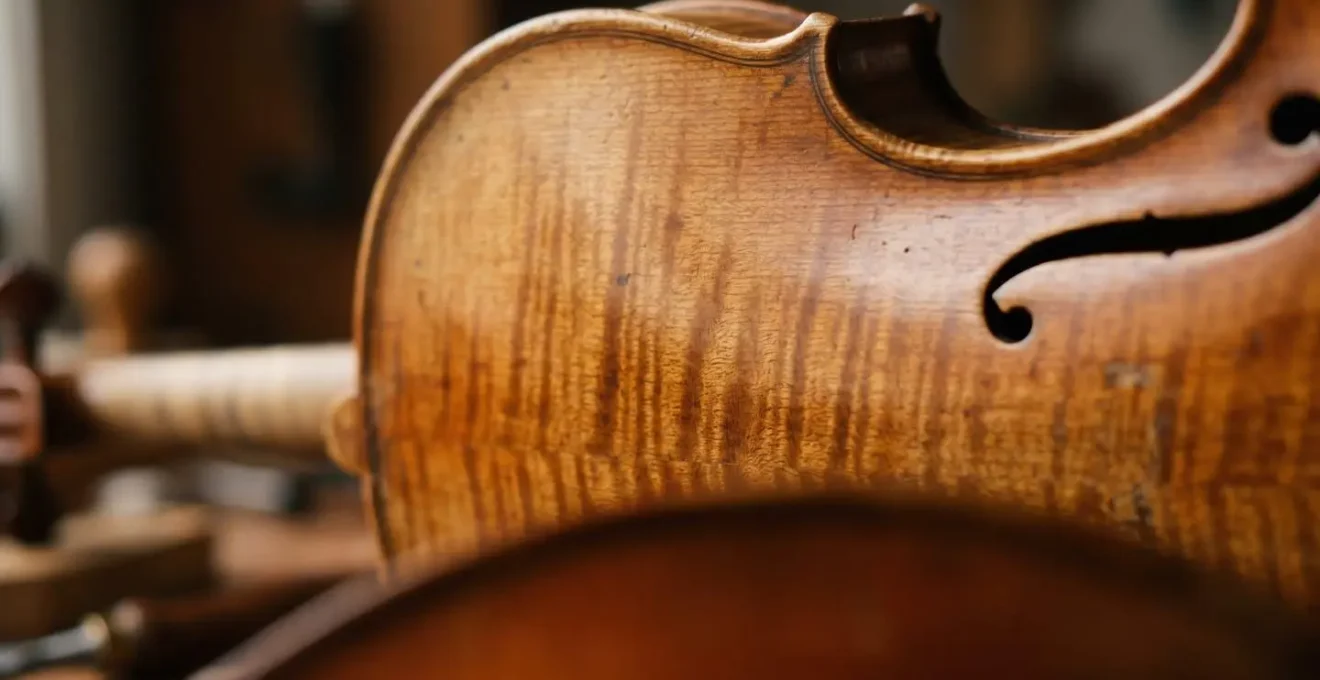
A violin’s sound quality is not magic; it’s a predictable outcome of measurable physical properties, from the cellular structure of its wood to its interaction with the room.
- Superior tonewood possesses a high stiffness-to-weight ratio, determined by slow, high-altitude growth, allowing for thinner, more resonant plates.
- A luthier’s « art » is the precise engineering of plate thickness (graduation) to control projection and tonal colour, not an unknowable secret.
Recommendation: Instead of focusing on price or maker’s name, evaluate an instrument based on its acoustic principles and test it under controlled, blind conditions to find its true voice.
For any serious string player, the vast chasm between a £500 student violin and a £50,000 professional instrument is a source of both aspiration and confusion. When both instruments use the same set of strings, what justifies the hundred-fold price difference? The common refrains— »it’s the aged wood, » « the secret varnish, » or the nebulous « art of the maker »—offer little practical clarity. They perpetuate a myth that sound quality is an alchemical mystery, accessible only to a select few. This leaves musicians in a difficult position, unable to discern genuine acoustic value from a high price tag and a storied reputation.
But what if the key wasn’t in myth, but in physics? The truth is that a violin is a complex but understandable acoustic system. Its final voice is the result of a chain of measurable factors, from the density of the spruce it’s made from to the way its sound waves behave in your practice room. The difference between a cheap instrument and a master-grade one lies not in secrets, but in the deliberate optimisation of each link in this acoustic chain. An expensive instrument is one where every component has been chosen and shaped to work in perfect concert, transforming the raw energy of the bow into a sound that is rich, powerful, and responsive.
This article demystifies that process. We will move beyond the romance and delve into the science. We’ll explore why the origin of the tonewood matters on a cellular level, how to scientifically test an instrument without being swayed by bias, and why your violin sounds dramatically different in a concert hall. By understanding the instrument as an acoustic engine, you can become a more discerning player, capable of making informed decisions about your sound, your next upgrade, and your next performance.
To navigate this complex world, we will break down the key acoustic principles that define a violin’s sound. The following sections explore each element, from the raw material to the final performance space, providing a clear framework for understanding instrumental quality.
Summary: Decoding the Sound of a High-End Violin
- Why Does Alpine Spruce from Specific Valleys Produce Brighter Tones Than Generic Tonewood?
- How to Blind-Test Violins Effectively Without Being Influenced by Maker Reputation?
- Contemporary Graduation vs Stradivari Patterns: Which Produces Better Projection for Soloists?
- The Central Heating Trap That Damages 20% of UK-Stored Violins Every Winter
- When to Invest in a New Bridge Versus Save for a Better Instrument?
- Why Does Your Low E String Boom in One Corner but Disappear in Another?
- How to Source English Oak and Ash Directly from Woodland Owners for 25% Less?
- Why Do Some Concert Halls Make Your Instrument Sound Better Than Your Practice Room?
Why Does Alpine Spruce from Specific Valleys Produce Brighter Tones Than Generic Tonewood?
The journey to a £50,000 sound begins with the tree. While a £500 violin might use generic, fast-grown spruce, a master luthier will insist on tonewood from specific, high-altitude locations like the Fiemme Valley in the Italian Alps. This isn’t romanticism; it’s physics. Trees at high altitudes endure harsh, cold winters and short growing seasons, leading to extremely slow growth. This process, which can take 150 to 200 years for a single violin-quality log, results in wood with exceptionally tight, straight, and consistent grain. The narrow growth rings create a material that is incredibly light yet remarkably stiff.
This high stiffness-to-weight ratio is the holy grail of tonewood. It’s the physical property that allows the violin’s top plate (the soundboard) to be carved very thinly without sacrificing structural integrity. A thinner, lighter top vibrates more freely and efficiently, converting the string’s energy into sound with minimal loss. Cheaper, heavier wood requires a thicker top plate to remain stable, which dampens vibrations and results in a duller, less responsive sound. As the experts at Dolce Violins note, this property is what makes spruce ideal for a violin’s top.
Because of its high stiffness-to-weight ratio, spruce maintains its strength even when it is cut very thinly, making it the ideal topwood for violins.
– Dolce Violins, Anatomy of a Violin – What a Violin is Made of
Furthermore, the consistent cell structure of slow-grown spruce transmits sound waves (vibrations) more quickly and evenly across the plate. This high speed of sound through the wood contributes to a brighter, more brilliant tone with a rich palette of overtones. In a cheaper instrument, the inconsistent, less dense wood transmits sound more slowly and erratically, smearing the tonal details and producing a « muddy » or « unfocused » sound. The initial investment in superior tonewood isn’t an arbitrary luxury; it’s a foundational decision that sets the absolute ceiling for the instrument’s potential acoustic performance.
How to Blind-Test Violins Effectively Without Being Influenced by Maker Reputation?
Even with the best materials, our perception of sound is notoriously unreliable. The knowledge that you are playing a £50,000 violin from a famous maker—or a priceless Stradivari—creates a powerful expectation bias. We *expect* it to sound better, and so it often does in our minds. This makes choosing an instrument based on sound alone incredibly difficult. The only way to truly assess an instrument’s voice is to remove this bias through a rigorous blind-testing protocol, isolating the sound from the story.
A landmark study in this field provides a powerful blueprint. The 2010 Indianapolis double-blind violin test pitted modern violins against legendary instruments by Stradivari and Guarneri del Gesù. Experienced soloists, wearing modified welders’ goggles to obscure their vision and with scent applied to each instrument to mask distinctive smells, were asked to evaluate the violins. The results were startling: the most-preferred instrument was a new one, and a Stradivari was the least-preferred. The modern violins were consistently rated higher for playability and response. This doesn’t mean old violins are « worse, » but it proves that without the influence of reputation, modern instruments can and do compete with—and even exceed—the performance of the most revered antiques.
Case Study: The Indianapolis Experiment
In a 2010 double-blind study, 21 professional violinists tested six violins (three new, two Stradivari, one Guarneri) in a hotel room with dry acoustics. To ensure anonymity, players wore darkened welders’ goggles and perfume was applied under each chinrest to mask wood scents. The stunning result was that the most-preferred violin was a modern instrument, while a Stradivari was the least-preferred. This study demonstrated that when maker reputation is removed, a violin’s playability and response can be judged on their own merits, often favouring contemporary craftsmanship.
For a serious player looking to invest, adopting this methodology is not just academic; it’s essential for making a financially sound decision. Focusing on how an instrument *feels* under the fingers and how it *responds* to your specific playing style, free from the psychological weight of its price tag or pedigree, is the surest way to find a true partner for your musical journey. It empowers you to trust your ears and hands over market hype.
Your Action Plan: Conducting an Effective Blind Test
- Isolate the Senses: Use darkened goggles or a blindfold to completely block vision. Apply a neutral scent (like a dab of essential oil on a cotton ball) under each chinrest to mask the unique smell of each violin’s wood and varnish.
- Randomise the Order: Have a third party present the violins in a random sequence, generated online or by drawing numbers. This prevents « order effects, » where the first or last instrument tested has an unfair advantage.
- Control the Environment: Test all instruments in the same room, preferably one with relatively dry acoustics (less reverberation). This allows you to hear the instrument’s true voice, not the room’s enhancement. Use your own bow for consistency.
- Focus on Playability and Response: Create a quick scorecard. Instead of a vague « tone » rating, score specific criteria: ease of response on the E string, clarity of articulation in fast passages, evenness of sound across all four strings, and dynamic range.
- Record and Listen Back: Have someone record you playing the same short passage on each instrument. Listening back as a passive observer can reveal nuances you missed while focusing on the physical act of playing.
Contemporary Graduation vs Stradivari Patterns: Which Produces Better Projection for Soloists?
If tonewood provides the raw acoustic potential, then graduation—the precise and often variable thickness of the top and back plates—is how the luthier refines that potential into a specific voice. This is where the « art » of violin making becomes the engineering of sound. A luthier isn’t just carving wood; they are tuning plates to resonate at specific frequencies, controlling which overtones are amplified and which are suppressed. A £500 violin often has plates of uniform thickness, machine-made and acoustically inert. A £50,000 instrument has plates that have been meticulously hand-carved, measured, and tap-tuned, with thicknesses varying by fractions of a millimetre to achieve a target sound profile.
The debate between Stradivari patterns and contemporary graduation methods centres on one key goal for soloists: projection. How does a violin cut through the sound of a full orchestra and fill a 2,000-seat hall? The answer lies in a specific acoustic phenomenon known as the « singer’s formant. » Research shows that the human ear is most sensitive to frequencies in the 2-4 kHz range. A violin that is strong in this frequency band will sound more powerful and be heard more clearly, even at a lower overall volume. Great operatic singers naturally produce this formant, and great solo violins are built to do the same.
Stradivari’s genius was in empirically developing graduation patterns that, often by happy accident, boosted this critical frequency range. Modern luthiers, armed with advanced acoustic analysis tools like spectrum analysers, can now achieve this with greater precision and intent. They can shape the plates to specifically amplify the 2-4 kHz frequency range, creating instruments with immense carrying power tailored for the modern concert hall. While a Stradivari pattern might produce a famously sweet and complex tone up close, a contemporary graduation pattern may be deliberately engineered for superior projection, making it a more effective tool for a touring soloist.
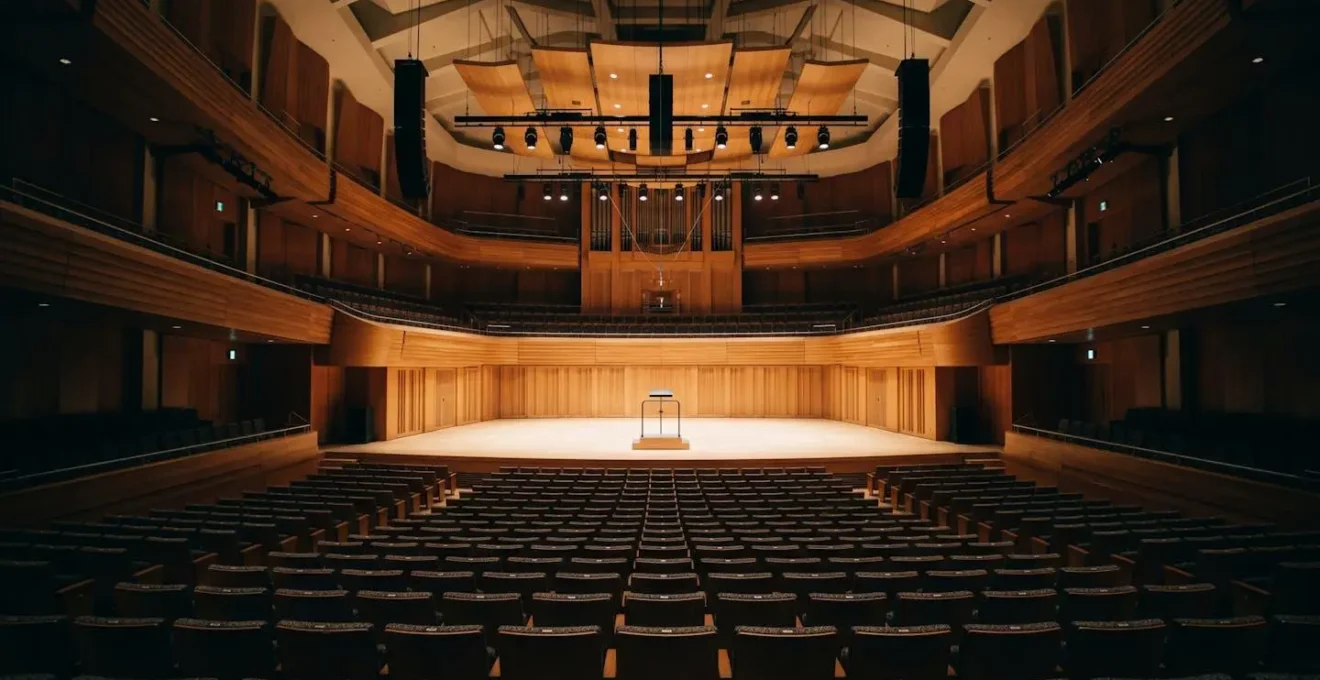
This choice is not about which is « better » in the absolute, but which is the right tool for the job. An instrument designed for intimate chamber music will have a different graduation, and thus a different sound profile, from one built to soar over a Mahler symphony. The high price of a professional instrument reflects this bespoke acoustic design—the hundreds of hours spent tuning the plates to meet the specific demands of a performing artist.
The Central Heating Trap That Damages 20% of UK-Stored Violins Every Winter
You can own the most exquisitely crafted instrument, but its acoustic properties are not static. They are profoundly affected by the environment, and the single greatest threat to a violin in the UK is the dramatic shift in humidity caused by central heating. Wood is a hygroscopic material, meaning it absorbs and releases moisture to stay in equilibrium with the surrounding air. In the damp UK autumn, your violin’s wood swells as it absorbs moisture. Then, when the heating is switched on for winter, the indoor air becomes extremely dry. The violin rapidly releases its moisture, causing the wood to shrink.
This rapid shrinkage is catastrophic. As the wood contracts, immense stress is placed on the seams, which can pop open. More alarmingly, the shrinking wood can lead to cracks, especially in the top plate—an often irreparable form of damage that can deaden an instrument’s sound permanently. Even if it doesn’t crack, a dry violin will sound different: often brighter, harsher, and thinner, because the wood becomes lighter and stiffer. The careful balance of a luthier’s work is undone by a lack of environmental control. While the title’s « 20% damage » figure serves to highlight the risk, the reality is that any instrument stored in a centrally heated home without humidity control is at risk.
Protecting your investment is therefore an active process. The goal is to maintain a stable environment. Luthiers and conservators agree that the ideal environment for a string instrument is a relative humidity of 40-60%, with the sweet spot being 45-55%. This is far higher than the 20-30% humidity commonly found in a heated UK living room. Achieving this stability requires a two-pronged approach. First, using a room humidifier to control the overall environment of your practice space. Second, using an in-case humidifier (such as a Dampit or a humidity control pack) to create a stable microclimate for the instrument when it’s not being played.
This isn’t an optional extra for a professional instrument; it is fundamental to its maintenance and the preservation of its tone. The cost of a good hygrometer (to measure humidity) and a humidifier system is negligible compared to the cost of a major repair or the irreversible loss of an instrument’s voice. It is a core part of owning a high-quality violin.
When to Invest in a New Bridge Versus Save for a Better Instrument?
The bridge is one of the most critical and often overlooked components of a violin’s acoustic system. It is not just a passive support for the strings; it is the primary transducer that transfers the strings’ vibrations to the top plate. Its shape, weight, and the quality of its fit have a dramatic impact on the instrument’s tone and response. A poorly cut or warped bridge can make an excellent violin sound muted and unresponsive, while a perfectly carved bridge can unlock the hidden potential in a modest instrument. This raises a crucial question for players: when is it worth investing in a high-quality bridge, and when is that money better saved for a new violin?
The decision hinges on the instrument’s underlying quality. For a very basic student instrument (£200-£500), where the top plate is thick and the materials are of low quality, a new bridge will yield only marginal improvements. The instrument’s fundamental acoustic potential is simply too limited. However, for a good intermediate or advanced student instrument (typically £1,000 and up), a professionally fitted bridge can be a transformative and highly cost-effective upgrade. According to industry data, professional bridge replacements typically cost between $70-$100+ (USD), a small fraction of the price of a new instrument. If your current violin has good bones—a solid, well-graduated top and decent tonewood—but suffers from a generic, factory-fitted bridge, this is often the single best investment you can make.
How can you tell if your bridge needs attention? A visual inspection can reveal the most common problems. A bridge should stand perfectly perpendicular to the violin’s top and should not be warped or bent. Its feet must fit flush against the curve of the top with no gaps. Over time, the constant tension of the strings pulls the bridge forward, causing it to warp, which muffles the sound and puts it at risk of snapping.
- Warping: Hold a ruler or straight edge against the side of the bridge facing the tailpiece. It should be perfectly flat. Any bowing or curvature indicates warping.
- String Grooves: The grooves where the strings sit should be shallow and smooth. If the strings are cutting deeply into the wood, the bridge is likely too soft or worn.
- Foot Contact: Look closely at where the bridge’s feet meet the violin top. There should be complete contact with no visible gaps. Any rocking or gaps mean vibrations are not being transferred efficiently.
- Angle: View the violin from the side. The back of the bridge (the side facing the tailpiece) should form a 90-degree angle with the top plate. If it’s leaning towards the fingerboard, it needs to be corrected or replaced.
If you notice any of these issues, a visit to a luthier is in order. They can assess whether a new bridge is a worthwhile investment. In many cases, it can breathe new life into an instrument, dramatically improving its power, clarity, and responsiveness for a fraction of the cost of starting over.
Why Does Your Low E String Boom in One Corner but Disappear in Another?
After meticulously selecting tonewood, graduating the plates, and fitting the perfect bridge, you take your violin into a small practice room, only to find its voice is frustratingly inconsistent. The low notes sound powerful and resonant in one corner, but thin and weak when you stand in the middle of the room. This isn’t a fault of the instrument; it’s a predictable acoustic phenomenon called room modes, or standing waves. Every room has a set of resonant frequencies determined by its dimensions. When you play a note that matches one of these frequencies, the sound waves reflect between parallel surfaces (like walls or the floor and ceiling) and either reinforce each other (creating a « boom » at a pressure peak, or antinode) or cancel each other out (creating a dead spot, or node).
Small, cubical rooms are the worst offenders, as their dimensions often create overlapping room modes in the bass and lower-mid frequency range, right where a violin or cello’s body resonates. This is why your instrument can sound muddy, boomy, or uneven in a small practice space. The corners of a room are where bass frequencies tend to build up, which is why a low G on the violin might sound overwhelmingly powerful when you practice facing a corner. Conversely, the exact centre of a room is often a null point for certain frequencies, making them seem to disappear entirely.
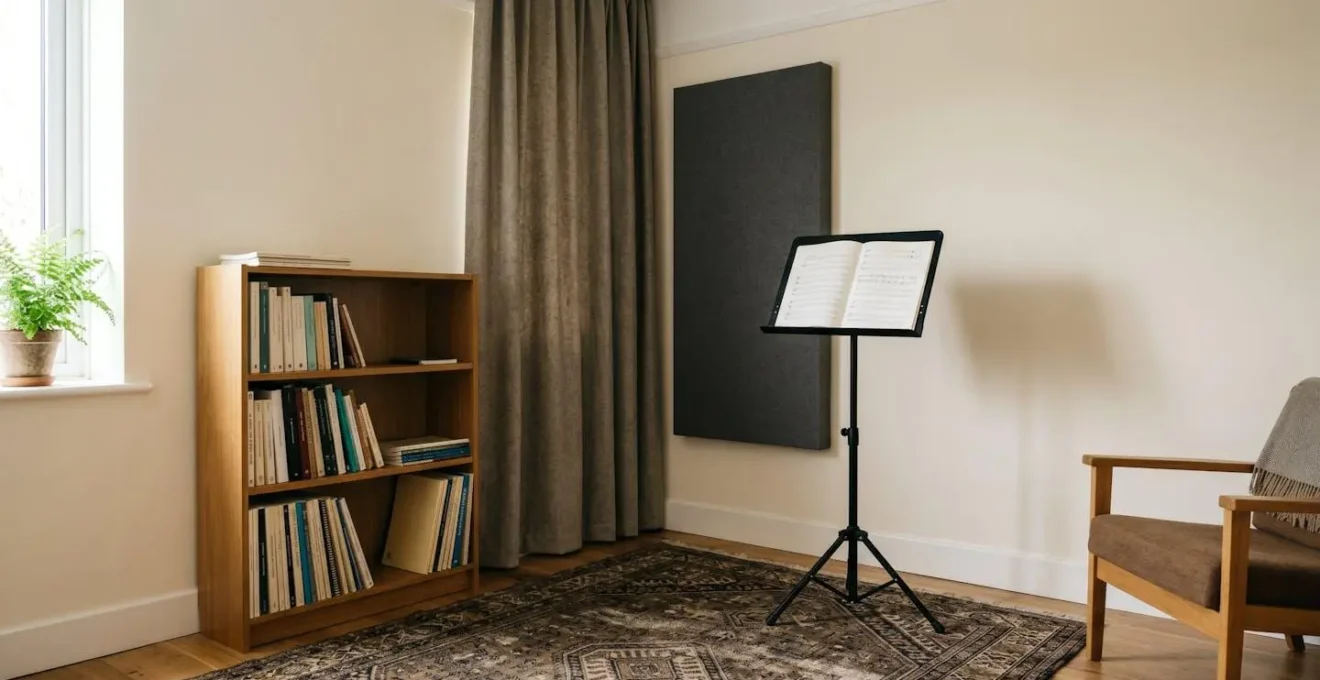
Fortunately, you don’t need to build a professional studio to combat this. Simple, strategic changes to your practice space can make a huge difference. The goal is to break up parallel surfaces and absorb or diffuse sound waves, particularly low frequencies. This is less about « soundproofing » and more about « acoustic treatment. »
- Change Position: The simplest solution is to avoid practising in corners or in the exact centre of the room. Experiment with different positions to find the spot where the response feels most even.
- Add Absorption: Heavy, soft materials are excellent at absorbing sound energy. Place a thick rug on a hard floor. Position a large, upholstered sofa or bookcase filled with irregularly-sized books against a reflective wall to act as a bass trap and diffuser.
- Break Up Parallel Surfaces: Avoid practising in an empty, square room. Even angling a large piece of furniture can help break up the standing waves. Heavy curtains or wall tapestries can absorb reflections and tame high-frequency harshness.
By understanding that your practice room is an extension of your instrument, you can take control of your sound. Treating your room allows you to hear the true voice of your violin, providing the clear, honest feedback you need to refine your technique and interpretation.
How to Source English Oak and Ash Directly from Woodland Owners for 25% Less?
The obsession with Alpine spruce and Bosnian maple has driven the cost of premium tonewood to extraordinary heights, making it a significant part of a £50,000 instrument’s price tag. However, a growing movement among luthiers, particularly in the UK, is challenging this orthodoxy by looking to local, sustainably sourced hardwoods. While the title mentions Oak and Ash, the principle extends to a variety of native species. This approach not only offers a significant cost advantage by cutting out importers and distributors, but it also revives a rich, historical tradition of British violin making.
For centuries, before global trade made Alpine wood ubiquitous, English makers used the materials available to them with great success. This historical precedent provides a powerful model for contemporary luthiers and players seeking high-quality, cost-effective alternatives. It demonstrates that a world-class instrument does not have to be made from imported materials. While sourcing directly from woodland owners requires more effort—building relationships, understanding wood seasoning—it offers greater control over the material and a deeper connection to the instrument’s origin.
Historical Case Study: The English Sycamore Tradition
Contrary to the modern belief that only Alpine maple is suitable for high-end violins, classic English makers like Barak Norman and the Wamsley school frequently used native English Sycamore (Acer pseudoplatanus) for the backs, ribs, and scrolls of their instruments. This local hardwood, a close relative of maple, produced instruments with a tonally distinct and highly regarded voice. This tradition proves that excellent string instruments can be crafted from locally-sourced British woods, offering a viable and historically-validated alternative to expensive European imports for today’s makers.
The principle of using local tonewood is not about finding a « cheaper » substitute, but a « different » one with its own unique acoustic signature. English sycamore, for example, can produce a slightly warmer, darker tone compared to the brilliance of high-altitude maple, a quality that might be perfectly suited to a chamber musician or a player in a folk ensemble. For the adventurous luthier or the player commissioning a custom instrument, exploring local woods like sycamore, pear, or even select cuts of ash opens up a new world of tonal possibilities. It’s a sustainable choice that challenges the monolithic culture of tonewood and can result in a unique, world-class instrument without the five-figure price tag attached to imported materials.
While the « 25% less » figure is a target, the real value lies in creating a unique instrument with a direct link to the local landscape, a narrative that is in many ways as compelling as the story of a centuries-old Italian tree.
Key Takeaways
- A violin’s sound is not mystical; it’s a system of measurable physics, from wood density to room acoustics.
- Superiority comes from optimising every link in the acoustic chain: high stiffness-to-weight ratio wood, precisely engineered plate graduation, and a perfectly fitted bridge.
- Your perception is biased. Blind testing is the only way to judge an instrument’s true voice, and your practice room’s acoustics are as much a part of the sound as the violin itself.
Why Do Some Concert Halls Make Your Instrument Sound Better Than Your Practice Room?
The final element in the acoustic chain is the performance space itself. A musician can spend years optimising their instrument, only to find that it truly comes alive in one hall and feels lifeless in another. A great concert hall is not a passive container for sound; it is an active acoustic partner that enhances and projects the instrument’s voice in ways a small practice room cannot. The primary difference lies in reverberation—the persistence of sound after the source has stopped. Your small, carpeted practice room is acoustically « dry, » with very little reverberation. This is good for clarity but lacks warmth and support.
A great concert hall, by contrast, is designed to have a long but clear reverberation time (typically around 2 seconds). This wash of reflective sound supports the violin’s tone, blending successive notes into a smooth, legato line and adding a sense of grandeur and warmth. The hall’s architecture, from the shape of the walls and ceiling to the materials used, is engineered to diffuse sound evenly, preventing harsh echoes and creating an immersive experience for the audience. This is the environment a £50,000 violin is built for. Its ability to produce a rich spectrum of overtones allows it to interact with the hall’s acoustics, creating a sound that is both clear and enveloping.
This creates a fascinating paradox for the soloist, perfectly captured by the great violinist Erick Friedman. The goal is to have an instrument that can be heard clearly at the back of the hall, yet retains its warmth and complexity for the listener in the front row. It is this dual capability that defines a world-class solo instrument.
I want a violin with an intimate sound – fifty feet away.
– Erick Friedman, Joseph Curtin Studios – Stradivari in Paris
Understanding this relationship between instrument and hall is the final piece of the puzzle. A cheap violin in a great hall will still sound cheap; it doesn’t produce enough tonal information for the hall to work with. But a great violin in a poor acoustic space will feel stifled and unresponsive. The ultimate sound is a synergy between the instrument’s inherent quality and the acoustic properties of the space it inhabits. The high price of a professional violin is, in part, an investment in an instrument with enough power and complexity to command not just a practice room, but a concert hall.
By moving beyond the myths and understanding these core acoustic principles, you empower yourself as a musician. You can now assess instruments with a critical ear, care for your violin with scientific precision, and make intelligent choices that will truly elevate your sound.