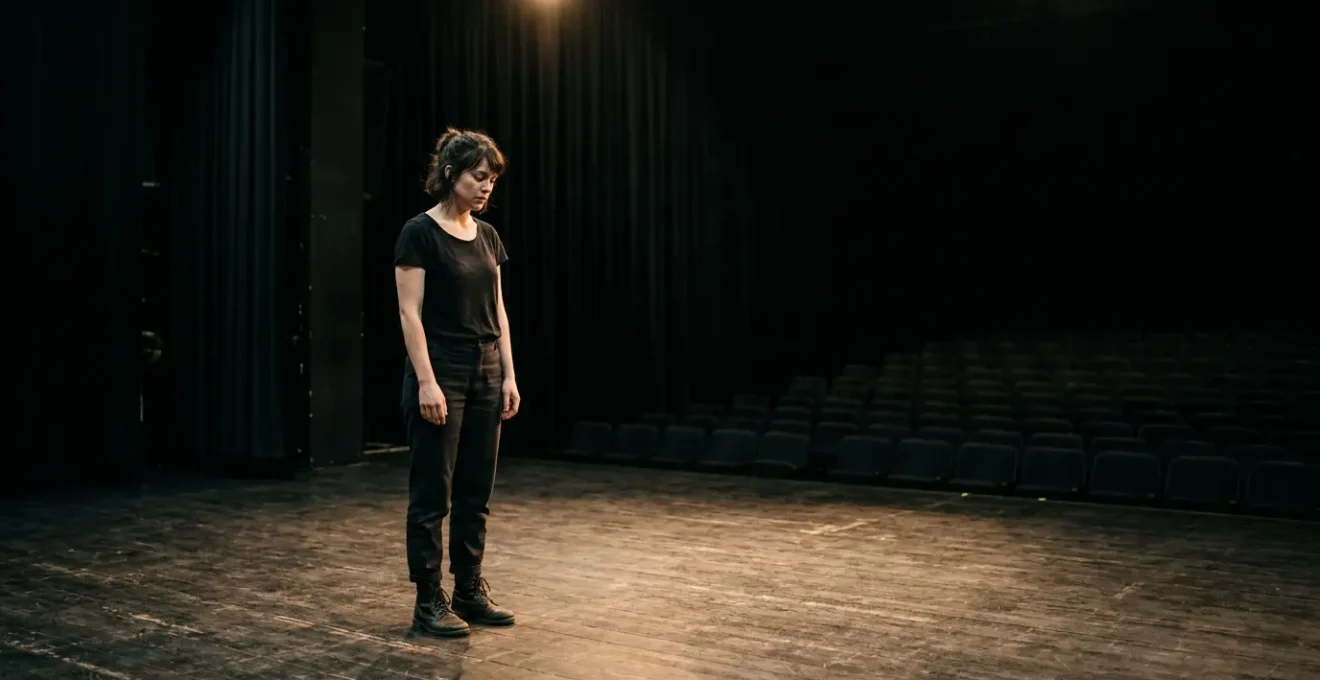
The pervasive belief is that technical mastery leads to powerful performances. The truth is, it often builds a wall between you and the audience.
- True emotional connection is born from embracing live uncertainty, not from perfecting an emotional state.
- Focusing on playable, active tasks (« actioning ») generates authentic emotion as a byproduct, rather than a goal.
Recommendation: Shift your focus from *showing* a feeling to relentlessly pursuing a character’s task. It is in the struggle, not the result, that the audience will find a reason to care.
You’ve done the work. Years of voice coaching, movement classes, and text analysis. You hit your marks, your diction is flawless, and you can summon a tear on cue. On paper, your performance is perfect. Yet, there’s a silence in the audience where a gasp should be. A polite applause where a standing ovation feels earned. You leave the stage with a nagging hollowness, the sense of a deep connection missed. This is the paradox of the skilled performer: the more polished the execution, the more it can feel hermetically sealed, admired from a distance but never truly felt.
The common advice— »be present, » « connect with your partner »—becomes meaningless when you’re already doing all the things you were taught. The problem isn’t a lack of skill; it’s that your skill has become a shield. It protects you from the messiness, the risk, and the raw vulnerability that is the very lifeblood of theatre. You’ve become an exquisite exhibit in a museum, rather than a live, breathing human grappling with something in front of us.
But what if the key wasn’t to add another layer of polish, but to strategically strip it away? What if the path to moving an audience wasn’t about achieving emotional certainty, but about bravely inhabiting a state of *live uncertainty*? This is where the craft transcends technique. It’s about shifting your entire creative focus from the product of emotion to the process of action.
This article will deconstruct the architecture of that emotional wall and give you the tools to dismantle it, brick by brick. We will explore the neurological basis of audience connection, the practical techniques to maintain freshness fifty shows in, and the fundamental shift in thinking that separates a competent actor from a compelling one. We will move from the abstract to the profoundly practical, giving you a new framework for your craft.
Summary: Why Your Technically Perfect Performance Leaves Audiences Emotionally Cold?
- Why Does Admitting Uncertainty Onstage Create Stronger Audience Engagement Than Confidence?
- How to Make the 50th Performance Feel as Fresh as Opening Night?
- Actioning vs Stanislavski Objectives: Which Unlocks More Playable Choices for UK Actors?
- The Tech Week Exhaustion That Flattens 30% of Opening Night Performances
- When to Use Physical Warm-Ups vs Vocal Preparation: Before Comedy or Tragedy?
- Why Does Your Voice Crack at the Passaggio Despite Years of Training?
- Why Does Your Working-Class Character Sound Like Your Middle-Class Protagonist?
- Why Do All Your Characters Sound Like the Same Person With Different Names?
Why Does Admitting Uncertainty Onstage Create Stronger Audience Engagement Than Confidence?
Confidence on stage often manifests as a closed circuit. A confident performer presents a finished product: « Here is the anger, » « Here is the joy. » The audience can admire it, but they cannot participate in its creation. Uncertainty, however, is an invitation. When an actor is genuinely grappling with a moment, unsure of the outcome, they create a space—a generative gap—that the audience instinctively leans into. We become partners in the discovery, holding our breath with the performer. This isn’t about appearing unprepared; it’s about the character, not the actor, being in a state of genuine risk.
This connection is not metaphorical; it’s neurological. Recent neuroscience research demonstrates that mirror neurons allow us to ‘resonate’ with others’ actions and intentions. When we witness an actor performing a task with a clear but unresolved goal, our brains fire as if we were attempting it ourselves. A display of pure emotion doesn’t engage this system in the same way. It’s the *struggle* that is contagious, not the feeling itself. The vulnerability of not knowing is what makes the performance feel alive and thrillingly immediate.

This shared experience, this neurological co-creation, is the bedrock of profound audience engagement. As one research team studying this phenomenon noted, it’s a deeply human response:
Anyone who has felt the emotional pain of a favorite actor or actress while watching a movie can testify to this.
– Research team on mirror neurons and second-person neuroscience, PMC – Mirror neurons are central for a second-person neuroscience
Therefore, the director’s note should not be « be more confident, » but « find the question in the scene. » What is your character desperately trying to figure out? What outcome do they fear? By playing the uncertainty, you give the audience the most generous gift possible: a reason to invest.
How to Make the 50th Performance Feel as Fresh as Opening Night?
The death of a long-running performance is not a sudden event; it’s a slow fading into repetition. The lines become rote, the blocking automatic, and the emotional connection a memory of what it once was. The trap is trying to *recreate* the feeling of opening night. The solution is to create the *conditions* for new discovery every single night. Freshness isn’t about repetition; it’s about renewal.
This is a structural challenge that the most successful long-running productions have mastered. They don’t just preserve the show; they actively manage its vitality.
Case Study: The Longevity of West End Institutions
Productions like Les Misérables and The Phantom of the Opera, which have run for decades in the West End, don’t survive on nostalgia alone. As an analysis of their success reveals, they employ systematic approaches to maintain quality. Regular cast changes infuse the show with new energy, and the production itself is meticulously maintained. The Mousetrap, with its staggering 72-year run, has perfected this model, constantly renewing itself for new generations while preserving the core identity that makes it a classic. It’s a testament to the fact that longevity requires a strategy of constant, managed renewal.
For the individual actor, this macro strategy must be mirrored on a micro level. The focus must shift from an internal state (« how do I feel? ») to an external one (« what is my scene partner giving me *right now*? »). Each performance becomes an act of radical listening. Instead of delivering a line the same way you did last night, you deliver it as a direct response to the tiny, new nuance in your partner’s voice or posture. This turns a monologue into a dialogue and a scene into a live event.
- Focus on action over emotion: The audience is there to see what the character does about their feelings, not just watch the feelings themselves.
- Treat emotion as an obstacle: Your character’s anger or sadness is something to be overcome in pursuit of a goal. This struggle is the drama.
- Become a detective: Instead of trying to feel what your character feels, investigate what makes them tick. What do they want on this specific line?
- Make it about them, not you: Shift your entire focus to your scene partner. Your goal is to affect them, to change something in them. In doing so, you will be changed in return.
Actioning vs Stanislavski Objectives: Which Unlocks More Playable Choices for UK Actors?
For decades, the concept of the « objective » has been central to actor training. We ask, « What does my character want? » This is a powerful question, but for the technically-minded actor, it can lead to a general emotional state rather than a series of specific, playable moments. You decide your character wants « to be respected, » and you spend the scene playing a general state of « demanding respect. » The result is monolithic and often emotionally inert. Even Stanislavski himself recognized that thought alone was not enough, stating, « The best analysis of a play is to take action in the given circumstances. »
This is where the technique of actioning provides a crucial, practical alternative, particularly resonant within the pragmatic history of UK theatre. Instead of a single objective for the scene, you assign a transitive verb—an « action »—to every single line or thought. Your objective may be to get a confession, but your actions line by line might be: *to test*, *to provoke*, *to plead*, *to corner*, *to reassure*, *to trap*. Each line becomes a new tactic. This forces you out of a general emotional state and into a dynamic, moment-to-moment struggle.
This technique isn’t a modern invention but a tool forged in the rehearsal rooms of some of Britain’s most influential theatre companies. As a study of its history shows, it was designed for clarity and creative empowerment within tight production schedules.
The best analysis of a play is to take action in the given circumstances.
– Konstantin Stanislavski, Stanislavski’s system – Wikipedia
An in-depth look at this method’s development shows Actioning was devised by the Joint Stock Theatre Company under directors like Bill Gaskill and Max Stafford-Clark in the late 1970s. It was created to empower actors to make clear, simple, and playable choices. The goal is to serve the text and the production, affording actors immense creative space. It’s not about abandoning Stanislavski but about making his « Method of Physical Action » intensely practical and line-specific. For the UK actor, whose work is often text-heavy and fast-paced, actioning is not just a tool; it’s a lifeline to specificity and away from generalised emotion.
The Tech Week Exhaustion That Flattens 30% of Opening Night Performances
Tech week is the crucible where the abstract ideas of the rehearsal room meet the unforgiving reality of theatrical mechanics. It is also where many vibrant, nuanced performances go to die, flattened by a specific and corrosive form of exhaustion. It’s a phenomenon that can impact what feels like up to 30% of opening night performances, turning what should be an explosive premiere into a tired echo of the final dress rehearsal. This isn’t just about being physically tired; it’s a cognitive and creative depletion.
During tech week, the actor’s brain is forced into a different mode of operation. Your focus is constantly pulled outwards: « Am I in my light? », « Did I hear that sound cue? », « Is this prop set correctly? ». You are processing hundreds of technical notes, which requires an analytical, problem-solving mindset. This mindset is the polar opposite of the open, receptive, and vulnerable state required for a deeply connected performance. You spend a week being a technician of your own performance, and it’s incredibly difficult to switch back to being an artist on opening night.
The danger is that this technical focus becomes ingrained. You start to execute the performance as a series of cues rather than living it as a series of moments. The spontaneity that was discovered in rehearsal is paved over with the concrete of technical precision. The solution is not to ignore the technical demands, but to build a firewall around your creative process. This means developing a rigorous pre-show ritual that is specifically designed to transition your brain from the analytical to the intuitive.
This ritual is your personal space to shed the skin of the technician and re-inhabit the soul of the artist. It’s about reconnecting with the core of your character’s journey and your primary relationships on stage, away from the noise of the lighting grid and the sound desk. It’s a conscious act of reclaiming the performance for yourself before you give it to the audience.
When to Use Physical Warm-Ups vs Vocal Preparation: Before Comedy or Tragedy?
The pre-show warm-up is often treated as a generic, one-size-fits-all routine. But a strategic director knows that the *type* of warm-up should be tailored to the specific demands of the play. You are not just « warming up »; you are tuning your physical and neurological instrument to the precise key of the performance. The choice between a physical or a vocally-focused warm-up before a comedy versus a tragedy is not arbitrary—it’s a decision rooted in psychophysiology.
For a comedy, particularly a farce or a piece requiring sharp timing and playful energy, a vigorous, game-based physical warm-up is essential. The goal is to get the company laughing, moving, and connecting in a state of high-energy play. There’s a scientific reason for this. The neuroscience of performance preparation shows that vigorous, game-based physical warm-ups release endorphins and dopamine. This creates a brain chemistry associated with pleasure, confidence, and high status—the perfect neurological cocktail for comedic brilliance. You’re physically programming a sense of joy and readiness into the ensemble’s bodies.
For a tragedy, however, the needs are different. While physical release is still important, the primary focus should shift to grounding, breath, and vocal connection. A tragedy often requires an actor to sustain immense emotional tension and navigate complex language. A frantic physical warm-up can create a jittery energy that works against the required gravitas. Instead, the warm-up should focus on slow, deep breathing to lower the center of gravity and calm the nervous system. As a performance guide notes, « Practicing proper breathing is important on stage. It allows for more ease when performing with better pacing when an actor is saying their lines. » This centered state allows for a more profound connection to the text and a vocal instrument that is supported and responsive, not strained.
The warm-up, therefore, is the first artistic choice of the night. For comedy, you generate energy from the outside in, through physical play. For tragedy, you build it from the inside out, through breath and centeredness.
Why Does Your Voice Crack at the Passaggio Despite Years of Training?
The passaggio—the break or transition point between your chest and head voice—is a notorious source of anxiety for singers and actors alike. You can have years of training, perfect posture, and impeccable breath support, yet your voice still cracks on that one crucial, rising note. This is rarely just a technical failure. More often than not, the vocal crack is a physical manifestation of a psychological hesitation. It is a crisis of commitment at the precise moment of greatest vulnerability.
Think of the passaggio as a leap of faith. To navigate it smoothly, you must commit to the note *before* you know for certain you will hit it. You have to send your breath and intention forward into the unknown. Any flicker of doubt, any « tensing up » in anticipation of failure, will constrict the very laryngeal muscles that need to be free to adjust. The crack is the sound of your body’s self-preservation instinct (« Don’t fail! ») colliding with your artistic intention (« Reach for that note! »).
For the technically perfect actor, this is a particularly vexing problem. Your training tells you that control is the answer, so you try to *manage* your way through the break. You over-support, you force the sound, or you « place » it with such precision that you squeeze the life out of it. All these strategies are born of a fear of losing control. They are the vocal equivalent of showing an emotion instead of living an action.
The solution is counter-intuitive. It’s not about more control, but about a more profound release. The work is to connect the sound to an absolute, undeniable character intention. You are not just singing a note; you are using that note to plead, to command, or to cry out. When the intention is powerful enough, the body often organizes itself to serve it. The leap of faith is no longer a technical exercise but a storytelling necessity. The crack happens when you are thinking about your voice; the perfect note happens when you are thinking about what your character needs.
Why Does Your Working-Class Character Sound Like Your Middle-Class Protagonist?
An actor’s default vocal quality is a direct product of their default physicality. We speak from where we live in our bodies. If your personal center of gravity is high in the chest and head—common for many people with a middle-class, academic background—your voice will naturally have a certain resonance and placement. When you then attempt a working-class character whose life experience has centered them physically in their gut or pelvis, simply putting on an accent is not enough. The accent becomes a thin veneer over your own unchanged physical and vocal habits. The result? The character sounds like you, doing a voice.
True vocal transformation begins long before you open your mouth. It begins with finding the character’s physical center. Where do they hold their tension? Where is their source of power? Are they grounded and rooted to the earth, or are they light and striving upwards? A character who has spent their life doing manual labour will have a different posture, a different way of breathing, and a different relationship to gravity than one who has spent their life behind a desk.

This physical shift is not just for visual effect; it fundamentally changes the architecture of your vocal instrument. A lower center of gravity, with weight settled in the pelvis, will tend to open up the lower resonators in the chest and pharynx, leading to a richer, more grounded sound. A character who leads with their chin, tense and ready for a fight, will produce a tighter, more forward and nasal vocal quality. The body is the resonating chamber. By changing its shape, you change the sound it is capable of producing. The voice becomes an inevitable consequence of the body you have built.
The work, then, is to stop *thinking* about the character’s voice and start *embodying* their physical life. Spend time in the rehearsal room simply walking as the character. How do they stand? Sit? How do they carry their shoulders after a long day? By answering these physical questions first, you create a body from which an authentic voice can emerge, rather than imposing a voice onto a body that doesn’t support it.
Key Takeaways
- Emotional connection is not a feeling to be demonstrated, but the result of the audience witnessing a character’s genuine struggle with an unresolved task.
- « Actioning »—assigning a transitive verb to each line—is a powerful tool to maintain moment-to-moment specificity and avoid generalized emotional states.
- Authentic character voice is born from a character’s physical center and posture, not from imposing an accent or vocal quality.
Why Do All Your Characters Sound Like the Same Person With Different Names?
If you find that your gallery of characters—the romantic lead, the grizzled detective, the comic relief—all share a distinct vocal and emotional familiarity, the root of the problem is singular. It’s you. Not your talent or your skill, but your own personal, ingrained habits of thought, movement, and expression. Without a rigorous process of transformation, every character you play will be filtered through your default settings. You are not building a new person; you are simply putting your own self in a different costume.
Breaking this cycle requires moving beyond intellect and into instinct. As actor Wendy Phillips advises, the goal is to stop planning your reactions and simply let them happen. The most powerful moments on stage are often involuntary.
The more relaxed and innocent you can get yourself, the better chance you have of reacting involuntarily. The goal in showing emotion as an actor is to not think about it in the moment. Actively listen to your scene partner, and don’t analyze how you’re going to react; just let yourself react.
– Wendy Phillips, Actor, Backstage – Acting Emotional: A Guide for Actors
This « innocence » is not naivety; it is a state of radical openness achieved through deep preparation. It is the end result of building a character from the ground up, starting with their physical life, their deepest needs, and their unique way of speaking. When this foundation is solid, you are free to stop worrying about « being the character » and can instead focus entirely on listening and responding in the moment. The character’s voice will be there because you built the body it lives in. The character’s emotions will be there because you are pursuing their goals with relentless intention.
Your Action Plan: Building a Diverse Character Library
- Physicality and Movement: Start without the text. Explore how your character moves, stands, and carries themselves. Find their physical center. Does their energy live in their chest, their gut, or their head?
- Voice and Speech: Once the physicality is established, experiment with vocal qualities that emerge from it. Record yourself improvising as the character. Discover their rhythms, pitch, and patterns, rather than imposing them.
- Sense Memory: Engage your senses to build the character’s world. What does their home smell like? What is the texture of their favourite coat? Use sensory details to ground your emotional state in tangible reality.
- Active Listening: Make your primary scene objective to listen so intently to your partner that you discover something new in their lines every time. Your reaction must be born of what you receive in that moment.
- Improvisation: Take the character into unscripted scenarios. How do they order a coffee? How do they react to being cut off in traffic? This builds a history and a set of instincts beyond the confines of the script.
Ultimately, a technically perfect performance that leaves an audience cold is a performance built from the outside in. It’s a beautiful, intricate mask with no one behind it. A truly moving performance is built from the inside out, grounded in physicality, driven by action, and brave enough to live in the uncertainty of the present moment.
Stop trying to be interesting and start being interested. Stop trying to show us how you feel and start showing us what you are trying to do. This is the work. Begin it now.