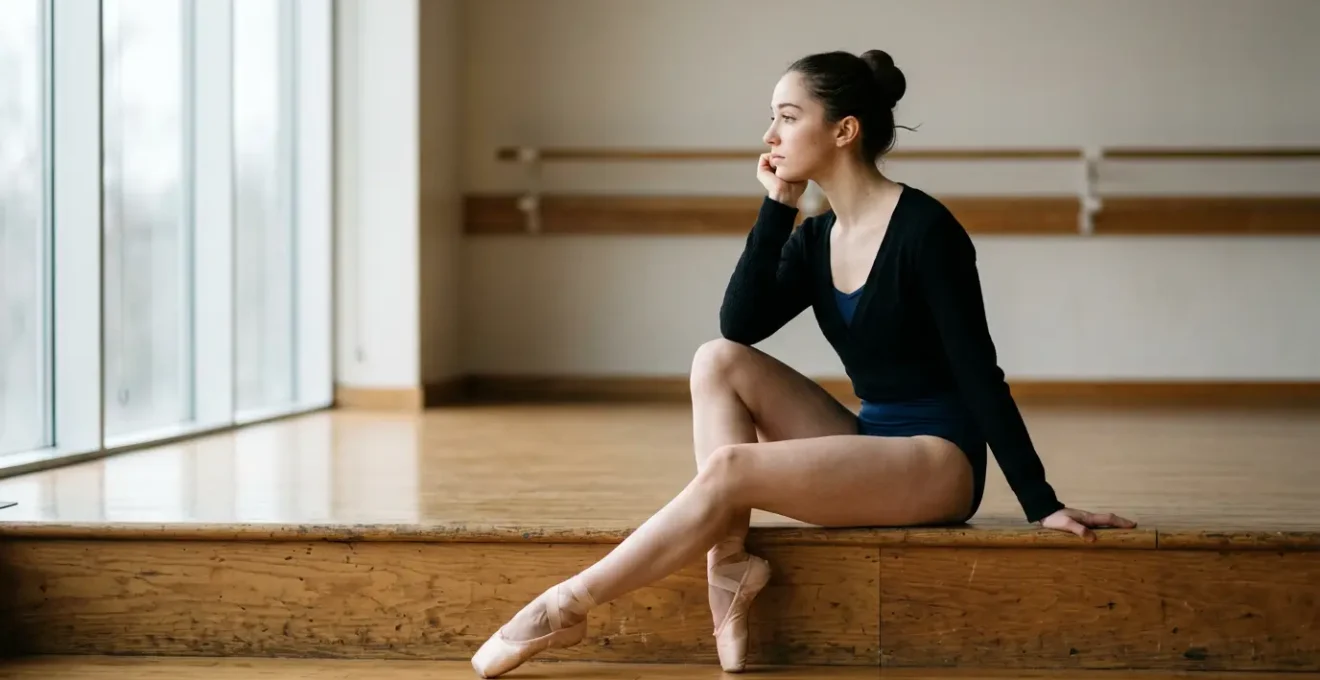
The hard truth: Your elite technical training is no longer your primary asset, and it’s why you’re losing contracts to dancers who seem less perfect.
- Success in the professional world requires a pivot from being a technically flawless student to becoming a compelling artistic asset.
- Directors hire storytellers who connect with an audience, not just technicians who can execute steps perfectly.
Recommendation: Stop chasing technical perfection and start building your performance intelligence, strategic career architecture, and emotional impact.
You have it all. The perfect arabesque line, honed over a decade in one of the UK’s most prestigious ballet schools. The clean fifth positions, the effortless pirouettes. You have followed every correction, pushed through every ounce of pain, and dedicated your life to this art form. Yet, at audition after audition, you see the contract go to someone else—someone whose technique, you notice with a sting of frustration, isn’t nearly as polished as yours. This isn’t a fluke; it’s a fundamental misunderstanding of what the professional dance world values.
The transition from student to professional is the most perilous journey in a dancer’s career. Your training has equipped you with an impeccable technical vocabulary, but it likely failed to teach you the grammar of professional performance. You were taught to be a perfect instrument, but not how to be the musician. The industry isn’t just looking for dancers who can execute choreography flawlessly; it’s looking for artists who can fill a role, captivate an audience, and function as a reliable, healthy, and intelligent part of a creative enterprise. It’s a shift from academic excellence to professional value.
But if perfect technique isn’t the key, what is? The answer lies in a set of skills your school probably never graded you on: stage presence that commands attention even from the back row, the intelligence to make dramatic choices, and the strategic foresight to manage your health and career path like a business. This is not about abandoning your technique, but about building a more compelling artistic identity on top of it.
This guide unpacks the unwritten rules of the industry. We will explore why presence trumps perfection, how to build a career with strategic choices, why your health is your most critical asset, and how to transform your technically perfect but emotionally cold performances into something unforgettable. It’s time to stop thinking like a student and start operating like the professional you intend to be.
Contents: Why Your Perfect Technique Isn’t Enough
- Why Did a Dancer with Perfect Arabesque Get Rejected While a Less Technical Peer Got Hired?
- How to Develop Stage Presence That Makes Directors Notice You in Corps Roles?
- British Company Apprenticeship vs German Staatsballett Contract: Which Launches Careers Better?
- The Pain Ignored for 6 Months That Required Career-Ending Surgery at 24
- When to Prioritise Class Over Rest During an Intensive Performance Run?
- Actioning vs Stanislavski Objectives: Which Unlocks More Playable Choices for UK Dancers?
- Atelier Residency vs Online Mentorship: Which Fixes Technique Faster for £1,500?
- Why Does Your Technically Perfect Performance Leave Audiences Emotionally Cold?
Why Did a Dancer with Perfect Arabesque Get Rejected While a Less Technical Peer Got Hired?
Let’s be blunt: the belief that superior technique is the deciding factor in an audition is the single greatest delusion of a young dancer. You see a peer with a slightly lower extension or a less-held balance get the job and you feel confused, even cheated. What you are failing to understand is that an artistic director is not a panel of judges at a competition. They are not scoring your execution; they are casting a production and running a business. Their primary concern is filling seats and creating a compelling theatrical experience.
A dancer who is technically sound but also possesses a magnetic stage presence, a unique quality of movement, and the intelligence to interpret a role is a far greater artistic asset than a technical prodigy who is a blank slate emotionally. The director knows they can refine the technique of a compelling performer. It is infinitely harder to teach a technically perfect dancer how to have a soul on stage. As dance educator Pattie Obey states, the choice is clear for those in charge:
I would hire the dancer with tremendous stage presence and work on the technique. If I am the director of a dance company I need to get butts on the seats.
– Pattie Obey, Dance Informa Magazine
This isn’t to say your training was a waste. The excellence of institutions like The Royal Ballet School is undeniable. While more than 70% of its graduates find employment in top-tier dance companies, the question you must ask is what differentiates that 70% from the highly-skilled remainder. The difference is the pivot from demonstrating steps to embodying character. Your perfect arabesque is a beautifully formed letter, but the director is looking for the dancer who can use it to write poetry.
How to Develop Stage Presence That Makes Directors Notice You in Corps Roles?
Stage presence is not a mystical quality you are either born with or not. It is a skill, a set of conscious choices and habits that can be developed and refined. While some may have a natural inclination, as legendary ballerina Alessandra Ferri notes, it is something that can be cultivated. She suggests, « Stage presence stems from a seed that you either have or don’t have. It can’t be taught completely. But, you can help people who don’t have it improve. » For you, the technically proficient dancer, improvement is your entire focus. It begins with changing your mindset in the studio, especially when you are one of twenty dancers in the corps de ballet.
Being in the corps is not about blending in; it is about contributing to the whole while maintaining your individual artistry. Directors watch the corps. They are looking for the next soloist, the dancer who is alive and listening on stage. This means your focus cannot be solely on your own steps. Are you breathing with the music? Are you actively listening to the soloists? Is your eyeline telling a story, or is it vacant? You must project an energy that says, « I am here, in this world, fully engaged. » This is what makes a director’s eye travel to you, even in the back line.
This image captures the essence of that focus. It’s not about a flashy smile; it’s about an internal intensity that radiates outward.
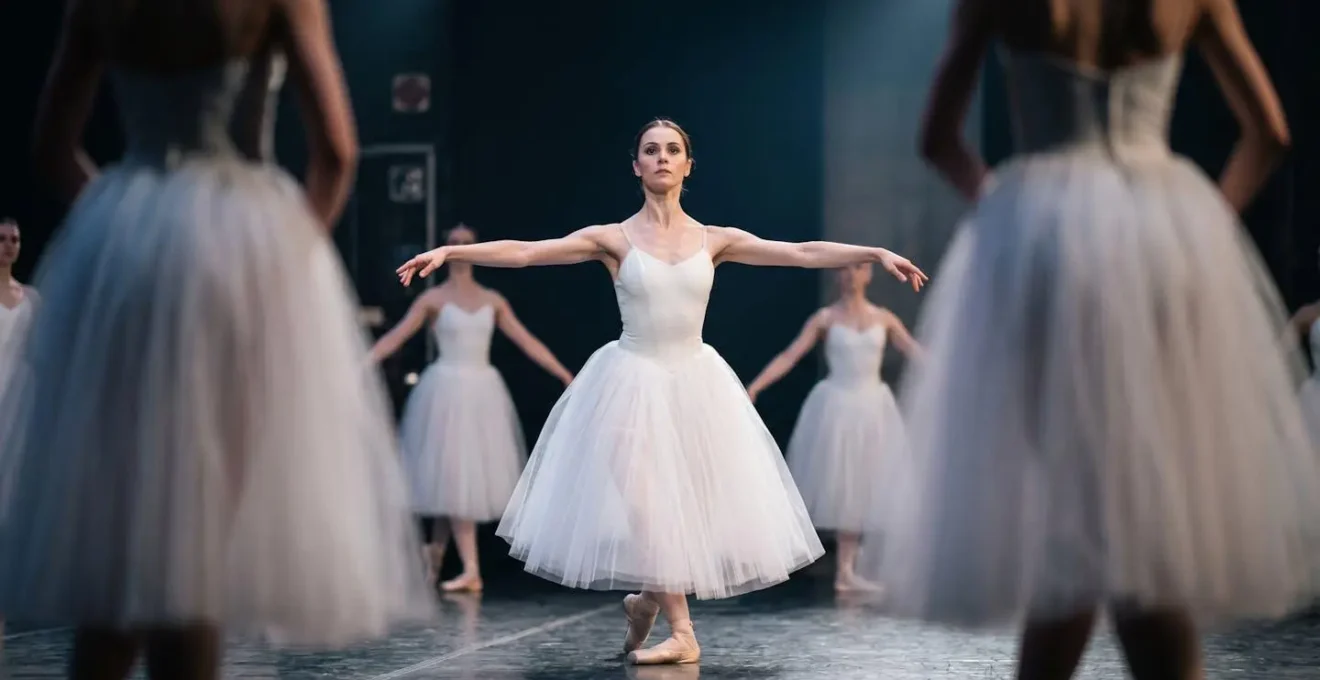
This quality is built through intention. Before you even move, define your purpose in the scene. Are you a guest at a royal ball? A grieving swan? A joyful peasant? Let that intention inform every port de bras, every glance. Practice filming yourself, not to check your alignment, but to watch your eyes. Do they look like a dancer concentrating, or a character experiencing something? The former is student work; the latter is professional artistry.
British Company Apprenticeship vs German Staatsballett Contract: Which Launches Careers Better?
Your talent is your product, and where you choose to sell it is one of the most significant business decisions you will ever make. For too many UK-trained dancers, the default path is to hammer on the doors of British companies. This often overlooks a more stable and potentially faster career track available in Germany. The German « Staatsballett » (state ballet) system operates on a fundamentally different model, one deeply rooted in a national respect for vocational training. This is evident even at a foundational level; while a mere 6% of English school leavers enter apprenticeships, a staggering one-third of their German counterparts do, creating a culture that values and protects skilled professions, including dance.
For a dancer, this translates into the « Festvertrag »—a permanent contract model that offers a level of job security, healthcare, and pension benefits almost unheard of in the project-based UK system. A UK apprentice contract is often precarious, dependent on annual funding cycles. A German contract is a state-backed position with regulated dismissal procedures. This stability is not just about peace of mind; it is a platform for artistic risk-taking. When you are not worried about your contract being renewed in six months, you are freer to grow as an artist.
This comparison is not just about security; it’s about opportunity and career velocity. The following table, based on a comparative analysis of the two systems, breaks down the core differences in these career pathways.
| Criteria | UK Ballet Apprenticeship | German Staatsballett Contract |
|---|---|---|
| Contract Structure | Project-based, often short-term apprenticeships | Regulated ‘Festvertrag’ (permanent contract) with state funding |
| Job Security | Less secure, dependent on annual funding and project availability | Strong employment protection, regulated dismissal procedures |
| Healthcare Benefits | NHS coverage (standard UK provision) | Comprehensive German health insurance system included |
| Pension Scheme | Variable, company-dependent | State-backed Dancers Pension Scheme (separate from state pension) |
| Performance Velocity | Slower progression, longer corps de ballet tenure | Faster role acquisition, more stage experience opportunities |
| Network Prestige | High-density connections in major UK/international dance hub | Regional network, strong local theatre ecosystem |
| Salary (Starting) | £23,813/year (2016 figure, corps de ballet first year) | €600-900/month apprentice allowance, progressing to competitive professional salary |
The choice is not simple. London offers unparalleled network prestige, but Germany offers a faster track to performing major roles and building a robust performance CV. Building a career is an act of strategic architecture. You must weigh the dense, high-stakes network of the UK against the stability and performance velocity of the German system and decide which environment is better suited to your long-term goals.
The Pain Ignored for 6 Months That Required Career-Ending Surgery at 24
We are taught from our first plié that pain is part of the process. Our tolerance for discomfort is a badge of honour. But there is a line between the « good pain » of muscle fatigue and the « bad pain » of a developing injury, and the culture of silence in the dance world encourages us to blur that line until it’s too late. The story is tragically common: a persistent ache in the ankle, a twinge in the hip, dismissed as normal. You push through rehearsals, ice it at night, and tell no one for fear of being seen as weak or losing a role. Six months later, that « twinge » is a torn labrum or a stress fracture that requires invasive surgery and a year of rehabilitation—if you’re lucky. For many, it’s the end of a career at 24.
Your body is not a tool to be used until it breaks; it is the most valuable asset you will ever own. Managing your physical health is not a weakness; it is a core professional strategy. The moment you sign a contract, injury prevention becomes as much a part of your job as attending class. This means listening to your body with an analytical, not an emotional, ear. It requires building a relationship with physiotherapists and doctors who understand the specific demands of dance. You must learn to distinguish between the soreness of exertion and the sharp, radiating, or persistent pain that signals genuine damage.
Proactive health management is about early, expert assessment, not stoic endurance. It’s about having the courage to speak up when something is wrong.

Ignoring pain is a gamble with stakes you cannot afford to lose. The dancer who lasts is not always the most talented, but the one who is the most intelligent about self-preservation. A short break to address a minor issue can save you from a forced, permanent retirement. Directors respect a dancer who is mature enough to manage their own instrument. They have no use for a brilliant performer who is perpetually injured. Your longevity in this career depends on this crucial mindset shift: your health is not secondary to your art, it is foundational to it.
When to Prioritise Class Over Rest During an Intensive Performance Run?
The schedule during a performance run is brutal: morning class, afternoon rehearsals, evening show, repeat. The temptation is to do it all, to prove your work ethic, to stay in peak form. But in this high-stakes environment, more is not always better. The belief that you must take class every single day, no matter what, is a relic of student thinking. As a professional, your primary job is to deliver a peak performance on stage at 7:30 PM. Sometimes, the most strategic choice you can make to achieve that is to skip class and rest.
But how do you make that call? It cannot be based on feeling « a bit tired. » That is a recipe for inconsistency. You need an objective system for evaluating your capacity. This is where the concept of Energy Auditing comes in. It’s a mental checklist you run every morning to make a strategic, not an emotional, decision about your day. You must assess your physical, mental, and emotional energy levels as separate but interconnected systems. Is your muscle soreness resolving, or is it accumulating? Can you focus and retain corrections, or is your brain foggy? Are you motivated, or are you feeling a sense of dread?
Answering these questions honestly allows you to distinguish between « good fatigue »—the healthy aftermath of exertion—and the systemic exhaustion that precedes injury and burnout. During a performance run, class should be for maintenance (« tuning the instrument »), not for improvement or pushing limits. Using a structured framework removes the guilt from resting and turns it into a calculated professional decision.
Your Daily Energy Auditing Framework
- Physical Energy Assessment: Rate muscle soreness (1-10), joint mobility, and overall fatigue level. Red flags include persistent pain lasting more than 24 hours post-performance, a noticeable reduction in your range of motion, or chronic exhaustion that doesn’t improve with sleep.
- Mental Energy Assessment: Evaluate your capacity to focus, your concentration during rehearsals, and your ability to retain corrections. Red flags are an inability to concentrate on tasks, repeatedly forgetting choreography, or feeling unusual irritability with colleagues.
- Emotional Energy Assessment: Monitor your motivation levels, anxiety about the upcoming performance, and your general emotional resilience. Red flags manifest as a feeling of dread before class, a significant escalation in performance anxiety, or a sense of emotional numbness or overwhelm.
- Decision Framework: If two or more red flags appear across any of the energy types, your priority must be rest over class. If all metrics point to « good fatigue » (post-exertion soreness without systemic exhaustion), attending class for maintenance is appropriate.
- Maintenance vs. Improvement Rule: During performance runs, your goal in class is solely to maintain your technical baseline. Never use this time to acquire new skills or push your physical limits, as the risk of a fatigue-related injury increases dramatically.
Actioning vs Stanislavski Objectives: Which Unlocks More Playable Choices for UK Dancers?
Here is where we bridge the gap between your physical technique and your dramatic purpose. A common criticism of technically brilliant dancers is that their performance, while perfect, feels sterile. They execute the steps but don’t communicate the story. The solution is to steal a powerful tool from the world of theatre: Actioning. While rooted in Stanislavski’s system of objectives, Actioning provides a more immediate and physical way to give your movement intention. It is the key to unlocking what directors call « playable choices. »
Instead of thinking about a broad emotional state (« I am sad »), you assign a transitive verb—an action—to a choreographic phrase. You are not just sad; you are « to plead » with your partner, « to reject » his advance, « to surrender » to your fate. This simple shift transforms a physical sequence into a dramatic event. As American Ballet Theatre’s renowned coach Irina Kolpakova powerfully demonstrated while coaching Swan Lake, the intention dictates the physical execution:
Don’t think about your shape when you first see Siegfried. This is not port de bras. This is ‘Don’t touch me!’
– Irina Kolpakova, Pointe Magazine
This approach moves you from simply making shapes to performing actions. Your port de bras is no longer just a position; it’s an act of « warding off, » « embracing, » or « revealing. » This gives your performance layers of meaning and provides the director with a range of interpretations to choose from. It is a technique increasingly taught at elite levels, as it directly addresses the need for dancers to be actors.
Case Study: Translating Actioning Technique for Ballet
Professional ballet pedagogy is increasingly borrowing from Stanislavski and actioning techniques used in British theatre. Instead of executing abstract movements, dancers assign transitive verbs (‘to plead,’ ‘to seduce,’ ‘to intimidate,’ ‘to protect’) to specific choreographic phrases. This transforms technical execution into dramatic action. The case study demonstrates how Royal Ballet School graduates apply this methodology: the same Black Swan variation can be performed with the objective ‘to seduce’ (characterised by a softer épaulement and an inviting gaze) versus ‘to intimidate’ (marked by a sharper attack and a commanding presence). This creates two physically identical but emotionally opposite interpretations that directors can select based on their production vision.
By building a vocabulary of actions for your roles, you develop what is known as Performance Intelligence. You are no longer just a body executing steps; you are a thinking, feeling artist making specific, communicable choices. This is what separates a good dancer from a captivating one.
Atelier Residency vs Online Mentorship: Which Fixes Technique Faster for £1,500?
Even with a contract, the work on your technique never stops. Identifying and fixing a persistent flaw—a « sticky » spot in your pirouettes, a weak jump, a coordination issue—is an ongoing professional responsibility. With a finite budget, say £1,500, you face a strategic choice: invest in an intensive, in-person atelier residency or a longer-term online mentorship program. The right answer depends entirely on the nature of your problem. You must accurately diagnose whether you have a « hardware » or a « software » issue.
A « hardware » issue is physical: a problem of alignment, weight placement, or muscular engagement. These issues benefit most from the hands-on, tactile feedback of an in-person residency. A master teacher can physically adjust your hip placement or demonstrate the correct proprioceptive feeling, providing an immediate correction that video analysis cannot replicate. The immersive environment and high number of contact hours are designed for rapid physical recalibration.
A « software » issue, by contrast, is conceptual: a misunderstanding of the mechanics of a step, a mental block, or a coordination pattern that needs to be re-written. These problems are often better addressed through the methodical, personalized approach of online mentorship. A mentor can use video analysis to break down your movement frame by frame, assign targeted homework exercises, and track your progress over several weeks. This distributed learning model allows time for new neural pathways to form.
The decision on how to invest your own professional development funds is a business calculation. An analysis of the return on investment for both models highlights the trade-offs in time, cost, and feedback style.
| Factor | Atelier Residency (In-Person) | Online Mentorship Program |
|---|---|---|
| Best For | ‘Hardware’ issues: physical alignment, hands-on correction, proprioceptive feedback | ‘Software’ issues: coordination misunderstandings, mental blocks, conceptual technique gaps |
| Time Investment | Intensive 1-2 week immersion (35-50 contact hours) | Distributed 8-12 weeks (12-20 contact hours + homework) |
| Feedback Depth | Immediate tactile correction, real-time spatial adjustment | Video analysis with detailed written/verbal feedback, homework exercises |
| Network Capital | High: connections with peers, faculty, potential company directors | Low: one-to-one relationship with mentor only |
| Personalization | Moderate: group setting with some individual attention | High: 100% personalized focus, tailored correction plan |
| Post-Program Support | Limited: ends after residency concludes | Extended: ongoing communication, progress tracking possible |
| Hidden Costs | Travel, accommodation, meals (additional £300-600) | Minimal: stable internet connection, video recording equipment |
Key Takeaways
- Artistic presence is more valuable to directors than sterile technical perfection.
- Managing your health, career path, and professional development are strategic business decisions, not afterthoughts.
- Emotional connection is a skill built through specific techniques like Actioning and embracing strategic vulnerability.
Why Does Your Technically Perfect Performance Leave Audiences Emotionally Cold?
We’ve come full circle. You have the technique, you’ve started developing your presence, and you’re thinking more strategically about your career and health. Yet, there can still be a final, invisible barrier between you and the audience: the pursuit of an effortless facade. The traditional ballet aesthetic teaches us to hide the struggle, to present a vision of weightless, flawless perfection. But this can create a performance that, while technically astounding, is emotionally sterile. It leaves an audience impressed, but unmoved.
The counter-intuitive truth is that audiences connect with humanity, and humanity involves effort. Choreographer Gillian Rhodes has explored this concept in her work on what she calls the « Vulnerability Gap. » This principle suggests that audiences form a more powerful bond with performers who allow their authentic effort, their breath, and their struggle to be visible. It’s not about being messy or losing your technique; it’s about letting the human being behind the dancer be seen. When you are a transparent channel for emotion, rather than an opaque wall of perfection, you become magnetic.
Case Study: The Vulnerability Gap
Choreographer and performer Gillian Rhodes documents the counterintuitive ‘Vulnerability Gap’ principle: audiences connect more powerfully with dancers who allow visible effort and authentic breathing rather than maintaining a flawless, effortless facade. According to her research, when dancers become ‘channels through which emotion flows’ rather than perfect technicians hiding struggle, they create magnetic performances. Rhodes’s findings show that immersion in a ‘flow state’—where movements feel spontaneous despite being rehearsed—combined with a genuine joy of performance, creates a stage presence that transcends technical perfection. This challenges the traditional ballet aesthetic of effortless execution, suggesting that strategic vulnerability—showing the humanity behind the technique—builds deeper audience engagement than mechanical perfection ever could.
This is the final piece of the puzzle. It requires the courage to be imperfect, to let your breath be heard, to sacrifice a fraction of your perfect line for a moment of raw, authentic emotion. This is the synthesis of everything: your technique provides the control, your performance intelligence provides the intention, and your vulnerability provides the connection. This is what transforms you from a great dancer into an unforgettable artist.
Your journey from the studio to the stage is not a test of your ability to replicate what you were taught. It is an audition for your potential as an artist. It requires you to be a strategist, a business owner, and a storyteller. Stop chasing the ghost of the perfect student and start building the reality of the invaluable artistic asset. Assess your presence, manage your health, make smart career choices, and dare to be human on stage. That is how you will get the contract.