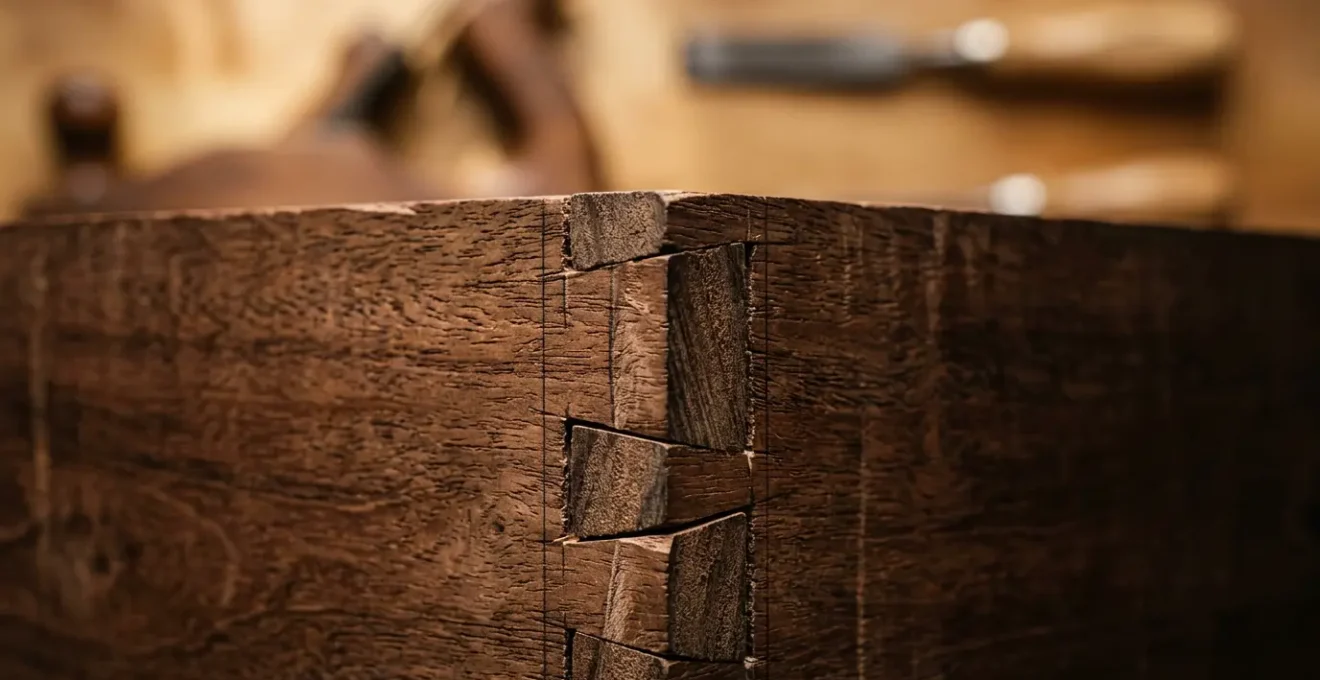
The revival of Georgian craft in London isn’t about nostalgia; it’s a strategic move to embed a sensory richness into modern design that digital fabrication cannot replicate.
- Hand-tooling creates unique « visual and haptic signatures »—subtle imperfections and textures—that our senses perceive as authentic and valuable.
- The difference between masterwork and amateur joinery lies less in the joint itself and more in the ‘visual grammar’ of the surrounding details, like shadow lines and chamfers.
Recommendation: Instead of simply replicating historical forms, contemporary makers should focus on reverse-engineering the sensory impact of these techniques to create emotionally resonant objects.
In a sleek Shoreditch workshop, amidst the hum of 3D printers and the glow of CAD software, a designer reaches for a tool that hasn’t changed much in 300 years: a hand plane. This scene isn’t an anomaly; it’s a growing movement. Across London, from Clerkenwell to Bermondsey, cutting-edge design studios are turning to Georgian furniture techniques. The easy explanation points to a renewed appreciation for quality, sustainability, or a simple rejection of mass-produced uniformity. These are valid points, but they miss the more profound reason for this resurgence.
The true motivation lies deeper, in the realm of human perception. The enduring power of 18th-century craft is not just in its longevity but in its ability to communicate authenticity through touch and sight. This isn’t merely about making things « by hand. » It’s about understanding and deliberately deploying the subtle, almost subliminal cues—the haptic signature of a hand-carved surface, the visual grammar of a perfectly executed joint—that tell a story of human skill and intention. These are the very qualities that a CNC-routed path, no matter how precise, inherently erases.
But how does a contemporary maker bridge this 300-year gap? The answer is not to become a historical re-enactor, but a strategic interpreter. It requires a shift in mindset: from simply copying a form to deconstructing its sensory impact. This article will serve as a bridge, exploring the perceptible differences between hand and machine work, decoding the lessons hidden in museum collections, and providing a framework for when to invest hundreds of hours in a technique that seems, at first glance, anachronistic. It’s a journey into the « why » behind the « how, » revealing that the most innovative path forward sometimes involves looking back.
To fully grasp how these historical methods can elevate contemporary practice, we will explore the tangible and intangible qualities that set them apart. This guide deconstructs the specific visual, tactile, and strategic elements that make Georgian craftsmanship a powerful tool for modern designers.
Summary: Why Georgian Furniture Techniques Are Redefining Modern Design
- Why Does Hand-Cut Dovetailing Look Different from CNC-Routed Joints Even to Untrained Eyes?
- Why Does a Hand-Planed Surface Reflect Light Differently Than Machine-Sanded Wood?
- Why Can Collectors Feel the Difference Between Hand-Carved and CNC-Cut Wood?
- How to Reverse-Engineer an 18th-Century Joint by Studying V&A Collection Pieces?
- Georgian Guild Records vs Modern Textbooks: Which Teaches Joinery Fundamentals Better?
- The Historical Accuracy Obsession That Alienates Contemporary Buyers
- When to Invest 200 Hours in Historical Technique: Early Career or After Commercial Stability?
- Why Does Your Joinery Look Amateur Next to 18th-Century Originals in the V&A?
Why Does Hand-Cut Dovetailing Look Different from CNC-Routed Joints Even to Untrained Eyes?
The difference between a hand-cut dovetail and its CNC-milled counterpart is felt as much as it is seen, and it speaks directly to our subconscious perception of authenticity. Even to an untrained eye, the hand-cut joint often projects a sense of precision and intentionality that a machined joint lacks. This is not because the machine is less accurate—in fact, it’s dimensionally perfect. The reason lies in the subtle « mistakes » and sharp details that are hallmarks of the human hand. Handmade products generate an emotional dimension precisely because they carry these traces of their creation.
A key visual giveaway is the geometry of the joint itself. A CNC router bit is round and spinning, meaning it can never create a perfectly sharp internal corner. It will always leave a small radius, or fillet. A craftsman using a chisel, however, creates a crisp, near-zero-radius corner. Furthermore, a skilled woodworker can make the « pins » of the dovetail exceptionally thin, a delicate feature that is often impossible for a standard router bit, which has a minimum cutting diameter. These impossibly thin pins and razor-sharp internal corners are a direct broadcast of hand-skill.
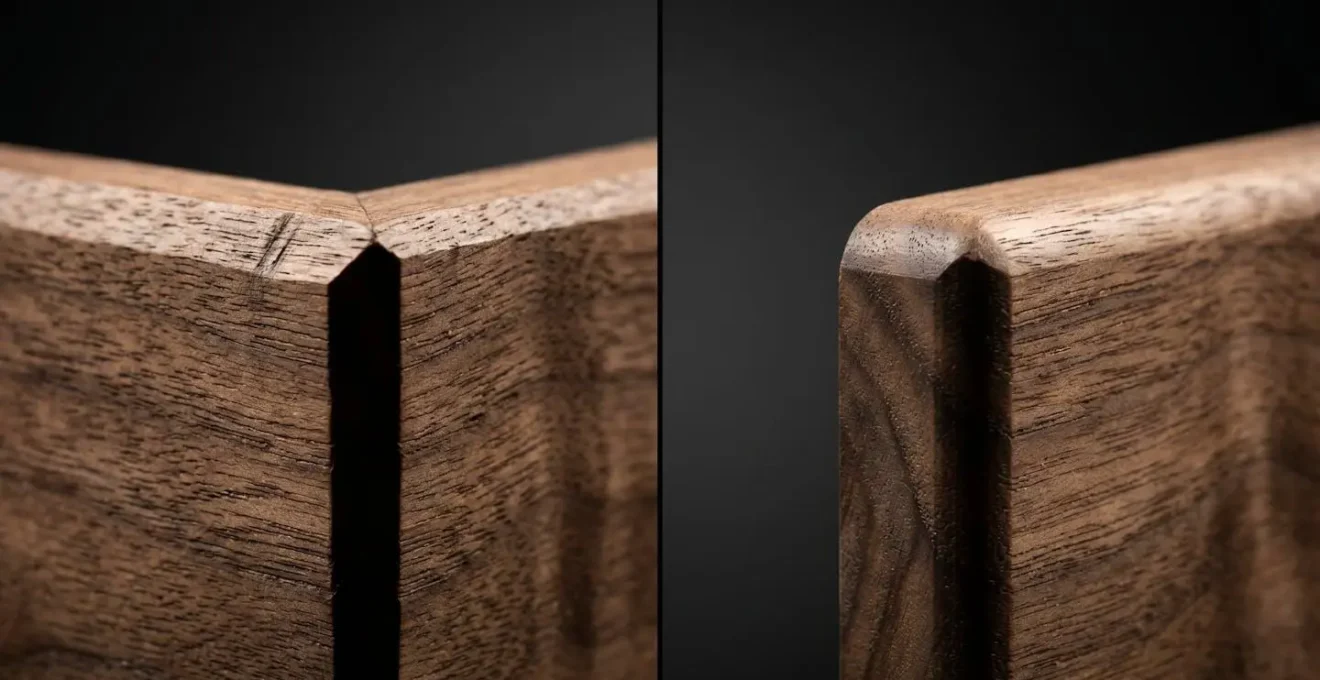
The image above highlights another subliminal difference: the scribe line. A hand-cut joint begins with a faint line scored into the wood with a marking knife. This tiny incision severs the wood fibers, creating a clean starting point for the chisel and resulting in a crisp, defined shoulder line that casts a sharp shadow. A CNC-cut joint lacks this foundational mark, often resulting in a slightly softer, less-defined edge where the two pieces of wood meet. It’s this collection of micro-details that our brains process as a cohesive language of craft.
Why Does a Hand-Planed Surface Reflect Light Differently Than Machine-Sanded Wood?
The profound difference in how light interacts with a hand-planed versus a machine-sanded surface is one of the most compelling arguments for reviving historical techniques. It’s not a matter of opinion but of physics. A sanded surface, when viewed at a microscopic level, is a chaotic landscape of torn and crushed wood fibers. The abrasive grit doesn’t cut; it scratches and pulverizes, creating a matted, diffuse texture that scatters light in all directions. This results in a dull, flat appearance, no matter how « smooth » it feels to the touch.
A hand plane, by contrast, operates with surgical precision. As master woodworker Rob Cosman explains, a sharp plane blade works by shearing the wood fibers cleanly, creating a unified surface composed of millions of tiny, contiguous facets. This is the essence of what I call light-shearing versus fiber-abrasion.
A sharp plane blade cleanly shears wood fibers, creating millions of tiny, contiguous, reflective facets. Sanding uses abrasion to tear and pulverize the top layer of fibers, creating a matted, non-directional surface that scatters light diffusely.
– Rob Cosman, Planing Wood Smooth
This clean-sheared surface acts like a single, slightly undulating mirror. It reflects light coherently, revealing the depth and chatoyance of the wood grain in a way sanding can never achieve. This phenomenon, known as « figure, » is the shimmering, three-dimensional quality seen in woods like maple or walnut. Scientific analysis confirms this; research on wood optics demonstrates that lightness and reflectance are determined by how light interacts with the wood’s cellular structure. Planing preserves this structure, while sanding destroys it. For a designer, this means a hand plane is not just a tool for flattening wood; it’s a tool for controlling light itself.
Why Can Collectors Feel the Difference Between Hand-Carved and CNC-Cut Wood?
The ability of collectors and connoisseurs to discern a hand-carved object from a machine-made one by touch alone is not mystique; it’s neuroscience. Our fingertips are incredibly sensitive instruments, capable of detecting microscopic variations. A surface carved by hand is a landscape of flowing, non-repeating tool marks. Each pass of the gouge or chisel leaves a unique path, a subtle record of the maker’s pressure, angle, and rhythm. This complex topography is what researchers call a « haptic signature. »
A CNC-milled surface, on the other hand, is a landscape of perfect, unvarying repetition. The path of the rotating cutter, guided by a digital file, creates a uniform texture. While it may be complex, it lacks the organic variation of handwork. Our sense of touch picks up on this regularity, which can feel sterile or lifeless by comparison. The « haptic signature » of a hand-carved piece is a direct, tactile connection to the maker’s process. It’s a form of embodied knowledge transferred from maker to object, and then from object to observer.
This transmission of skill through a material object is a core concept in craftsmanship. As studies on tacit knowledge in crafts reveal that the nuances of making cannot be learned from a book or a screen; they are acquired through physical engagement. This same principle applies to appreciation. The « feel » of a piece is a form of practical perception, an authenticating clue that tells us this object was shaped by a human hand, not just a computer program. It is this sensory feedback that creates a powerful sense of connection and value for the collector.
How to Reverse-Engineer an 18th-Century Joint by Studying V&A Collection Pieces?
For any London-based maker, the Victoria and Albert Museum is not just a repository of beautiful objects; it is an unparalleled library of techniques. To reverse-engineer an 18th-century joint, one must learn to « read » the furniture not as a finished product, but as a series of decisions and actions frozen in time. The V&A’s dedicated furniture gallery is uniquely suited for this, as its curatorial approach often groups items by construction method rather than just chronology.
Case Study: The V&A’s Technique-Based Curation
The Dr. Susan Weber Gallery at the V&A presents a revolutionary way to study furniture. By arranging over 200 pieces thematically, with displays focused on joinery, carving, and finishing, it allows makers to draw direct comparisons. Conservation analysis, a key part of the gallery’s mission, has unearthed hidden construction details, such as the discovery that an 18th-century bureau veneered with mother-of-pearl required an estimated 5,000 hours of labor. These displays effectively act as three-dimensional textbooks, showing not just the ‘what’ but the ‘how’ of historical craft.
To begin, focus on the imperfections. Machine-made furniture strives for a flawless, homogenous surface. Antique furniture, even the highest-end pieces, celebrates a different kind of perfection—one that includes the subtle marks of its making. Look for the slight unevenness in the spacing of dovetails, the faint scribe line at the shoulder of a tenon, or the almost imperceptible bruising of the wood where a clamp was applied. These are not flaws; they are authentication clues that tell the story of the tool used and the hand that guided it.
Start by photographing a joint from multiple angles under different lighting. Sketch it, not just its overall shape, but the direction of the tool marks. Ask critical questions: Is there a scribe line? How was it made—with a knife or a gauge? Are the saw kerfs visible on the inside of the joint? Can you see the faintest ripple from a hand plane on the adjacent surface? By documenting this visual grammar, you are not just copying a joint; you are reverse-engineering the thought process and physical movements of the original Georgian craftsman.
Georgian Guild Records vs Modern Textbooks: Which Teaches Joinery Fundamentals Better?
This question presents a false dichotomy. Modern textbooks and Georgian guild records are not competitors; they are complementary sources of knowledge that teach different things. A modern textbook is unparalleled at teaching the explicit knowledge of joinery: the geometry of a dovetail, the mechanical principles of a mortise-and-tenon, the sequential steps of construction. It provides a clear, rational, and repeatable blueprint. For learning the « what » and the « how-to » in a structured way, textbooks are indispensable.
Georgian guild records, apprenticeship indentures, and the surviving objects themselves, however, teach the far more elusive tacit knowledge. This is the knowledge that is « in the hands, » a deep, intuitive understanding of material and process that cannot be fully articulated in words. It’s the feel for how much pressure to apply to a chisel, the sound of a plane when it’s cutting perfectly, the ability to read the grain of a board and predict how it will behave. Research into craftsmanship describes this as a « perceptive-cognitive alignment, » a process of attuning one’s skills to the feedback of the material world.
Where a textbook might give you five steps to cut a tenon, the culture of a Georgian workshop—partially gleaned from guild records—would have taught an apprentice how to adapt that process to a dozen different wood species, each with its own character. It taught economy of motion, the strategic use of materials, and an obsession with the sharpness of one’s tools. Therefore, the modern maker should use textbooks to build the foundational, explicit skills. But to achieve mastery—that fluid, intuitive competence seen in 18th-century work—one must pursue the tacit knowledge, either through relentless practice, mentorship, or the careful deconstruction of historical objects. The textbook gives you the map, but the guild tradition teaches you how to read the terrain.
The Historical Accuracy Obsession That Alienates Contemporary Buyers
A common pitfall for makers rediscovering historical techniques is the slide from appreciation into an obsession with perfect historical replication. While admirable from a scholarly perspective, this pursuit of absolute accuracy can be a commercial dead end. The contemporary buyer, even at the high end, is not typically a museum curator. They are looking for a piece that feels authentic, well-made, and relevant to their modern life, not a flawless 18th-century reproduction that feels like an artifact.
The key is to understand the psychology of what makes an object feel « real. » It isn’t about 100% historical fidelity. Instead, it’s about what researchers call perceptual authenticity. This is where the subtle markers of handcraft—the non-repeating tool marks, the crisp shadow lines—play a crucial role. These elements signal human intention and skill, which triggers a positive emotional response. In fact, research on craft authenticity shows that perceived genuineness in one aspect creates a « halo effect, » enhancing the positive evaluation of the entire object.
This means a maker can be highly strategic. You don’t need to use period-correct hide glue if a modern adhesive is better for the application, as long as the visible, touchable parts of the piece communicate craft. This is strategic anachronism: the art of combining the best of old and new. A maker might use a CNC machine for the laborious work of roughing out components but switch to hand tools for the final fitting and surface finishing, embedding that crucial haptic and visual signature where it matters most. The goal is not to create a perfect copy of the past, but to borrow its language to tell a compelling story in the present.
When to Invest 200 Hours in Historical Technique: Early Career or After Commercial Stability?
The decision to invest a significant amount of time—say, 200 hours—mastering a complex historical technique like hand-cut joinery or decorative carving is a critical business calculation for any independent maker. The romantic ideal is to pursue craft for its own sake, but the practical reality demands a return on that time investment. There are compelling arguments for both approaches: investing early to build a brand identity, or waiting for commercial stability before dedicating time to non-essential skills.
Investing early, while financially risky, can be a powerful market differentiator. In a crowded field of makers, being the one who can execute a perfect serpentine front or a complex rococo carving establishes a reputation for elite skill. This can attract a niche clientele willing to pay a premium for unparalleled craftsmanship, effectively building your brand around mastery from day one. However, it can also lead to burnout if the high-end commissions don’t materialize quickly.
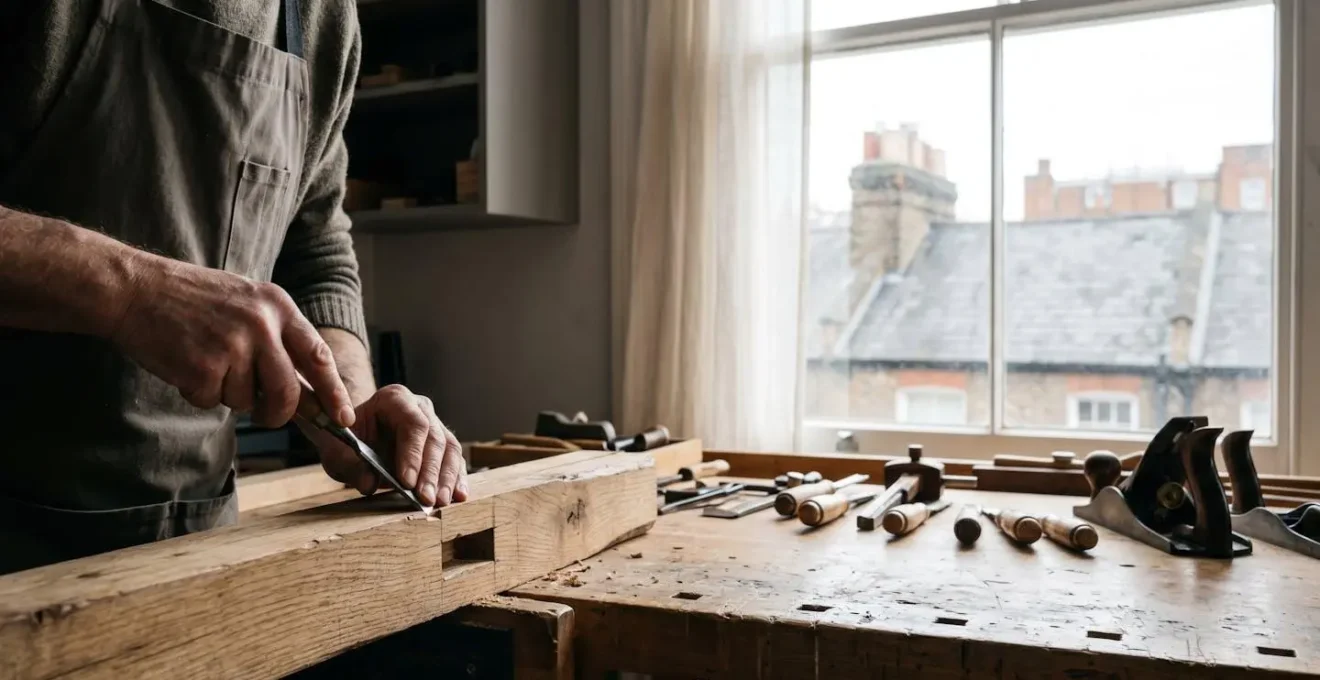
The more pragmatic approach is to first establish a commercially viable studio based on more efficient, modern construction methods. Once a stable revenue stream is secured, the maker can then reinvest profits and time into « slow craft » techniques. This allows for experimentation without the pressure of immediate financial return. These new skills can then be introduced as a premium offering, a « capsule collection, » or a signature detail that elevates the existing product line. Ultimately, the choice depends on the maker’s personal risk tolerance and business strategy, but a structured approach is essential.
Your Action Plan: Integrating Slow Craft Strategically
- Position as a Differentiator: Identify a specific historical technique that complements your modern aesthetic and market it as a signature of quality and character, creating pieces with a presence factory-made items lack.
- Align with Sustainability: Frame your use of traditional joinery as a commitment to longevity and a move away from « throwaway culture, » using responsibly sourced timber for furniture designed to last generations.
- Develop as Repairable Infrastructure: Focus on joinery methods (like mortise-and-tenon) that are not only strong but can be maintained or repaired, adding long-term value and a selling point for discerning clients.
- Cultivate as a Competitive Advantage: Document and share your process of learning and applying a historical technique. This narrative of patience and deliberate skill becomes a powerful marketing tool that builds your brand’s authority.
- Balance Viability and Mastery: Don’t go all-in at once. Introduce one « slow craft » element at a time, analyzing its impact on your workflow, pricing, and client reception before committing further.
Key Takeaways
- The power of Georgian craft lies in its « sensory signature »—the visual and tactile cues from hand tools that our brains interpret as authentic and valuable.
- Learning from historical masters is not about blind replication but about deconstructing their « visual grammar » by studying the details around the joinery in museum originals.
- The most successful contemporary makers practice « strategic anachronism, » combining modern efficiency with historical techniques where they have the most sensory and narrative impact.
Why Does Your Joinery Look Amateur Next to 18th-Century Originals in the V&A?
Staring at a piece of 18th-century cabinetry in the V&A can be a humbling experience for a modern maker. The precision and life in the joinery seem to belong to another plane of existence. The secret, however, often lies not in the joint itself, but in the meticulous details surrounding it. Amateur joinery focuses on getting the two pieces of wood to fit. Masterful joinery focuses on how the joint is presented. It’s the difference between a statement and a mumble.
As insights from V&A curators suggest, Georgian masters were obsessed with the visual grammar that frames a joint. This includes several key elements. First is the crispness of the shoulder lines, cut with a knife to sever fibers cleanly, creating a stark shadow that defines the joint’s edge. Second is the use of a subtle chamfer or bevel on the edges of the components. This tiny detail catches the light, visually separating the joint from the surrounding surface and making it « pop. » Third is the perfect parallelism of layout lines and the precision with which they are executed, signaling a deep discipline.
Furthermore, historical makers demonstrated a profound ingenuity and understanding of material economy. They knew precisely where to apply lavish detail and where to be frugal. Decoration was concentrated where it would be seen and appreciated, a principle modern designers can learn from. The focus was always on the overall composition. An « amateur » joint might be structurally sound, but it often sits dead on a surface. A master’s joint actively participates in the piece’s design; it controls light and shadow, creates rhythm, and directs the eye. It is a focal point, not just a connection point. The goal is to stop thinking about joinery as mere engineering and start thinking of it as a form of communication.
The next time you are at your bench, shift your focus from the fit of the joint itself to the narrative you build around it. Consider the shadow lines, the edge treatments, and the rhythm they create. That is where craft transcends construction and becomes art. That is where mastery begins.