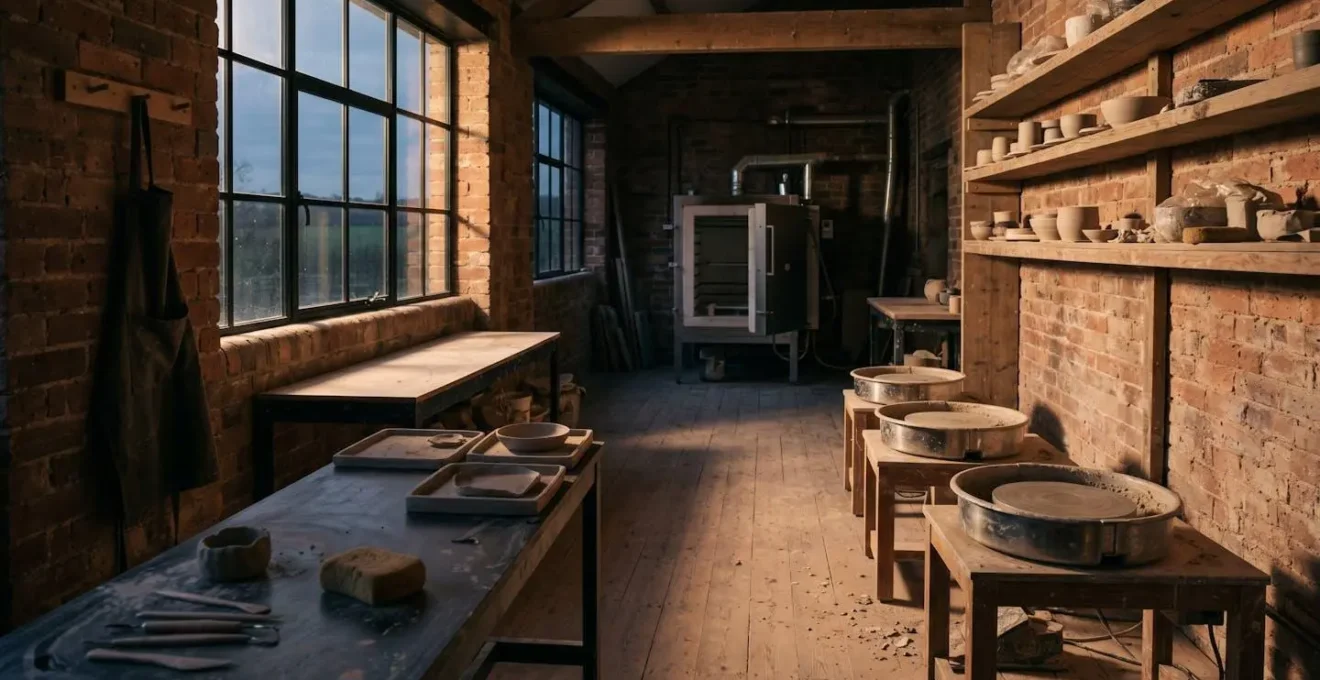
The high failure rate of UK pottery studios is not due to a lack of artistic talent, but a failure to implement a system of robust operational levers.
- Profitability hinges on moving beyond basic cost-plus pricing to strategic curriculum design that guarantees student retention and high-margin corporate offerings.
- Long-term viability depends on proactively managing specific financial risks, from hidden equipment costs to critical insurance gaps, and planning for succession.
Recommendation: Shift your mindset from being a potter who teaches to a business operator who leverages pottery skills, focusing on creating a sellable asset, not just a job.
The dream is alluring: turning a passion for pottery into a source of income by sharing your craft with others. Yet, the question posed in the title reflects a harsh reality for many UK ceramicists. The path to a thriving workshop is littered with financial pitfalls that passion alone cannot overcome. Many new studio owners focus on creating a beautiful, inspiring space and marketing their classes on social media, believing that quality teaching and artistic integrity will naturally lead to success. They often follow generic business advice, calculating prices based on clay and firing costs, and hope for the best.
But what if this approach is fundamentally flawed? What if the key to survival and profitability isn’t just about being a better artist or a more enthusiastic teacher? The uncomfortable truth is that a successful pottery studio operates less like an art project and more like a well-oiled machine. Its success is determined by a series of interconnected operational levers: the granular details of kiln economics, the psychological architecture of a course curriculum, the strategic targeting of different client types, and the sober management of financial risk.
This article will not offer platitudes about passion. Instead, it provides a pragmatic, commercially realistic roadmap. We will deconstruct the hidden costs, analyse proven revenue models, identify critical liabilities, and explore the long-term strategies that separate the studios that close from the ones that flourish and become valuable assets. It’s time to move beyond the potter’s wheel and look at the business with the clear eyes of a strategist.
This guide breaks down the essential business levers you need to control to build a resilient and profitable pottery studio in the UK. Explore the sections below to master each component, from fine-tuning your costs to maximising your value.
Summary: A Pragmatic Guide to Building a Viable Pottery Teaching Business
- Why Does Firing a Kiln Cost £45 Per Load and How Does That Affect Pricing?
- How to Design a 6-Session Course That Makes 80% of Students Return for Level 2?
- Wheel Classes vs Hand-Building: Which Attracts More Corporate Away-Day Bookings?
- The Insurance Gap That Leaves 60% of UK Pottery Teachers Personally Liable for Burns
- When to Launch New Pottery Courses: January Wellness Rush or September Fresh-Start Energy?
- When to Start Training a Successor: At 50 or When Orders Exceed Capacity?
- Solar Panels vs Green Tariff: Which Reduces a Kiln-Intensive Studio’s Emissions More Cost-Effectively?
- Why Do Skilled Woodworkers Earn Less Than Plumbers Despite Longer Training?
Why Does Firing a Kiln Cost £45 Per Load and How Does That Affect Pricing?
The figure of £45 for a single kiln load can be alarming, often representing a worst-case scenario involving a large kiln, peak electricity rates, and a very long, high-temperature firing. In reality, for most small to medium-sized UK studios, the direct energy cost is more manageable. Data from UK pottery suppliers shows an average cost of £4-6 per firing for a typical hobbyist kiln. So, where does the inflated perception of cost come from? It comes from ignoring the hidden operational costs that are intrinsically linked to each firing cycle.

The true cost per firing is not just the electricity consumed. It must include the amortised cost of the kiln itself, the inevitable degradation and replacement of expensive heating elements and thermocouples, and the cost of kiln furniture (shelves, props) which all have a finite lifespan. As the image above illustrates, each firing causes microscopic wear and tear that accumulates into significant future capital expenditure. Therefore, pricing a class or a piece based solely on the raw electricity bill is a direct path to unprofitability. A fully-loaded cost model is essential, factoring in maintenance, depreciation, and consumables into every firing.
Don’t fire the kiln unless it’s full. Making the most out of each firing by ensuring that your kiln is as full as possible can significantly reduce the cost per piece.
– Sarah Mitchell, Kiln Crafts UK – Cost to Run a Pottery Kiln
This principle of maximising kiln capacity is the most powerful operational lever for controlling firing costs. A half-empty kiln costs almost as much to fire as a full one, effectively doubling the cost per item. Your pricing strategy must therefore not only cover the fully-loaded cost but also incentivise a workflow that ensures every firing is economically efficient. This might mean setting minimum class sizes or establishing a clear schedule for bisque and glaze firings to consolidate work from multiple classes.
How to Design a 6-Session Course That Makes 80% of Students Return for Level 2?
For a pottery studio, student retention is the engine of profitability. Acquiring a new customer is expensive; getting an existing one to return is smart business. While industry research shows average retention rates between 30% and 60%, achieving an ambitious 80% return rate is not a matter of luck. It’s a matter of strategic curriculum design. The goal is to structure your foundational course not as a self-contained experience, but as the compelling first chapter of a longer story. The student shouldn’t just leave with a finished pot; they should leave with a clear sense of progress and a strong desire for what comes next.
This means treating your curriculum as a sales funnel. The initial sessions must deliver immediate success and build confidence, while the later sessions must strategically reveal the depth and complexity of the craft, creating an appetite for more advanced skills. It’s a delicate balance of gratification and aspiration. A student who successfully makes a simple pinch pot in session one is happy; a student who sees you demonstrate the art of pulling a complex vase handle in session five, and is told « that’s what we cover in Level 2, » becomes a future customer.
Action Plan: Structuring a High-Retention 6-Session Course
- Sessions 1-2 (Foundation & Confidence): Introduce clay types (stoneware, earthenware) and master fundamental hand-building techniques. The goal is to ensure every student creates a successful piece they are proud of, establishing a strong feeling of accomplishment.
- Sessions 3-4 (Introducing the Wheel): Begin wheel throwing basics like centering and opening. This new challenge creates engagement, while continuing hand-building ensures they still have projects progressing, mitigating potential frustration from the wheel’s steep learning curve.
- Session 5 (The ‘Teaser’ Session): Demonstrate more complex techniques, such as advanced glazing or altering thrown forms, that are explicitly framed as « what you’ll learn in Level 2. » This plants the seed of continuation by showcasing a clear path to mastery.
- Session 6 (Celebration & Conversion): Host a mini-exhibition of the students’ work. Provide printed « Certificate of Completion » and facilitate peer appreciation. Conclude with a time-sensitive « Graduate’s Discount » for immediate booking of the Level 2 course, converting intent into action.
By structuring the course in this way, you transform the final session from a simple farewell into a powerful conversion event. The combination of pride in their finished work, a clear vision of their future skills, and a tangible incentive creates a powerful psychological pull towards re-enrolment, making the 80% target a strategic objective rather than a hopeful guess.
Wheel Classes vs Hand-Building: Which Attracts More Corporate Away-Day Bookings?
Diversifying into the corporate market is a powerful operational lever for a pottery studio, offering higher margins and filling weekday slots. However, the key is to offer the right product. The choice between wheel-throwing and hand-building is not just an artistic one; it’s a strategic business decision that caters to different corporate needs, group sizes, and budgets. While the iconic ‘Ghost’ moment at the wheel has strong individual appeal, hand-building often proves to be the more versatile and scalable option for corporate clients.
A successful model, as demonstrated by UK studios like Honeybourne Pottery, is to not choose one over the other but to position them as distinct solutions for different corporate objectives. As their approach shows, wheel-throwing can be marketed as a premium, intensive experience for smaller leadership teams focusing on individual resilience and focus. In contrast, hand-building is perfect for larger departmental events where collaboration, creativity, and a high success rate are the primary goals. The following table, based on an analysis of the UK corporate market, breaks down the core differences.
| Factor | Wheel-Throwing | Hand-Building |
|---|---|---|
| Group Size Capacity | 1:1 ratio (limited by wheel count) | Higher capacity (10-30+ participants) |
| Corporate Appeal | Individual focus & resilience training | Team collaboration & creativity |
| Price Point (UK Market) | £60-70 per person (premium) | £30-45 per person (scalable) |
| Skill Development Time | 2.5-3 hours for basic competency | 1.5-2 hours for finished piece |
| Instagram Factor | High – iconic ‘Ghost’ moment individual photos | Moderate-High – collaborative group project photos |
| Success Rate | Lower (higher failure rate for beginners) | Higher (more forgiving techniques) |
Ultimately, hand-building workshops offer a lower barrier to entry, a higher guarantee of a successful outcome for all participants, and greater logistical scalability, making them the more frequent choice for large corporate team-building days. Wheel-throwing, while less scalable, can be a highly profitable, premium offering. The most resilient business strategy is to develop and market both, allowing you to capture a wider spectrum of the lucrative corporate market by tailoring your pitch to the client’s specific team size and desired outcomes.
The Insurance Gap That Leaves 60% of UK Pottery Teachers Personally Liable for Burns
While worrying about kiln costs and student numbers, many studio owners overlook a far greater threat: financial ruin from a liability claim. The high-temperature environment of a pottery studio, with kilns reaching over 1200°C, presents significant risks of burns or other injuries. The title’s alarming statistic reflects a common and dangerous misunderstanding about insurance. Many artisans assume their standard Public Liability insurance covers them for teaching, but often there’s a crucial gap in the policy, especially concerning « hot works » or activities involving high heat.

This oversight can leave a sole trader or small business owner personally liable for damages, a risk that could easily shutter a business. This fragility is reflected across the craft sector; a report from Heritage Crafts UK noted that five major UK pottery firms closed in recent years, highlighting the sector’s vulnerability to all forms of risk, both market-driven and operational. An insurance policy is not just a box-ticking exercise; it’s a critical piece of financial armour. You must explicitly confirm with your insurer that your policy covers teaching activities and includes specific provisions for injury related to kiln use. A specialist craft insurance provider is often the safest choice.
Beyond insurance, proactive risk mitigation is your best defence. This includes documented safety briefings for every class, clear signage around the kiln area, providing appropriate personal protective equipment (PPE) like heat-resistant gloves, and maintaining a meticulously organised and safe workspace as shown above. These are not just best practices; they are demonstrable proof that you have taken reasonable steps to ensure student safety, which is invaluable in the event of a claim. Failing to manage this risk is a gamble that no small business can afford to take.
When to Launch New Pottery Courses: January Wellness Rush or September Fresh-Start Energy?
A profitable studio doesn’t just offer great courses; it offers them at the precise moment people are most motivated to buy. Timing your course launches to align with seasonal consumer behaviour is a key operational lever. The two most powerful windows for marketing longer, high-commitment courses are indeed January and September. January taps into the « New Year, New Me » wellness trend, where people are actively seeking new hobbies and self-improvement activities. September leverages the « back to school » energy that encourages adults to start new learning projects after the summer break.
However, a truly strategic calendar goes beyond these two peaks. The entire year should be mapped out with a diverse portfolio of offerings designed to maximise revenue during both high and low seasons. The quiet months of April or October aren’t « downtime »; they are opportunities for premium, specialised workshops that appeal to a smaller, more dedicated audience. The summer holidays are perfect for high-volume, low-commitment taster sessions that act as lead generation for your September courses. A robust annual plan ensures consistent cash flow and maximises facility usage.
A well-structured course calendar for a UK studio might look like this:
- Q1 (Jan-Mar): Launch your flagship 6-8 week foundation courses. This is the time for high-ticket packages (£250-£450) capitalising on New Year’s resolutions and corporate teams planning their annual training budgets.
- Q2 (Apr-May): Fill the post-Easter lull with specialised weekend workshops (e.g., Raku firing, advanced glazing) at a premium price point (£70-£80) to attract existing students and experienced potters.
- Q3 (Jun-Aug): Pivot to high-volume taster sessions (£40-£55) and children’s summer camps. The goal is to maximise footfall and build an email list for the main September launch.
- Q3-Q4 (Sep-Nov): Deploy the second major launch of foundation courses. This is also a prime time for corporate away-days as companies use their remaining annual budgets. Introduce « beat the winter blues » messaging for shorter 4-6 week courses.
- Q4 (Dec): Capitalise on the festive season with intensive one-day « Make a Christmas Gift » workshops (£50-£65). Heavily promote gift cards for January course enrolment, effectively pre-selling your Q1 capacity.
By treating the calendar as a strategic tool, you move from reactive selling to proactive business management, creating a rhythm of activity that sustains the studio throughout the entire year.
When to Start Training a Successor: At 50 or When Orders Exceed Capacity?
This question presents a false choice. The right time to start thinking about succession is not tied to your age or a single trigger point like being overbooked. The right time is the moment you decide you want to build a business asset rather than just create a job for yourself. An owner-dependent studio, where all teaching, admin, and operations rely on you, has almost no saleable value. It’s a freelance career with high overheads. The process of training others is the process of building tangible, transferable value into your business.
An ‘owner-dependent’ studio is a job, not a sellable asset. A studio with a trained manager/lead teacher and documented processes has tangible value.
– Business Strategy Analysis, Pottery Studio Business Planning Guide
The goal is not to find a single « successor » who can replace you, but to build a distributed system of responsibility that makes the business resilient and independent. This should be a gradual, multi-year process that begins as soon as the business is stable. Instead of waiting until you are overwhelmed, you should proactively invest your profits into building a team. This de-risks the business, allows for scaling, and ultimately gives you, the founder, the freedom to focus on creative direction rather than daily operations.
A practical, phased approach to building this system could look like this:
- Year 1-2 (Operational Delegate): Hire a part-time Studio Assistant or Manager to handle bookings, inventory, and customer service. This frees up your time to focus on teaching and business development. Document every single operational process.
- Year 2-3 (Teaching Delegate): Identify a promising advanced student or hire an experienced potter to become a Lead Teacher. You will train them not just in pottery, but in your specific teaching methodology. Document all course curricula and lesson plans.
- Year 3-4 (Specialist Roster): Build a small team of 2-3 freelance specialist instructors for specific workshops (e.g., wheel-throwing, hand-building). This adds variety to your offering and reduces dependence on any single teacher.
- Year 4-5 (Founder’s Transition): With the day-to-day running delegated, your role can transition to that of Creative Director, focusing on vision, partnerships, and high-level workshops, while the studio runs largely independently.
This approach transforms your personal expertise into a documented, replicable system. That system is what a future buyer would acquire, or what would allow the business to continue operating and providing you with an income, even if you step away.
Solar Panels vs Green Tariff: Which Reduces a Kiln-Intensive Studio’s Emissions More Cost-Effectively?
For a craft so connected to the earth, sustainability is a natural concern for pottery studios. With electricity being a major operational cost—with the UK average rate at around 28.6p per kWh—reducing both carbon footprint and energy bills is a smart business goal. The two main paths, installing solar panels or switching to a green energy tariff, offer very different financial and operational implications. A green tariff is an easy operational switch with zero upfront cost, guaranteeing that the energy you use is matched with renewable generation elsewhere on the grid. Solar panels, however, are a significant capital investment in generating your own green energy on-site.
The core challenge for a pottery studio is the fundamental mismatch between when solar energy is generated (daytime) and when kilns are most often fired (overnight, to take advantage of off-peak tariffs and for safety). This makes a simple solar panel installation less effective than it might appear. To truly power a night-time firing with solar energy, a costly battery storage system is required, dramatically increasing the initial investment and extending the break-even timeline from 7-12 years to 12-18 years or more.
This table outlines the trade-offs for a typical UK-based pottery studio:
| Factor | Solar Panel System | Green Tariff |
|---|---|---|
| Initial Investment (UK) | £5,000-12,000 CAPEX | £0 (switch existing supply) |
| Ongoing Costs | Minimal maintenance (£100-200/year) | Volatile OPEX (typically +5-15% premium) |
| UK Smart Export Guarantee | Earn 3-6p per kWh exported | N/A |
| Kiln Schedule Compatibility | Poor – solar peaks daytime, kilns fire overnight | Excellent – 24/7 green supply |
| Battery Storage Solution | Add £3,000-7,000 for daytime capture/night use | Not required |
| Break-Even Timeline | 7-12 years (without battery), 12-18 years (with) | Immediate operational |
| Marketing Value | High – visible commitment, ‘sun-fired pottery’ USP | Low – invisible choice to customers |
| Carbon Reduction | 80-100% (if daytime firing schedule adapted) | 100% (supplier dependent) |
For a new studio focused on preserving capital, a green tariff is the most cost-effective immediate choice. It achieves the carbon reduction goal without a large upfront investment. A solar panel system offers a powerful marketing story (« sun-fired pottery ») and long-term protection from energy price volatility, but it should be considered a long-term strategic investment, potentially phase two, once the business has established stable profitability. The high capital cost and the need for expensive batteries make it a less pragmatic choice for a business in its fragile early years.
Key takeaways
- Your curriculum is a retention tool. Design it to upsell students from Level 1 to Level 2 by creating a sense of progress and aspiration.
- Treat corporate bookings as a separate, high-margin business line. Offer both wheel and hand-building workshops positioned for different corporate needs (individual focus vs. team collaboration).
- True business resilience comes from building systems. Document all processes and gradually train a team to make your studio a sellable asset, not just a job dependent on you.
Why Do Skilled Woodworkers Earn Less Than Plumbers Despite Longer Training?
This question cuts to the heart of the challenge for any artisan business, including pottery. A plumber solves an urgent, tangible problem—a burst pipe—and their fee is perceived as a necessary cost. A skilled woodworker or potter, despite potentially years more training, often sells a « nice-to-have » product, where the price is judged against discretionary spending. This is the perceived value gap, and it is the single biggest reason why many craft-based businesses, including pottery studios, struggle for profitability. They are selling the wrong thing.

You are not selling clay and kiln time. You are not even just selling a pottery class. To command a price that reflects your skill and ensures profitability, you must reframe your offering. You are selling a solution to a modern problem: digital burnout, a lack of tangible creativity, a need for mindfulness, or a unique team-building experience. When you sell a « 2-hour pottery class, » you compete with cinema tickets and restaurant meals. When you sell a « digital detox experience » or a « team resilience workshop, » you are solving a more valuable problem, and can therefore command a higher price.
Cautionary Tale: The Struggle of Denby Pottery
The case of Denby Pottery, a 217-year-old UK heritage brand, is a stark reminder of this principle. The company entered administration in March 2024 after a significant drop in sales. They cited a decline in consumer willingness to pay for luxury handmade goods as a key factor. This demonstrates that even a brand with immense history and skill cannot survive if its products are perceived only as a ‘nice-to-have luxury’ in a tough economic climate. For a small studio, the lesson is clear: you must anchor your value proposition in solving a contemporary need, not just in celebrating the craft itself.
Closing the value gap requires a conscious shift in marketing and communication. Your website, social media, and course descriptions should talk less about the technical aspects of pottery and more about the benefits and outcomes for the student. Focus on words like « unwind, » « connect, » « create, » and « achieve. » By successfully reframing your product from a craft activity to a wellness or team-building solution, you move out of the crowded market of hobbies and into the higher-value market of experiences, allowing you to price your work based on the value you deliver, not just the costs you incur.
By implementing these pragmatic strategies, you can navigate the financial challenges and build a pottery studio that is not only creatively fulfilling but also commercially resilient and profitable. The next step is to take this framework and build your own detailed business plan.