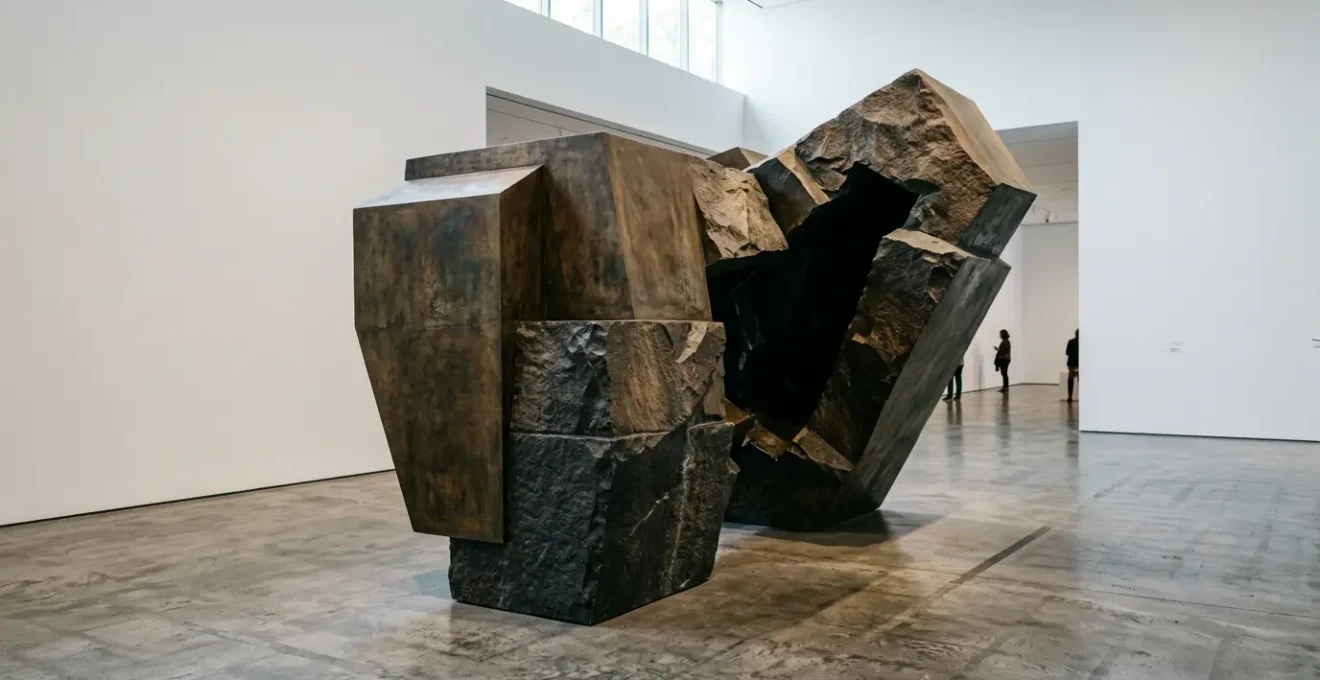
The problem isn’t that you can’t ‘think in 3D’; it’s that you’re still composing for a static, 2D photograph—a habit inherited from painting.
- A sculpture’s success in a physical space depends on designing the transitional voids between views, not just a series of strong silhouettes.
- Your choice of maquette material is a critical diagnostic tool; clay reveals tactile flaws, foam reveals massing errors, and 3D prints reveal lighting issues.
Recommendation: Stop designing for the ‘hero shot’ and start choreographing the viewer’s kinetic journey around the form.
There is a specific, sinking feeling familiar to many emerging sculptors, particularly those with a background in painting or photography. You have a piece in the studio. In photographs, it is magnificent—the lighting is perfect, the angle is powerful, the composition is locked in. It gets selected for a show. Then, under the flat, unforgiving light of a gallery, you walk around it. From the front, it holds. But as you move to the side, the tension dissolves. The form goes slack. From another angle, it becomes a confusing jumble of shapes. This phenomenon, this ‘compositional collapse’, is not a failure of talent but a failure of process, rooted in a two-dimensional mindset.
The common advice is to simply ‘think in 3D’ or to use a turntable. While not wrong, this is superficial. It treats the symptom, not the cause. The cause is the subconscious hunt for a ‘hero angle’—that one perfect viewpoint from which the work is documented and judged. This habit is a direct import from the world of pictorial representation, where the artist has absolute control over the viewer’s perspective. Sculpture, however, cedes that control to the viewer’s body in space. The work must perform from an infinite number of viewpoints.
But what if the key was not to design a series of strong static profiles, but to choreograph the kinetic unfolding of the form itself? This requires a shift in thinking: from designing the object to designing the viewer’s journey around it. It means paying as much attention to the ‘in-between’ views—the transitional voids and shifting masses—as to the primary elevations. This article will deconstruct this painterly bias. We will analyse why a 360-degree viewing experience is critical, how different maquette techniques can preemptively reveal specific flaws, and why the unseen internal structure is the true narrative backbone of your work.
This guide provides a critical framework for diagnosing and resolving the issues that cause a sculpture to falter in physical space. The following sections break down the core principles of truly three-dimensional composition.
Contents: Deconstructing the Three-Dimensional Form
- Why Do Painters Struggle When They First Attempt Sculpture?
- How to Design a Sculpture That Rewards 360-Degree Viewing Without Weak Sides?
- Clay vs Foam Core vs 3D Print: Which Maquette Method Reveals Flaws Fastest?
- The Armature Shortcut That Collapsed a £15,000 Commission After Installation
- When to Finalise Dimensions: After Site Visit or Before Client Approval?
- Why Does a Rotating Stage Increase Audience Engagement by 35% According to Studies?
- Why Does Removing 70% of the Props Make a Set Feel More Real?
- Why Does Your Naturalistic Set Look Like a Furniture Showroom Instead of a Lived-In Home?
Why Do Painters Struggle When They First Attempt Sculpture?
The fundamental challenge for a painter moving into sculpture is the surrender of perspectival control. A painting is a dictatorship of the eye; the artist chooses the single, unchangeable viewpoint. The viewer is static. A sculpture is a democracy of the body; the work must persuade and hold interest as the viewer moves, choosing their own path and pace. This painterly instinct to find and perfect a single ‘hero angle’ is the root of the problem. You are composing an image, not a form.
This is not a new problem. The ‘Paragone’, or comparison of the arts during the Renaissance, endlessly debated this very point. As Daniel Perez notes in an article on these debates, in a painting, the artist dictates the viewer’s visual perspective of the subject. The sculptor has no such luxury. They must create a form that resolves itself compellingly from every possible approach. The Whitney Museum’s exhibition ‘In the Balance’ explored how painters from 1965–1985 grappled with sculptural concerns, demonstrating that this is a persistent and fertile ground of artistic inquiry.
The struggle arises because the tools of 2D composition—framing, cropping, controlled lighting—are either absent or radically different in sculpture. A sculptor cannot crop out a weak angle. They must design it out of existence. The first step is to recognise this ingrained bias: you are not making a better picture, you are making a physical object that must command the space it occupies. It demands a structural narrative, not a static tableau.
How to Design a Sculpture That Rewards 360-Degree Viewing Without Weak Sides?
The solution to the ‘hero angle’ problem is to design for the transitions. A successful 360-degree sculpture is not one with four great sides, but one where the journey between those sides is a process of discovery. This is achieved by mastering form and, crucially, the absence of form: the void. The negative space is not a hole; it is an active compositional element. It is a lens. The great British modernist Barbara Hepworth pioneered the use of negative space when she created her first pierced form in 1932, fundamentally changing the language of modern sculpture.

As seen in the work of sculptors who master environmental integration, a void can frame the landscape, another part of the sculpture, or even the viewer. These transitional voids change shape as one moves, creating a dynamic interplay between solid and empty, here and there. Your focus should shift from the silhouette (a 2D concept) to the kinetic unfolding of mass and space. A prime example in the UK is Antony Gormley’s Angel of the North. It was specifically designed to be seen by people moving at 60 mph. Gormley angled the wings forward to create an ’embrace’, ensuring the form is constantly in a state of becoming as a viewer speeds past, never resolving into a single, static image for the 33 million people who view it annually.
To achieve this, work on your maquette on a turntable, but with a new intention. Do not stop to find the good angles. Instead, keep it in slow, constant motion. Your eye should be trained to spot the points of compositional collapse—the exact moments where the form becomes awkward or inert. Mark these angles. That is where your work begins. You must add or subtract mass not to improve a static view, but to solve the problem of that awkward transition.
Clay vs Foam Core vs 3D Print: Which Maquette Method Reveals Flaws Fastest?
The maquette is not a miniature version of your final sculpture; it is a thinking tool. Different materials reveal different types of flaws, and using the right one at the right stage is a matter of strategic diagnostics. Choosing a material is not about preference, it’s about asking the right question of your form. Are you testing the surface? The overall mass? The way it interacts with light? Each question has its ideal tool.
A detailed analysis of maquette materials highlights their distinct diagnostic strengths. Clay offers immediate haptic feedback for surface and texture, while foam is unparalleled for rapidly assessing the core silhouette and large-scale compositional relationships.
| Material | Best for Revealing | Speed | Typical Scale | Primary Advantage |
|---|---|---|---|---|
| Clay (Sculpey, WED) | Tactile & organic surface flaws, texture issues | Fast (hours) | 1/6 to 1/4 scale | Immediate haptic feedback, allows feeling structural problems through hands |
| Foam Core/EPS Foam | Silhouette & planar relationships, overall composition | Very Fast (minutes to hours) | Any scale | Instantly reveals ‘big picture’ weaknesses from distance, ideal for testing major masses |
| 3D Printing (FDM/Resin) | Lighting behavior, scaling accuracy, complex geometry | Moderate (24-48 hours including print time) | Precise scaling possible | Tests how digital form translates to physical reality under controlled lighting conditions |
Using these materials sequentially is a powerful workflow. Start with cheap, fast foam to block out the major forms. Stand 20 feet away. Does the massing hold up? If not, it’s a five-minute fix with a hot wire cutter, not a five-day crisis in bronze. Once the large forms are resolved, move to clay. Now, get close. Feel the transitions between planes. Is there an awkwardness that your hands can detect but your eyes missed? Finally, a small-scale 3D print can be invaluable. It is not a shortcut, but a verification tool. Place it under a single, harsh light source. It will ruthlessly show you how the form will behave under gallery lighting, revealing unplanned shadows or highlights that can kill a form.
The Armature Shortcut That Collapsed a £15,000 Commission After Installation
A compelling form with a weak internal structure is a time bomb. The cautionary tale of a £15,000 commission collapsing post-installation due to a flawed armature is not just a horror story; it’s a lesson in material science and the concept of structural narrative. The failure often begins with a seemingly clever shortcut: using two different metals for the armature because they are what’s on hand, for instance, an aluminium rod connected with a copper fastener. This is a catastrophic error.
The issue is galvanic corrosion. When two dissimilar metals are in electrical contact in the presence of an electrolyte (even atmospheric moisture), one becomes the anode and the other the cathode, and the anode metal corrodes at an accelerated rate. What you see is a bloom of white, powdery oxide at the joint, but what is happening is the structural heart of your sculpture is literally dissolving.

This failure is a physical manifestation of a flawed structural narrative. The armature isn’t just a skeleton to be hidden by a skin of clay or plaster; it is the core of the work’s physical integrity and long-term story. It dictates the lines of force and tension. A well-designed armature, built from a single, appropriate material (like stainless steel for outdoor works) and properly welded, is an elegant drawing in space that prefigures the energy of the final form. A poorly-conceived one is a liability waiting to declare itself. The shortcut that saves you a day in the studio can cost you your reputation and a five-figure sum years later.
When to Finalise Dimensions: After Site Visit or Before Client Approval?
The question of when to lock in the final dimensions of a commissioned sculpture is a critical point of negotiation that can make or break a project. Finalising dimensions too early, before a thorough site visit, is a recipe for disaster. A sculpture that looks perfect as a 50cm maquette might feel diminutive or overbearing when scaled to 3 metres in its intended location. Conversely, waiting too long can lead to budget disputes and client frustration. The solution is a two-stage approval process that separates conceptual agreement from dimensional finalisation.
First, you secure client approval and a contract based on a concept design and a ‘scale class’ (e.g., ‘human-scale’, ‘monumental’). This locks in the creative direction and budget range. Only then do you conduct the definitive site visit. On-site, you are not just measuring the space; you are analysing sightlines, pedestrian flow, surrounding architecture, and light conditions throughout the day. This is when you use tools like AR mockups on a tablet to test various scales in situ. The sculpture’s final dimensions should be a direct response to this real-world data.
This structured approach protects both artist and client. It ensures the work is perfectly scaled for its environment and avoids the nightmare scenario of fabricating a piece that simply does not fit, aesthetically or physically. Following a clear, staged framework is essential for professional practice.
Action Plan: The Two-Stage Approval Framework
- Stage 1 (Conceptual Approval): Secure a signed contract for the approved concept design and a ‘scale class’ (e.g., ‘monumental,’ ‘approx. 2m high’) to fix the project’s scope and initial budget.
- Stage 2 (Site Assessment): Conduct a thorough on-site visit to measure spatial constraints, document key viewing angles, analyse surrounding architectural context, and assess environmental factors like light and weather exposure.
- Stage 3 (Dimensional Testing): Use on-site measurements, photographs, and augmented reality (AR) mockup tools to test exact dimensions in context. This is where you determine if the piece needs to be 2.5m or 2.8m high.
- Stage 4 (Final Specification): Document the final, exact dimensions, materials, orientation, and installation requirements in a formal Contract Addendum. This document must be signed by both parties before fabrication begins.
- Stage 5 (Planning Verification): Cross-reference the final dimensions with local planning permission requirements (especially for public or large-scale private works) to prevent any legal challenges or removal orders.
Why Does a Rotating Stage Increase Audience Engagement by 35% According to Studies?
While specific figures like « 35% » can be difficult to source definitively, the underlying principle is robust and confirmed by the behaviour of audiences in major institutions. The power of a rotating view—whether the stage moves or the viewer does—lies in its ability to transform passive looking into active discovery. It forces a constant re-evaluation of the object’s form. The sculpture is not a static picture but a continuous, unfolding event. This sense of kinetic unfolding holds the viewer’s attention far longer than a static object.
In a traditional gallery setting, the viewer’s movement provides this rotation. However, in the digital realm, this effect is simulated to great effect. Consider The Metropolitan Museum of Art’s acclaimed Met 360° Project. By presenting their sculptures as objects to be virtually rotated and explored from all angles, they create a profoundly more engaging experience than a simple flat photograph. The fact that The Met’s 360-degree sculpture series has been viewed more than 11 million times is a powerful testament to the universal human desire to understand an object in the round.
This principle directly informs studio practice. If you want to create an engaging sculpture, you must build in reasons for the viewer to move. This could be through a complex interplay of forms that reveal and conceal each other, a surface texture that invites a closer look from a different angle, or a void that frames a new perspective. The goal is to create a visual narrative that can only be completed by the viewer’s ambulation. An engaging sculpture rewards movement.
Why Does Removing 70% of the Props Make a Set Feel More Real?
This title, seemingly about theatre, holds the most critical lesson for a sculptor: the power of subtraction. A cluttered stage, like a cluttered sculpture, is a field of noise. By removing extraneous elements, the artist forces the viewer to focus on what remains. The forms become more potent, the relationships between them more charged. This isn’t minimalism for its own sake; it’s editing for impact. You are removing the props so the viewer can see the play.
In sculpture, the « props » are the unnecessary flourishes, the unconsidered curves, the bits of visual clutter that do not serve the central idea of the form. The most powerful act of « removal, » however, is the creation of the void. Piercing the mass is the ultimate act of subtraction. It does not just remove material; it introduces space as an active, positive element. It creates connection. As the writer Jeanette Winterson observed in her essay on Barbara Hepworth for the Tate:
Holes were not gaps, they were connections. Hepworth made the hole into a connection between different expressions of form, and she made space into its own form.
– Jeanette Winterson, The Hole of Life essay for Tate
This is the essence of sculptural reality. A successful sculpture feels ‘real’ not because it’s full of detail, but because every element, including the empty space, has a purpose. The next time you feel a sculpture is weak, don’t ask what you can add. Ask: what is the most courageous subtraction I can make? Can I pierce this mass? Can I simplify this complex curve into a single, decisive plane? By removing 70% of the visual noise, you allow the remaining 30% to speak with absolute clarity.
Key takeaways
- The primary obstacle for painters in sculpture is the habit of composing for a single, static ‘hero angle’ instead of a dynamic, 360-degree experience.
- Successful three-dimensional form relies on the ‘kinetic unfolding’ of the work, where the transitions and negative spaces are as composed as the solid masses.
- A professional commissioning process separates conceptual approval from dimensional finalisation, which must happen only after a thorough site visit.
Why Does Your Naturalistic Set Look Like a Furniture Showroom Instead of a Lived-In Home?
The final metaphor for the struggling sculptor is the difference between a furniture showroom and a lived-in home. A showroom is a collection of well-designed objects. A home is a system of relationships. The objects in a showroom are placed; the objects in a home have found their place through use, history, and interaction. A sculpture that fails from certain angles is a showroom. It is a collection of handsome parts—a nice curve here, an interesting texture there—that have not been composed into a single, coherent spatial system. It lacks a history of interaction.
A « lived-in » sculpture, one that feels resolved from all angles, has this quality of internal relationship. Each part seems to be a necessary consequence of another. The way a plane curves into a void feels inevitable. This is the result of a process that considers the whole form at every stage. It is the result of turning the maquette constantly, of feeling the transitions, of understanding the structural narrative of the armature. It is the opposite of assembling a series of pleasing but disconnected ‘hero shots’.
Ultimately, the mastery of three-dimensional form is a process of deep seeing. It is an understanding that informs all visual arts, a feedback loop between the hand that makes and the eye that sees. This is why the greatest painters have always understood the value of sculpture. As the publication Art Studio Life astutely points out:
Great painting is grounded in great seeing. And great seeing is deeply tied to understanding form. The old masters knew this, which is why they didn’t just study color or composition—they studied sculpture.
– Art Studio Life, Why Great Painters Study Sculpture
Your struggle is not a weakness but an opportunity: to unlearn the painter’s habit of the static frame and embrace the sculptor’s reality of the moving body in space. By doing so, you will not only become a better sculptor but a more profound artist.
The next time you are in the studio, put down the camera. Turn your sculpture away from its ‘hero angle’. Begin your critique from its weakest point. That is where the real work of sculpture begins.